The booking wall verified
These sell out or block foreigners if you arrive unprepared — the dates, the official link, and whether your passport works.
Mogao Caves (莫高窟)
✓ 2026-06-11- Release
- Online, timed entry; quota is tight, so book days ahead in season
- Price
- ¥238
- Foreigners
- Passport works
- Resellers
- None official
Foreigner tickets are real-name with your passport via the official channel; timed slots, guided entry only.
The full ticket includes a guided route of selected caves. Sells out in peak season; no same-day luck in July-August.
Source: official ticketing
Mingsha Dunes & Crescent Lake
✓ 2026-06-11- Price
- ¥110
- Foreigners
- Passport works
Ticketed at the gate; passport not required to enter.
Go at 16:00 or later. The dunes are brutal at midday and best at sunset. Shoe covers are worth the rental.
Source: official ticketing
Yumen Pass (Jade Gate Pass) & Han Great Wall (玉门关)
✓ 2026-06-11- Release
- Real-name combined ticket; book a day ahead in season as part of the Yangguan-Yumenguan ticket
- Price
- ¥40
- Foreigners
- Unclear
- Resellers
- None official
The official scenic area sells one combined ticket covering both Yumen Pass and Yangguan, and its own booking notice says you enter at the gate on your own ID card (本人身份证). It does not spell out a passport path, and there is no English online booking. In practice foreigners are admitted on a passport as ID, but we couldn't confirm that from the official channel, so treat the passport route as unverified and be ready to buy at the on-site ticket window with your passport rather than relying on the app.
The official booking page is the official 敦煌阳关玉门关旅游区 ticketing page (dhymg.com). The site has an English version but the booking itself is real-name, Chinese-first. Entry around ¥40; a ¥90 version adds the shuttle bus, which you effectively need because the Han Great Wall and Hecang granary ruins are spread far apart across the desert. Hours adjusted to 8:30-19:00 from spring 2026, last shuttle 19:00. About 90 km northwest of town, a long drive each way.
Source: official ticketing
Yangguan (Yang Pass) (阳关)
✓ 2026-06-11- Release
- Same combined real-name ticket as Yumen Pass; reserve a day ahead in peak months
- Price
- ¥50
- Foreigners
- Unclear
- Resellers
- None official
Covered by the same one combined ticket as Yumen Pass through the official scenic-area site. The official booking notice specifies entry on your own ID card (本人身份证) with no stated passport path and no English online booking. Foreigners are generally let in on a passport, but since we can't verify that against the official channel, plan to settle it at the on-site window with your passport in hand.
The official booking page is the shared 敦煌阳关玉门关旅游区 page (dhymg.com); the combined ticket lets you see both passes, so you don't buy Yangguan separately if you already hold the joint ticket. The Yangguan side has a reconstructed gate-tower and a museum; the genuinely old part is the lone beacon-tower on the ridge. Roughly ¥50 entry with a shuttle inside the grounds. South of the Yumenguan road, usually paired with it on one long desert day.
Source: official ticketing
Western Thousand Buddha Caves (Xiqian Fodong) (西千佛洞)
✓ 2026-06-11- Release
- Real-name online reservation through the Dunhuang Academy ticketing channel; weather can close it with no notice
- Price
- ¥30
- Foreigners
- Passport works
- Resellers
- None official
Run by the Dunhuang Academy, the same body as the Mogao Caves, so it uses the same real-name system: book online and enter with a passport as your ID document. The Academy's own discount rules explicitly cover foreign students and foreign children, which confirms foreigners are admitted on real-name terms. The booking account is Chinese-first; have your hotel help if the app is a barrier.
The official booking page is the Dunhuang Academy's official Western Thousand Buddha Caves page. Full ticket ¥30, half price ¥15 for eligible visitors; the price doesn't swing by season. Hours: 08:30-17:30 in peak (Apr 1-Nov 30), 09:00-17:00 off-season (Dec 1-Mar 31). About 35 km southwest of town on the road toward Yangguan, so it pairs naturally with a two-passes day. Far smaller and quieter than Mogao, but real, guided cave visits — and it shuts in sandstorms or heavy rain.
Source: official ticketing
Landing & registration
The first-24-hours facts: hotels, police registration, and whether your card works.
- Hotels take foreigners
- Mixed — check first
- Foreign card via Alipay/WeChat
- Works
- Police registration
- Stay where they can register foreign guests with the police; mid-range chains do it routinely. Note: Gansu is NOT covered by China's 240-hour visa-free transit — Dunhuang requires a full Chinese visa.
Eat like a local
What to order, where locals actually queue, and the food-street traps to skip.
Hand-pulled alkaline noodles with braised donkey, Dunhuang's signature.
Cheaper and better a street off the night market.
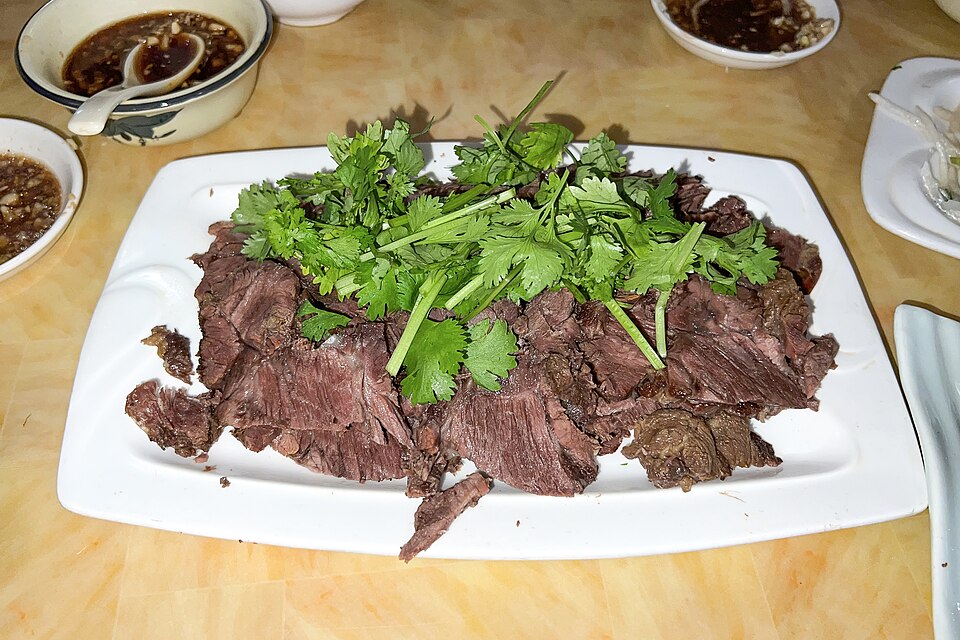
Hand-pulled yellow noodles served with a plate of braised donkey meat on the side.
The local signature; eat the noodles tossed and the meat as a topping.
A sweet-tart chilled drink boiled from dried local apricots, sold all over the night market.
The desert thirst-quencher; buy it cold by the cup, not the bottled kind.
Dunhuang's dish is huang mian: hand-pulled yellow noodles, often with donkey meat (a regional staple, not a dare). A bowl runs ¥15-25 in shops off the night market; the market stalls charge more for the same thing with a show.
Shazhou night market is genuinely fun but price-tag-free at some stalls, so ask the price before they pour, grill or wrap anything. Dried fruit is sold by the jin and adds up fast; agree the amount, not 'a bag'.
The honest layer
The part a tourism board will never print.
Mogao isn't a walk-up sight: daily entry is capped and timed, and in season the official slots vanish days out. Book the moment your dates firm up. Everything else in Dunhuang can flex, this can't. If full tickets are gone, the 'emergency' B-ticket (fewer caves) is the honest fallback, not a scalper.
Tour buses hit the dunes at 10am when the sand is an oven. Locals go after 16:00, watch sunset from the ridge, and pay the same ticket. The camel ride is fine once; the photo sellers mid-route are the upsell to skip.
Shazhou night market is fine for grilled lamb and apricot juice, but the "antique" jade, scrolls and Silk Road relics on the stalls are factory-made souvenirs with a tourist markup. Haggle hard if you want a trinket, and never treat anything there as genuinely old.
Yumen Pass and Yangguan are sold on a single combined ticket through one official scenic-area site, not bought separately. They're 90-odd km out of town in opposite-ish directions, with the Han Great Wall and the Hecang granary ruins flung far apart inside the Yumenguan grounds, so you need the shuttle and a half- to full-day car. Manage expectations: the famous Jade Gate is a weathered mud-brick block in empty desert, powerful for the history, underwhelming if you came for a 'gate'. The official booking is real-name and Chinese-first, and its notice talks only about entry on a mainland ID card, so don't count on a smooth app path as a foreigner; be ready to sort it at the on-site window with your passport.
Same Dunhuang Academy, same real-name booking, a fraction of the crowd. If Mogao's slots are gone, the Western Thousand Buddha Caves give you genuine guided cave-painting visits for ¥30 on the way out to Yangguan. The catch: it's small, remote, and shuts with no notice in sandstorms or heavy rain, so it's a bonus stop on a two-passes day, not a sight to build a trip around.
Straight answers
How far ahead should I book the Mogao Caves?
In peak season (May-October), book as soon as your dates are fixed, because official timed slots sell out days ahead and the quota is hard. Use the official channel with your passport; there is no authorized reseller.
Can I see the caves without a tour?
No — entry is by guided route only, and that's part of the conservation system. English-language slots exist but are fewer, so book those even earlier.
Is Dunhuang doable without Chinese?
Yes, with prep: the caves' official booking has an English path, hotels are used to foreign guests, and payments work via Alipay/WeChat with a foreign card. Download offline maps; coverage gets thin around the dunes.
Do I need to book Yumen Pass and Yangguan separately, and can I do it with a passport?
No — they share one combined ticket sold through a single official scenic-area site (dhymg.com), so you buy once for both. The catch for foreigners: the official booking notice only mentions entering on a mainland ID card and there's no English online path. Foreigners are generally admitted on a passport, but we couldn't verify that against the official channel, so plan to buy at the on-site window with your passport rather than relying on the app. Budget a half- to full-day car; the passes are ~90 km out and far apart.