Sitting in a restaurant right now? Photograph the menu.
English + pinyin + prices + spice levels in seconds, with show-the-waiter cards.
Aksu →
✓ checked 2026-06-13This is Uyghur country, and the bread is a destination in itself: Kuqa is famous for its giant 'big naan' (库车大馕), wheel-sized flatbreads baked against the wall of a tandoor, crisp-edged and stamped in patterns. You'll see them stacked at every bazaar. Around it sits the rest of the Uyghur staple repertoire — laghman hand-pulled noodles (拉条子), polo lamb pilaf (抓饭), kawap lamb skewers grilled over charcoal, and samsa baked meat pastries. Lamb and mutton are the heart of the cooking, done well and everywhere; pork is essentially absent in this Muslim region. Eat at the busy bazaar stalls and local restaurants and you'll eat very well and cheaply.
Aksu is an oasis-and-orchard belt on the Tarim rim, and the fruit is exceptional in season. Aksu is known across China for its sweet apples, and the prefecture's apricots, mulberries, figs, grapes and melons are a real local pleasure — sold fresh in summer and dried year-round at the bazaars, where dried apricots, raisins and walnuts are piled up by the sackful. If you're here in summer, buy fruit from the market stalls; it's one of the genuine, unmissable tastes of the region.
The default drink is milk tea or plain brick tea, poured constantly and good with the heavy, meaty food. Don't drink the tap water — stick to bottled or boiled. At bazaar stalls, pick busy ones with high turnover, and ease into the rich lamb dishes if your stomach isn't used to them. Alcohol exists but is low-key in this conservative Muslim region; don't expect a bar scene, and be respectful around the mosques and during prayer times.
Altay →
✓ checked 2026-06-13Altay is Kazakh pastoral country, and the food shows it. The dish to seek out is beshbarmak — boiled lamb with flat noodles, potato and carrot, traditionally eaten with the hands — alongside simple salt-and-peppercorn lamb stew that locals will tell you is special because the sheep graze wild mountain pastures. Round it out with milk curd lumps (nai gada), air-dried beef, naan and salty milk tea, and finish with airan, the local Kazakh yoghurt. This is herder cooking, hearty and dairy-and-lamb-heavy rather than a polished restaurant spread, and it's at its best and cheapest at busy local places rather than tourist menus.
Down in Burqin, the local twist on the standard Xinjiang plate is fish from the Irtysh — China's only river flowing toward the Arctic. Grilled cold-water pike (often called by its local names) is the dish people rave about, charcoal-grilled until the flesh is tender, and you'll also see it in fish-head casseroles and hotpots over toward Beitun. Burqin's Sino-Russian 'old wharf' food street leans into the border-Russian influence too, with kvass and yoghurt alongside the fish. It's a genuine change from all the mutton and worth ordering specifically while you're in Burqin.
Across Altay city and Burqin you get the familiar Xinjiang repertoire done well and cheap: lamb skewers (just 'kebab' or yangrouchuan locally), big-plate chicken, hand-pulled laghman noodles and fresh tandoor naan, best at busy local spots and night markets. Up toward Hemu and the mountains, look for clay hotpot — a heavy clay pot of lamb, beef and vegetables over a long-simmered bone broth. Sweet-tooth and souvenir shoppers will find Altay beef jerky and milk-curd everywhere; they make easy gifts, though some find the jerky on the dry side.
The distances here are large and the country between towns is empty. Remote village stalls, small park fees and the local ¥1 town buses don't always handle a foreign-linked Alipay or WeChat Pay smoothly, and signal drops out on the long stretches. Carry some cash, stock water and snacks before the remote legs toward Koktokay or out past Burqin, and don't count on much choice between settlements — a bowl of milk tea and naan at a roadside stop is often the meal on offer, so lean into it.
Anqing →
✓ checked 2026-06-13If you try one regional thing in Anhui, make it hairy tofu (毛豆腐 máo dòufu): tofu deliberately fermented until a fuzzy white fungus grows over its surface, then usually pan-fried until golden and served with a chilli-and-soy dip. It looks alarming and smells pungent, but the frying mellows it into something savoury and almost cheese-like — a genuine provincial speciality rather than a tourist gimmick. Look for it at busy local restaurants and street griddles, where it's cooked to order, rather than off a hotel buffet.
Anqing is a Yangtze town, and freshwater fish is the natural thing to order — usually steamed or braised simply so the freshness carries, sometimes done as a clear fish soup. Riverbank and old-town restaurants do it well and cheaply. As with river fish everywhere, expect bones and eat slowly; the point is the clean, fresh flavour rather than heavy sauce. Pair it with a plate of local greens and you've got the honest version of an Anqing meal.
Beyond the headline dishes, Anhui (Hui) cuisine leans into preserved and fermented flavours, braises, and wild mountain ingredients — bamboo shoots, dried and salted vegetables, stinky-style fermented preparations that reward an open mind. It's less about chilli heat than Sichuan or neighbouring Jiangxi and more about deep, slow, savoury depth. Eat where the locals queue, point at what looks good, and use a translation app for the menu; you'll eat well and cheaply, and you'll taste why Hui cooking counts among China's regional schools.
Anshun →
✓ checked 2026-06-13The local thing to eat is guoku (裹卷): thin steamed rice-flour wrappers rolled around shredded vegetables, pickles and sometimes meat, dipped in a sour-spicy sauce. It's a cheap, light street snack sold all over the old town, and it's distinctly Anshun rather than something you'll find done the same way elsewhere. Point at a busy stall and try a couple.
Guizhou food runs sour and chilli-hot rather than just numbing, and the local noodle to know is duoduo fen (夺夺粉) — a bubbling, pick-your-own-ingredients hotpot-noodle done in the Anshun style. Expect pickled-sour broths, fermented chilli, and a lot more sourness than Sichuan. If you don't want it blistering, say 'weila' (mild) and they'll dial it back.
Food right at the Huangguoshu entrance is the usual marked-up scenic-area fare. You'll eat far better and cheaper back in Anshun city or at a busy local restaurant on the way. Carry water and a snack into the scenic area, because it's a long walk between the parts, and save the proper meal for town.
Anyang →
✓ checked 2026-06-13The thing to eat around here is Daokou roast chicken (道口烧鸡), a Henan classic from Daokou town in nearby Hua County — chicken braised and roasted with a secret spice mix until the meat falls off the bone, eaten cold or warm and often torn by hand. It's a genuine regional speciality, not a tourist invention, and you'll find it both in proper restaurants and as a takeaway bird for around ¥45-50. Pair it with a local beer and it's a meal.
Anyang's everyday signature is biǎn fěn cài (扁粉菜) — a hearty bowl of wide sweet-potato noodles simmered with greens, tofu and pig's blood, finished with the shop's own chilli oil and garlic. It's a cheap, filling breakfast-and-lunch staple eaten at busy local shops, not hotels. Look too for fried 'pi zha' (油炸皮渣, a fried starch-and-vermicelli cake eaten with garlic sauce) and blood cake (血糕) made from buckwheat — both proper local street snacks. Point at what the regulars are having; the busy stalls are the good ones.
Anyang sees few foreign tourists and the dining is Henan home cooking — hearty, noodle- and wheat-heavy, mildly spiced compared with the south. That's the appeal, but if you need Western food or English menus you'll mostly find them only in the bigger hotels near Wanda Plaza. Use a translation app, head for the busy noodle and roast-chicken shops over anything in a mall, and you'll eat very well and very cheaply.
Arxan →
✓ checked 2026-06-13You're in Inner Mongolia, and the default cooking is Mongolian and Dongbei (northeastern) hearty food built for the cold. Mutton is the staple — roasted, in hand-grabbed slabs, or in a well-flavoured Mongolian hotpot whose broth, unlike the chilli-loaded central-Chinese kind, is mild and meant to let the lamb carry. Dairy runs through everything: milk tea (the salty, buttery Mongolian kind served with breakfast), milk curd and dried-milk snacks. It's filling, warming and exactly right for a place that's below freezing much of the year. Eat at busy local places over anything aimed at tour buses, and use a translation app — menus are usually Chinese and Mongolian with no English.
The Greater Khingan forest larder shows up on the table here. Wild mushrooms gathered from the cold-temperate woods are a regional speciality, often stewed with the local chicken or mutton. And the mountains are blueberry country — the small wild blueberries (lan mei) of the northeast turn up as fresh fruit in season and, year-round, as juice, jam, dried berries and wine sold all over town. They're a genuine local product rather than a tourist gimmick, and they make an easy, packable souvenir. Ask for the wild-mushroom dishes and you'll be eating what the forest actually provides.
As a hot-spring town, Arxan leans into warming, restorative eating — stews, soups, hotpot and the mineral-water mythology that surrounds the springs. It's simple, hearty, mountain-and-grassland fare rather than a refined food scene, and that's the point. Don't expect a Western-food or English-menu scene to speak of; this is a small remote town. Carry cash as a backup — mobile pay works in the town centre, but the smaller and more far-flung the eatery, the patchier the signal and the more a few yuan in your pocket saves the day.
Baise →
✓ checked 2026-06-13Across Baise and Jingxi the everyday dish is rice noodles (米粉), served every which way — in broth, stir-fried, or 'dry' with the sauce tossed through — and topped with beef, pork or duck, pickled vegetables and a splash of spiced 'sour water'. It's cheap, fast and genuinely local rather than a tourist item, and a busy noodle shop in a market or on a side street will feed you better and cheaper than anything aimed at visitors. This is also Guangxi, so expect the bright, sour-spicy pickled note that runs through the region's food rather than heavy chilli heat.
Baise and especially Jingxi are heartland Zhuang country — the largest ethnic minority in China — and the cooking reflects it: glutinous and five-coloured rice (the dyed sticky rice tied to Zhuang festivals like the Double Third), sour and pickled vegetables, free-range mountain chicken and duck, river fish, and lots of fresh herbs. Being hard against Vietnam, the area also leans toward the bright, fresh, sour-and-aromatic end of southern cooking. Look for a Guangxi/Zhuang-cuisine restaurant or a food street in Baise city (the Golden Triangle food street area is a known cluster) to sample a spread rather than a single dish, and ask your driver or host what's in season locally.
A distinctive Jingxi-area treat is fruit-jam barbecue (果酱烧烤): skewers grilled over charcoal and brushed not with heavy spice but with a sweet-tart local fruit jam — made from things like wampee (yellow-skin fruit) and passion fruit — so the glaze caramelises and cuts the fat. It's a fun, regional twist worth seeking out at night markets. More generally, the farmers' markets in Jingxi and Baise are the place to graze: seasonal subtropical fruit, snacks and small specialty stalls, often better value and more interesting than a sit-down restaurant. Point, sample, and use a translation app — you'll eat well and cheaply.
Baoji →
✓ checked 2026-06-13This is the home of Qishan saozi mian — thin wheat noodles in a hot, sour, oily broth topped with a finely diced pork-and-vegetable saozi, the defining noodle of the western-Shaanxi (Xifu) table. The local way is small bowls, lots of them, and traditionally you eat the noodles and leave the soup. Find a busy county-style shop rather than a hotel restaurant; the sour-and-spicy balance is the whole point, and the good versions don't hold back on either.
Ganmianpi is the regional take on liangpi: chewy, hand-stretched wheat noodles served cold with chilli oil, vinegar, garlic water and a slab of spongy gluten (mianjin). It's the cooling counterweight to a hot bowl of saozi noodles, and a few yuan a portion. Western Shaanxi argues endlessly about whose is best — just eat it where there's a queue of locals and you'll do fine.
Baoji's eating is solidly local western-Shaanxi: wheat, chilli, vinegar, mutton and noodles, with little in the way of English menus or Western food outside the bigger hotels. That's a feature. Use a translation app, point at what the next table is having, and you'll eat very well and very cheaply at the noodle shops the locals fill at lunch.
Bazhong →
✓ checked 2026-06-13If Bazhong has one edible claim to fame, it's silver tree-ear fungus (银耳, yin'er) from Tongjiang county — the prefecture bills itself as the home of China's white fungus. It turns up most often as a gently sweet, slightly gelatinous white-fungus soup (银耳汤), the kind of restorative, easy-on-the-stomach dish that's a genuine regional speciality rather than a tourist invention. You'll see dried packs of it sold as a local souvenir in city supermarkets too. It's mild and a little unusual to a Western palate — worth trying precisely because it's the one thing this corner of Sichuan is actually known for.
Don't forget where you are: this is Sichuan, and the local cooking leans genuinely hot and numbing, not a token sprinkle. Bazhong's everyday eating is the real thing — dry-pot ribs and goose feet, mala fish hotpots cooked in Sichuan-style broth (the city has a strong line in spicy fish, from clear soups to fierce peppercorn versions), casserole 'pot rice,' grilled skewers and roast meats at the night-beer streets along the river. The mountain counties also do hearty meat: Nanjiang yellow sheep (goat) is a local point of pride, especially in winter. If you don't take chilli well, say 'bù là' (not spicy) when you order — but know that toning it down flattens the dishes worth coming for, and the default here is hot.
Bazhong sees almost no foreign visitors, so don't expect Western food or English menus outside the bigger hotels. That's a feature: the eating here is solidly local Sichuan mountain fare and it's cheap, from old breakfast shops doing fresh pork buns, noodles and rice noodles, to family casserole-rice places and busy stew joints. Pick a packed local spot over anything that looks aimed at outsiders, use a translation app or just point at what looks good, and you'll eat well for very little. Wash it down the local way — Bazhong is tea-house country, with covered-bowl tea (盖碗茶) in old neighbourhood tea houses, and the surrounding counties grow their own teas (Luocun and Pingchang greens) and a few local baijiu liquors.
Beihai →
✓ checked 2026-06-13Beihai is a working fishing port, so the seafood is the reason to eat here — but the same buy-and-cook game as other Chinese beach towns applies. Prices on tanks are usually per jin (500g), and a fish can be several jin, with a separate cooking fee on top. Agree the per-jin price and the cooking charge before anything goes in the pot, watch the scale, and you'll eat very well and cheaply. The overcharging only works on people who don't ask first.
The taste of Beihai that you won't find inland is sha xie zhi — a pungent, fermented sauce made from tiny local sand crabs, used as a dip or to dress vegetables and meat. It's an acquired, funky-savoury flavour and very much a regional thing; try it on the side rather than ordering a whole dish blind. Locals are quietly proud of it, and it's a more authentic souvenir of the place than anything in the pearl shops.
Beihai sits in Guangxi, so beyond the seafood you're in rice-noodle country — look for local noodle bowls and the fresh, light, slightly tangy southern style rather than heavy northern food. It's cheap, everywhere, and a good cool-down from the coastal heat. Pick a busy local shop over anything aimed squarely at tour groups and you'll do fine.
Beijing →
✓ checked 2026-06-11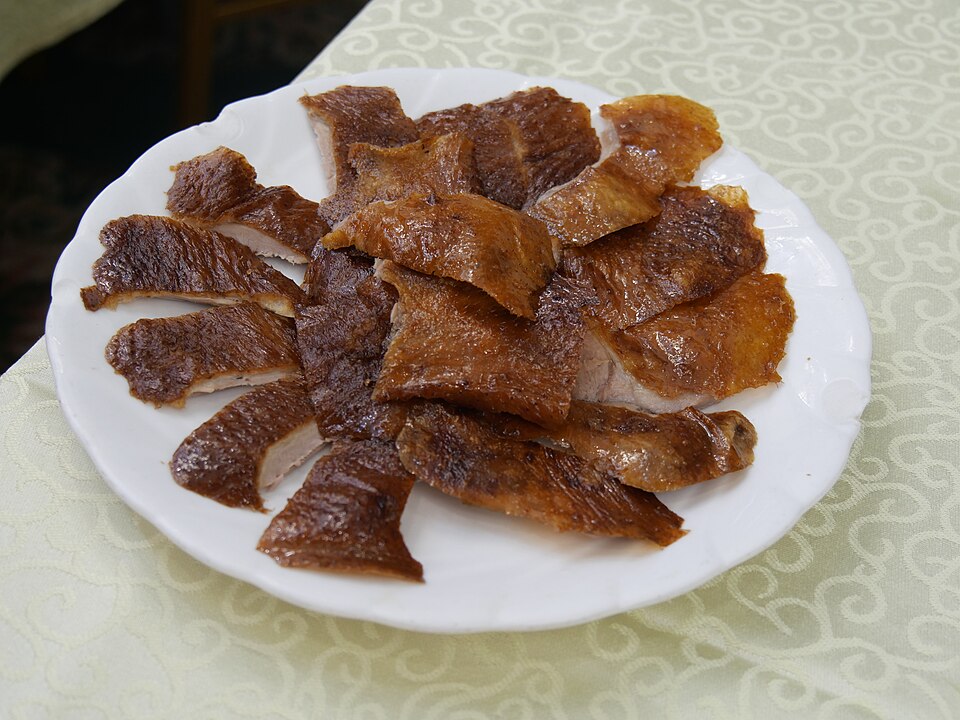
Roast duck carved tableside, wrapped in thin pancakes with scallion and sweet bean sauce.
Order a half duck for two people; say 'yí bàn' (one half).
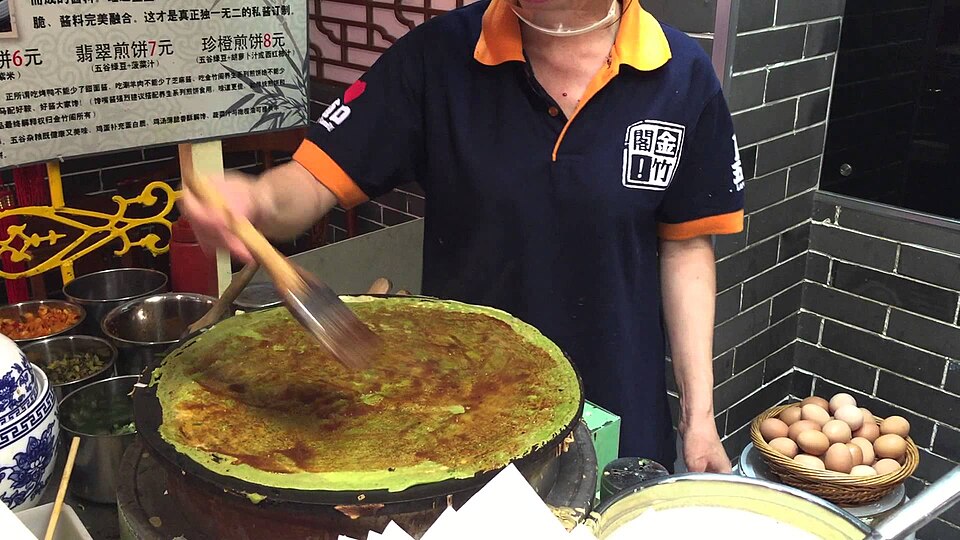
Savory breakfast crepe with egg, crisp cracker and chili paste, folded to go.
Morning windows only; point and hold up fingers for quantity.
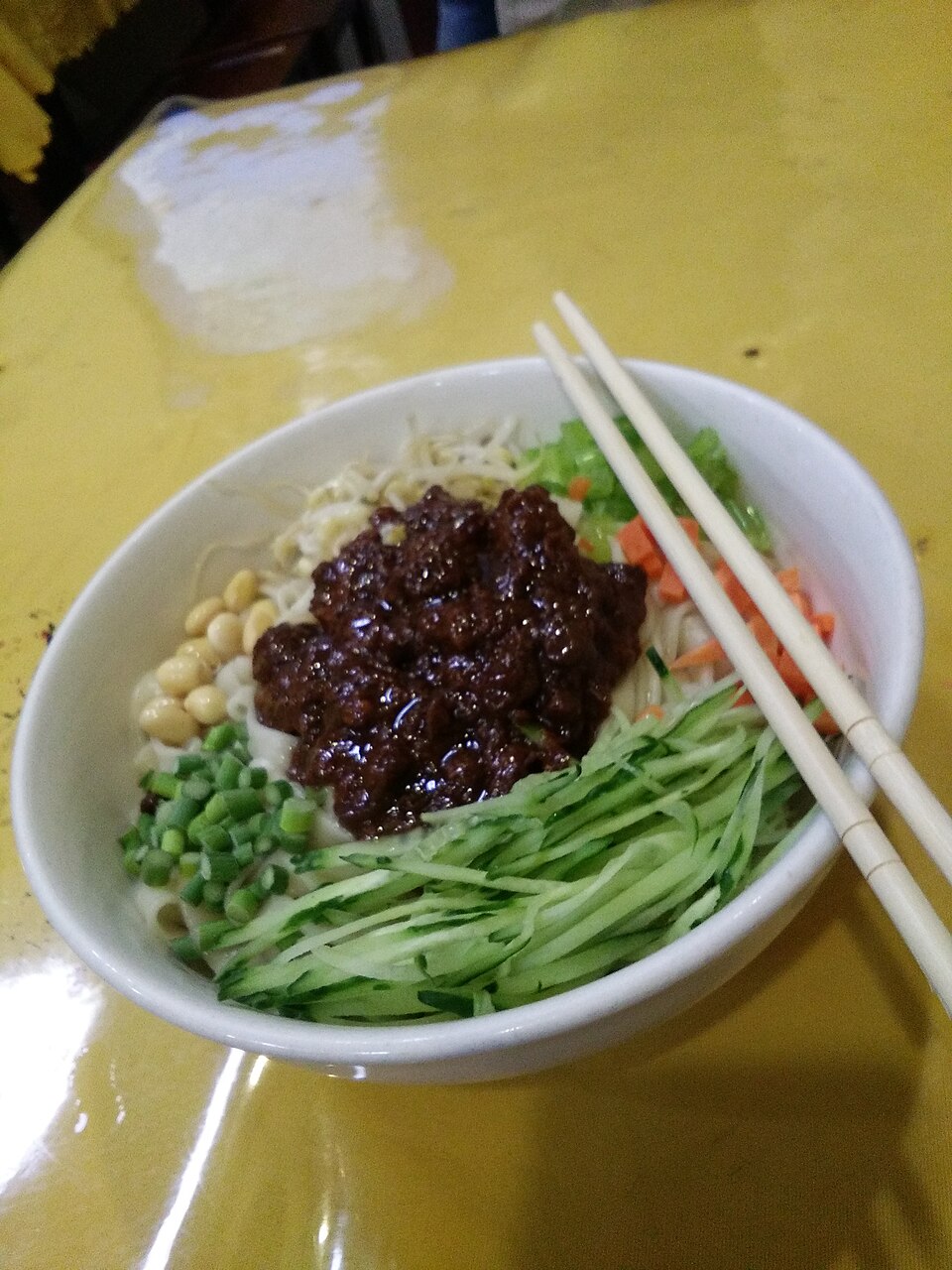
Thick wheat noodles under a dark fermented soybean and pork sauce; mix before eating.
A hutong lunch staple; comes with raw vegetable slivers on top.
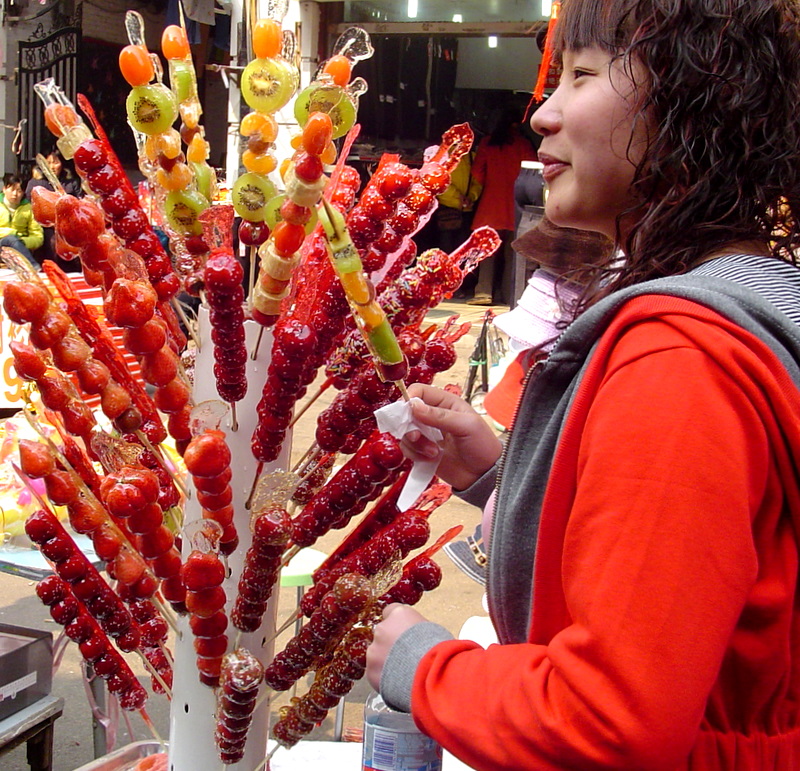
Skewered hawthorn berries dipped in hard sugar glaze, tart under the crunch.
Winter street carts do it best; the plain hawthorn one is the classic, not the strawberry.
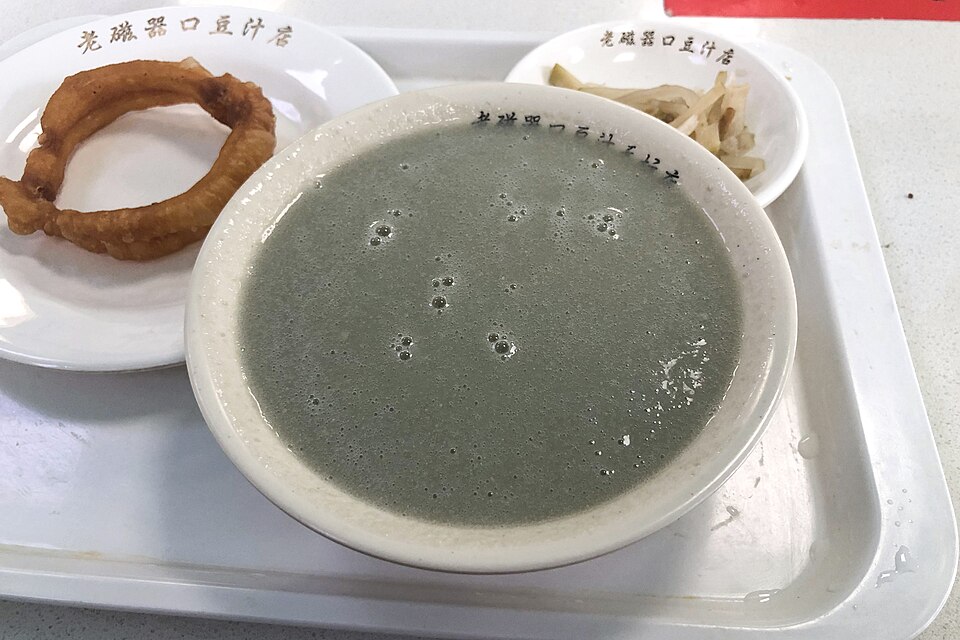
Fermented mung-bean drink, sour and divisive, drunk with a fried dough ring.
An acquired Beijing taste; pair it with jiaoquan and try a small cup first.
Skip the famous flagships with two-hour queues unless the ceremony matters to you. Mid-range sit-down places roast the same bird for ¥200-300 a duck. It's carved tableside; wrap slices in the pancakes with scallion and sweet bean sauce. One duck feeds two to three.
A jianbing (savory crepe with egg, crisp wonton and chili paste) from a morning window runs ¥8-12 and locals eat it standing. If a place has a queue of commuters at 8am, that's your endorsement. Pay with Alipay/WeChat — even carts take it.
The zhajiangmian and dumpling shops worth finding are a few blocks off the main drags, with handwritten menus and no English. Point at a neighbor's plate or use Alipay's camera translate. Nobody minds, and it's the best food-per-yuan in the city.
Benxi →
✓ checked 2026-06-13Benxi eats like the rest of Northeast China (Dongbei): big, warming, generous portions built for cold winters. Look for the classic stews — pork-and-vermicelli, chicken braised with mushrooms, pork-rib-and-bean — slow-cooked one-pot dishes meant to be shared over rice. Add the Dongbei staples of guobaorou (sweet-sour crispy pork), di san xian (stir-fried potato, eggplant and pepper) and hearty dumplings, and you've got the local default. Pick a busy neighbourhood restaurant over anything aimed at tour groups, and you'll eat very well for not much.
Benxi sits in forested, hilly country, and the kitchens make the most of it: wild and cultivated mountain mushrooms, mountain vegetables (shancai), chestnuts and other forest ingredients turn up in stews and stir-fries, often with local free-range chicken. These mushroom-and-mountain-vegetable dishes are a genuine regional strength rather than a tourist gimmick, and they're at their best in and around the scenic areas. If you see a chicken-and-mushroom stew on the menu, order it.
Northeast China has a large ethnic Korean population, and that influence runs through the food in eastern Liaoning — cold noodles (lengmian), kimchi and other pickles, grilled meats and rice dishes — more so the further east you go toward Huanren, near the Korean cultural sphere and the Koguryo heritage. It's a real part of the local table, not an import, and a good, lighter counterpoint to the heavy stews. Worth seeking out a Korean-style restaurant for at least one meal.
Benxi sees few foreigners and the dining is solidly local, with little Western food and few English menus outside the bigger hotels. That's a feature: the Dongbei home cooking here is the reason to eat out. Use a translation app, photograph the menu, or point at what looks good at a busy place, and you'll do fine. There's also a small craft-beer and bar scene in the Mingshan district if you want a drink after dinner.
Bijie →
✓ checked 2026-06-13You're in Guizhou, where the defining flavour is sour-and-spicy rather than the straight chilli heat of Sichuan. The dish to seek out is sour-soup fish (酸汤鱼) — fish simmered in a tangy, chilli-laced fermented broth, often the Miao version — which you'll find across the prefecture, including up at Weining. It's a real regional speciality, not a tourist invention. The broth's sourness comes from fermented tomato and rice water rather than vinegar, and it's the thing to order over anything generic on a menu.
Out at high, cold Weining the food turns mountain-hearty. This is potato country — the local yangyu (洋芋, potato) turns up fried, mashed into cakes and in stews — and Weining is known for its cured ham and for little buckwheat griddle-cakes (威宁小粑粑) made from local buckwheat. Look out too for rice tofu (米豆腐), a soft, slithery local snack served cold and spicy. It's plain, filling highland fare that suits the altitude and the chill.
Bijie's mountains are home to Yi, Miao and Hui communities alongside Han, and the food carries their stamp. Expect Miao sour-soup dishes, Hui halal beef and mutton noodle places in the towns, and Yi country cooking — smoky cured meats, buckwheat, potato and corn — out in the highlands. There's little in the way of Western food or English menus once you leave Guiyang, so lean into the local table: use a translation app, point at what's cooking at a busy stall, and you'll eat well and cheaply.
Bozhou →
✓ checked 2026-06-13The Bozhou street food to seek out is niuroumo (牛肉馍) — a large, flat, pan-fried wheat pastry stuffed with seasoned minced beef and vermicelli, crisped on a griddle and cut into wedges. It's hearty, cheap, and properly local to the Bozhou–Fuyang corner of northern Anhui rather than something you'll find done the same way elsewhere. Eat it hot from a busy morning stall; it's a breakfast and snack staple, not a banquet dish.
Forget the bamboo-and-fermented-tofu 'Hui cuisine' of the mountainous south of the province — this is the wheat-eating north, near Henan, and the table reflects it: noodles, steamed and griddled breads, hearty beef and mutton, soups and braises built for cold winters rather than delicate stir-fries. It's filling, unfussy, and best found at busy local shops away from the sights. A translation app and pointing at what looks good will serve you well; English menus are rare.
Because Bozhou lives and breathes traditional Chinese medicine, you'll see herbal touches woven into local eating and drinking — medicinal teas and tonic preparations, herb-infused soups — alongside the city's other claim to fame: baijiu. Bozhou is the home of the well-known Gujing Gong (古井贡) liquor, one of China's named historic baijiu brands, so a small glass of the local spirit is the regional thing to try if you drink. Go gently — Chinese baijiu is strong — and treat the herbal tonics as curiosity rather than medicine.
Changbaishan →
✓ checked 2026-06-13Changbaishan sits in the Yanbian Korean Autonomous Prefecture, and the local food is Korean-Chinese (Chaoxianzu) cooking, which is the real reason to eat well here. The signature is cold buckwheat noodles — naengmyeon / lengmian (冷面) — served in an icy, tangy-sweet broth, genuinely refreshing after a day on the mountain. Look also for Korean-style charcoal barbecue, kimchi and banchan side dishes, and rice-cake and blood-sausage (sundae) snacks. It's a distinct regional cuisine, not generic northeastern food, and it's at its best in Yanji and the Yanbian towns you pass through getting here.
The Changbai range is famous for wild forest harvest, and it shows up on the table: wild mountain vegetables and ferns (shancai), foraged mushrooms, pine nuts, plus the region's prized ginseng and honey, which you'll see for sale at every gate and roadside stall. A pot of local chicken or a stew built around mountain mushrooms and wild greens is the hearty, genuinely regional order, especially welcome in the cold. Buy ginseng and honey if you like, but treat roadside-stall pricing as negotiable and tourist-marked.
Northeastern and Korean-Chinese menus in this region can include dog meat (gourou), which is traditional here; it won't be forced on you and there is plenty else to eat, but if you want to avoid it, learn to recognise the dish or ask, since it's not always obvious in translation. Separately, don't count on dining inside the park: there are essentially no restaurants up on the mountain, prices at the gate snack stalls are high, and in the low season shops along the road may be shut — carry your own water, fruit and snacks for the day and eat your proper meals down in Baihe, Songjianghe or the resort zone.
Changchun →
✓ checked 2026-08-09Like the rest of Dongbei, Changchun runs on 锅包肉 (guobaorou) — crispy pork in the pale, vinegary sweet-and-sour northeastern style, not the red Cantonese one. It's the dish locals judge a kitchen by. Order one for the table at any busy neighbourhood Dongbei restaurant with a cold cucumber salad, and you've eaten like the city for very little money.
This is cold-country home cooking: 杀猪菜 (sha zhu cai, the 'pig-slaughter' stew of pork, blood sausage and pickled cabbage), pork-and-cabbage braises and heavy hotpots built to get you through a Jilin winter. Portions are enormous — order fewer dishes than you think you need. It's hearty, local and cheap, and it's at its right moment in the deep cold.
Jilin has a large Korean-Chinese (Chaoxianzu) community, and the local specialty to seek out is 冷面 (lengmian) — chewy buckwheat cold noodles in an icy, tangy broth, often with kimchi, beef and a boiled egg. Counter-intuitively it's eaten year-round, including winter. The Korean-Chinese restaurants do it best; pair it with grilled meat for a proper meal.
Changde →
✓ checked 2026-06-13If you eat one thing in Changde, make it the local beef rice noodles — Changde niurou fen (常德牛肉粉). These are round rice noodles in a fragrant, chilli-spiked broth topped with stewed beef, and they're a genuine regional institution: locals eat them for breakfast and any time, and Changde's noodle culture is famous across Hunan. Skip the tourist strips and pick a busy local noodle shop — the east end of the walking street and the lanes near Changde No. 1 Middle School are name-checked for good bowls. Cheap, hearty, and properly local; ask for less chilli (不要太辣) if you need to, but the heat is the point.
Changde's other signatures lean salty, smoky and fierce. Sauce-cured / salted duck (酱板鸭, jiang banya) is the famous one — duck dry-cured and braised dark with a five-spice, soy-sweet, crisp-skinned intensity, sold all over town and a classic edible souvenir. Changde spicy meat (麻辣肉) is the other: pork rich with the chilli-and-Sichuan-pepper má-là numbing heat that defines the local palate, found in restaurants and as packaged snacks. Lotus sausage (莲花香肠) is a traditional cured sausage worth a look too. These are the flavours to buy from a Hunan specialty shop if you want to take Changde home with you.
Changde sits in Hunan, and the cooking is properly spicy: fresh and pickled chilli woven through the braises, stir-fries and broths, not a polite sprinkle on top, often with the numbing tingle of Sichuan-style pepper layered in. Dongting Lake and the Yuan River also put freshwater fish on local tables — usually cooked simply or in a spicy braise so the freshness carries. If you don't take chilli well, say 'not spicy' (不要辣 / 微辣) when you order; it's understood. But know that the local default is genuinely hot, and toning it all the way down can flatten the dishes that are worth coming for.
Changsha →
✓ checked 2026-06-11
Changsha's black-fried stinky tofu, crisp outside and soft within, doused in chili, garlic and a savory sauce.
The black version is the local one; the smell is stronger than the taste, try a small plate first.
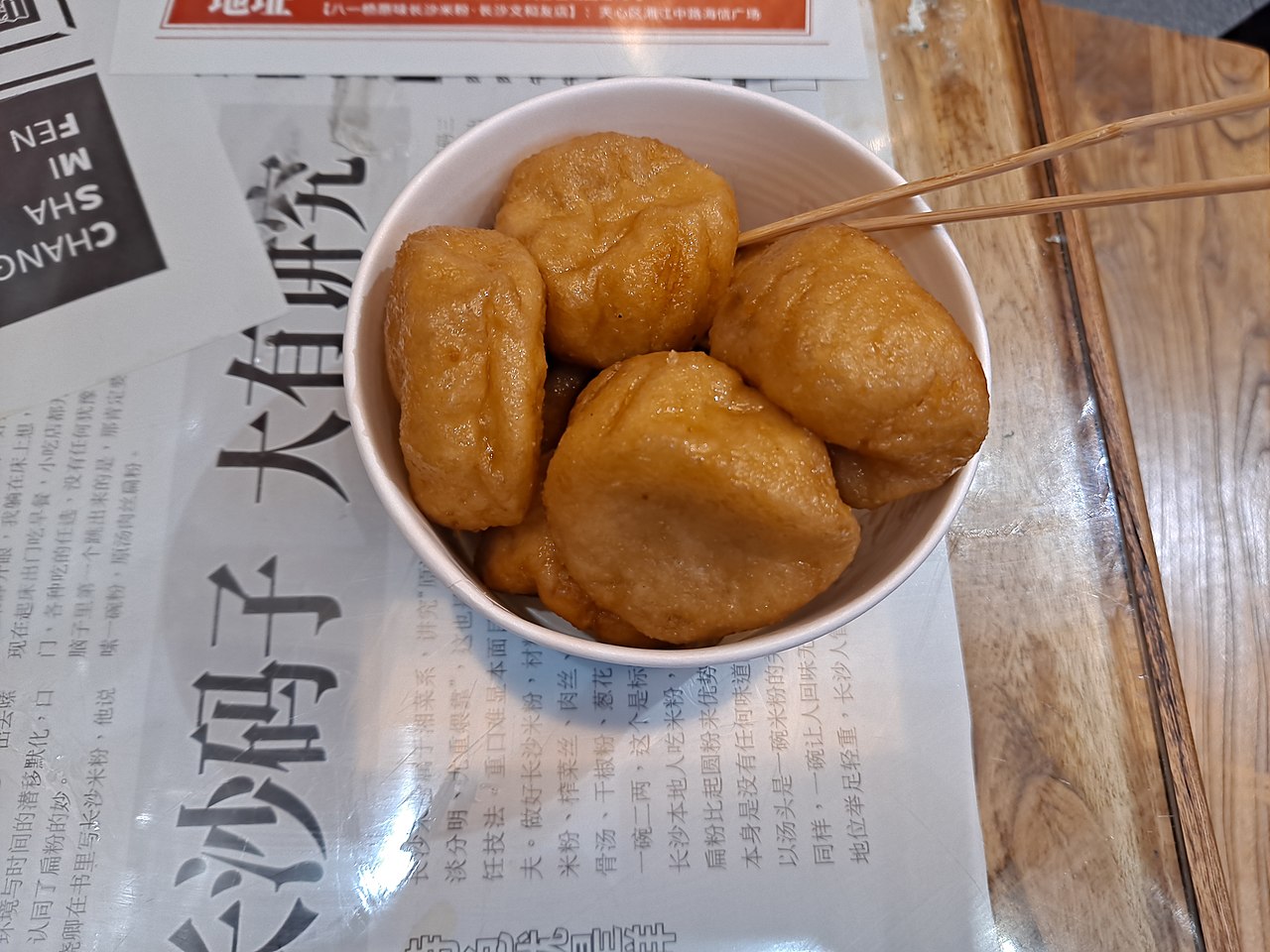
Glutinous rice balls fried in sugar and oil until sticky and caramelized, a cheap Changsha street sweet.
Eat them warm and fresh; they turn hard once they cool.
Crayfish stir-fried with chili, garlic and perilla, the city's late-night eat-with-your-hands dish.
A summer night-market thing, sold by weight; messy by design, so take the gloves.
Changsha's stinky tofu is deep-fried black, crisp outside and soft in, served in a pool of chili-garlic sauce - a different beast from the pale versions elsewhere. It's a ¥10-ish street snack; buy it from a busy stall with turnover, not the one with the longest curated photo queue. Smells worse than it tastes, in a good way.
Summer in Changsha is spicy crayfish season - whole tubs of them in garlic, chili or a numbing 13-spice sauce, eaten by hand with gloves and a beer. It's messy, communal and the real local night-out. Priced by weight, so check the per-jin rate. Wenheyou made it famous; the backstreet places do it cheaper.
Breakfast is a bowl of Changsha rice noodles (mifen) with a fried-mince or pork topping, a few yuan, done by mid-morning like everywhere in the south. And try Mao's red-braised pork (hong shao rou) - the local sweet-savory version Mao Zedong supposedly loved, fatty and dark, a Hunan staple worth ordering once.
Changzhi →
✓ checked 2026-06-13This is the old Shangdang region of Shanxi, so the base of the food is noodles and wheat: knife-shaved daoxiao mian, hand-pulled and pinched shapes, often served with a hearty braised-meat or tomato-and-egg topping. It's cheap, filling and everywhere. Skip the tourist restaurants at the canyon and eat at a busy local noodle shop in the city, where the same bowl is a fraction of the price and usually better.
The dish to look for is Shangdang hotpot (上党火锅), a layered casserole-style hotpot of meatballs, pork, egg dumplings, tofu and vegetables stacked in a pot — a regional speciality of this corner of Shanxi rather than the spicy-broth hotpot most foreigners picture. It's a hearty, warming, communal plate that suits the cold plateau climate, and it's the thing a local would order to mark a proper meal. Worth seeking out over anything generic.
You're on the Shanxi loess plateau, and the regional habits show: aged vinegar on the table as a near-condiment, yellow millet porridge, mutton and pork in the colder months, and a generally hearty northern register. Changzhi sees few foreigners, so English menus and Western food barely exist outside the bigger hotels — that's a feature, not a flaw. Use a translation app, point at what looks good in busy shops, and you'll eat well and cheaply.
Changzhou →
✓ checked 2026-06-13Changzhou's signature is the crab-roe soup dumpling — xiaolongbao enriched with crab, juicier and richer than the plain version. The local way is to nip the skin, sip the soup, then eat the rest; bite in carelessly and you'll wear it. The time-honoured spots downtown do the proper version, and it's a far better breakfast than anything you'll find at the theme-park gates.
Two more local staples worth seeking: yinsi mian, fine 'silver-thread' noodles in a clear broth that's the classic Changzhou breakfast, and da magao, a flaky sesame-studded baked cake that comes in a salty (preserved-vegetable) or sweet (sugar-syrup) version. Mind the sweet one straight off the stove — the molten sugar core will scald your mouth if you rush it.
Food right at the Dinosaur Park and the scenic gates is overpriced park fare. The good, cheap eating is back in the city — the downtown snack lanes and time-honoured noodle shops near the old centre — where the dumplings, noodles and sesame cakes are done properly. Carry a snack into the park and save the real meal for town.
Chaozhou →
✓ checked 2026-06-13Chaozhou treats beef seriously. The local hotpot (潮汕牛肉火锅) is built around a clear beef broth and paper-thin cuts sliced to order by part of the animal, each with its own name and its own seconds-long dip time — let a local or the staff guide the order. And the hand-pounded beef balls (牛肉丸) are the real, springy, bouncy version the frozen supermarket ones are a pale copy of. Have both.
Teochew braised meats (卤鹅 — goose simmered in a spiced master stock, sliced cold) are a signature, as is the local oyster omelette (蚝烙, o-luah), crisper and more egg-forward than the Taiwanese version. Then graze: kway teow noodles (粿条), fish balls, taro paste (芋泥), pork-trotter jelly, and the sweet 糖葱薄饼 — spun maltose-sugar threads wrapped in a thin pancake. Order small from busy stalls along Paifang Street and try a lot rather than committing to one big plate.
Chaozhou is the home of gongfu cha (工夫茶) — strong oolong brewed in a tiny pot and poured through a row of thimble cups in a precise, repeated sequence. It's offered everywhere, often for free as hospitality in shops and tea houses, and refusing a cup can feel abrupt. Sit down for a round; watching it done properly is half the point, and it's the local social glue.
Chengde →
✓ checked 2026-06-07The local snack: a sweet roll of glutinous rice with a bean filling, dusted and 'rolled' in yellow soybean flour — the name jokes that it looks like a donkey rolling in dust. It's a cheap dessert-y bite found around Chengde, served by the plate (a large plate is generally under ¥100). A genuine local thing rather than a tourist invention; try a small plate.
As a Qing summer capital, Chengde plays up 'imperial' Manchu cooking and northern game dishes (venison and the like appear on tourist menus). Some of it is theatre for visitors and priced accordingly. If you want the show, fine; if you want value, the everyday northern-Chinese restaurants in the city centre do hearty, cheaper meals without the imperial markup.
Food stalls and restaurants clustered right outside the resort and temple entrances charge a captive-audience premium for ordinary fare. Walk a few blocks into the actual city for the same noodles, dumplings and northern dishes at normal prices. The gap is real and the walk is short.
Chengdu →
✓ checked 2026-08-08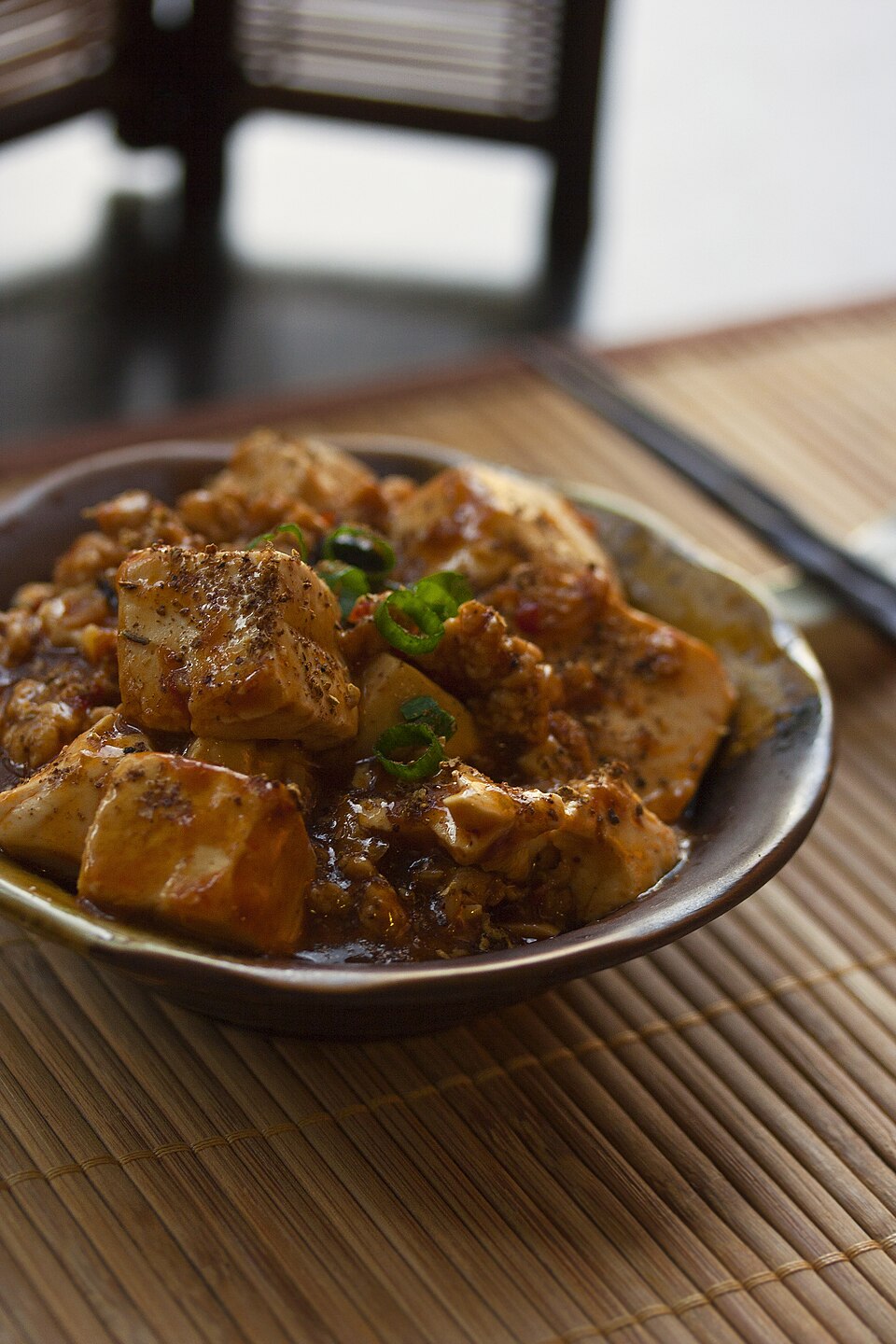
Silken tofu in a numbing-spicy beef and chili-bean sauce, born in Chengdu.
Eat over rice; ask 'wēi là' for mild heat.

Split-pot hotpot: one half fiery beef-tallow broth, one half mild.
Dip cooked pieces in the oil-garlic dish; don't drink the red broth.

Small bowl of noodles in chili oil, minced pork and ground peanuts.
A snack-size portion; order alongside dumplings.
Skewers of meat and veg you cook yourself in a numbing-spicy pot, billed by the stick.
Keep your empty skewers; the bill is counted by the pile at the end.
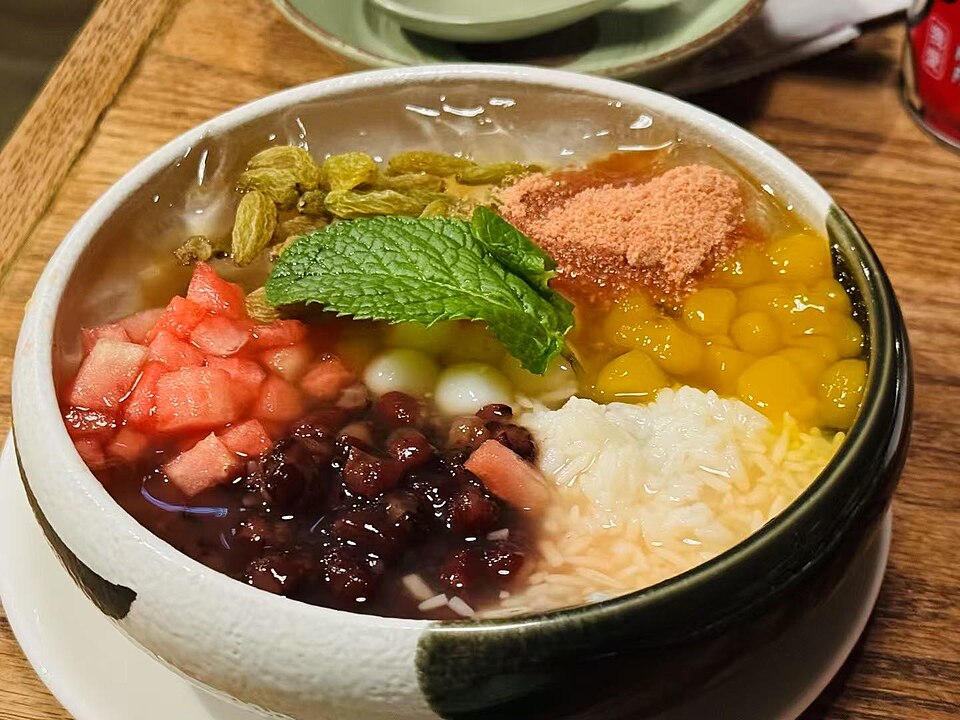
Wobbly cold jelly in brown-sugar syrup with peanuts, raisins and rice balls.
The cooling antidote after hotpot; eat it on the spot before the ice melts.
Order yuanyang (half fiery, half mild) and nobody loses face. The numbing buzz is the Sichuan peppercorn, not a mistake. Mix your dip from the oil-and-garlic station, and don't drink the red broth — even locals don't.
Cangying guanzi: scruffy hole-in-the-wall joints locals swear by: plastic stools, a short handwritten menu, and the best mapo tofu and twice-cooked pork in town. If it looks too humble to photograph, order more.
At a People's Park teahouse, ¥20-30 buys a bottomless cup and the right to sit for hours while snack vendors circulate. The traditional ear-cleaning is optional and louder than you expect. This is Chengdu's actual main attraction.
Chenzhou →
✓ checked 2026-06-13Chenzhou is southern Hunan, and the cooking is full-blooded Xiang cuisine: fresh and pickled chilli, fermented black beans, smoked and cured meats, the heat woven through the dish rather than sprinkled on top. It's one of China's spiciest regional kitchens and the locals mean it. If you don't take chilli well, say 'bu la' (not spicy) when you order, but know the default is genuinely hot and toning it right down can flatten the dishes worth coming for. Pick a busy local stir-fry place over a hotel restaurant and you'll eat better and cheaper.
The regional speciality to seek out is Linwu duck (临武鸭) — a prized breed of duck from Linwu County in Chenzhou prefecture, often sold as a savoury braised or blanched 'plate duck' (临武鸭/血鸭-style cooking) and a genuine local product rather than a tourist invention. You'll see it on menus and in vacuum-packed form as a regional souvenir. Order it freshly cooked in a local restaurant to taste why it has the reputation; the packaged version travels but isn't the same.
With a giant clean reservoir on the doorstep, freshwater fish is a natural order out at Dongjiang Lake — usually cooked simply, sometimes fiercely spicy in the Hunan 'blood duck'-style heat, so the freshness carries. In the city, look for everyday southern-Hunan home cooking: smoked pork (larou) with chillies, claypots, river fish and seasonal greens, all hearty and local. As everywhere, prices inside the scenic area run higher than in town, so eat your main meals in Chenzhou or Zixing rather than at the lakeside tourist stalls.
Chifeng →
✓ checked 2026-06-13This is pastoral Inner Mongolia, and the food is built on lamb and mutton. The two dishes to seek out are hand-grabbed mutton (手抓羊肉) — chunks of mutton on the bone boiled simply and eaten with your hands, with garlic and dipping condiments, prized for the quality of the grassland meat — and, for a group or a celebration, a charcoal-roasted whole lamb (烤全羊), crisp-skinned and tender, that's a genuine Mongol banquet centrepiece rather than a tourist gimmick. Out at the grassland camps these are the local default and done well; in the city you'll find them in dedicated mutton and Mongol restaurants.
Mongolian milk tea (奶茶) is the everyday drink here, and it's not the sweet bubble-tea kind — it's a savoury, lightly salted brew of tea and milk, sometimes with butter or fried millet stirred in, drunk to warm up and to go with meat. Alongside it comes a whole grassland dairy tradition: dried milk curds and milk skin, milk tofu and other cheeses (奶豆腐, 奶皮子). They're an acquired taste — tangy, chewy, sometimes quite sour — but they're authentic local fare and worth a try, especially fresh at a grassland farmstay rather than packaged in a city shop.
Beyond the set-pieces, the everyday eating is hearty northern-frontier cooking: a Mongol-style mutton hotpot with a clear, fragrant broth; crisp fried lamb chops (炸羊排) dusted with cumin and chilli; and plenty of noodle and braise dishes to handle the cold. Chifeng also has its own local specialities and snacks worth asking after, and the prefecture is known for good apples and other fruit you'll see at markets. Pick busy local mutton and Mongol restaurants over anything aimed squarely at tour buses, use a translation app for menus, and you'll eat very well and fairly cheaply.
Chongqing →
✓ checked 2026-06-11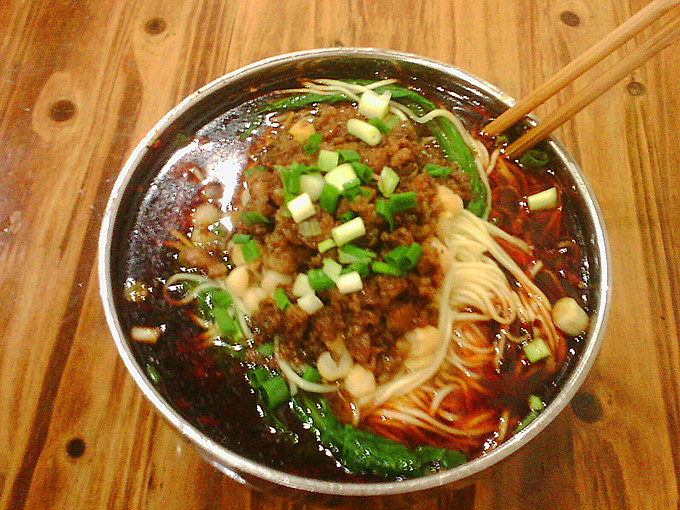
The city's breakfast: wheat noodles in a chili-and-peppercorn slick.
Say 'xiǎo là' for less heat; nobody judges.
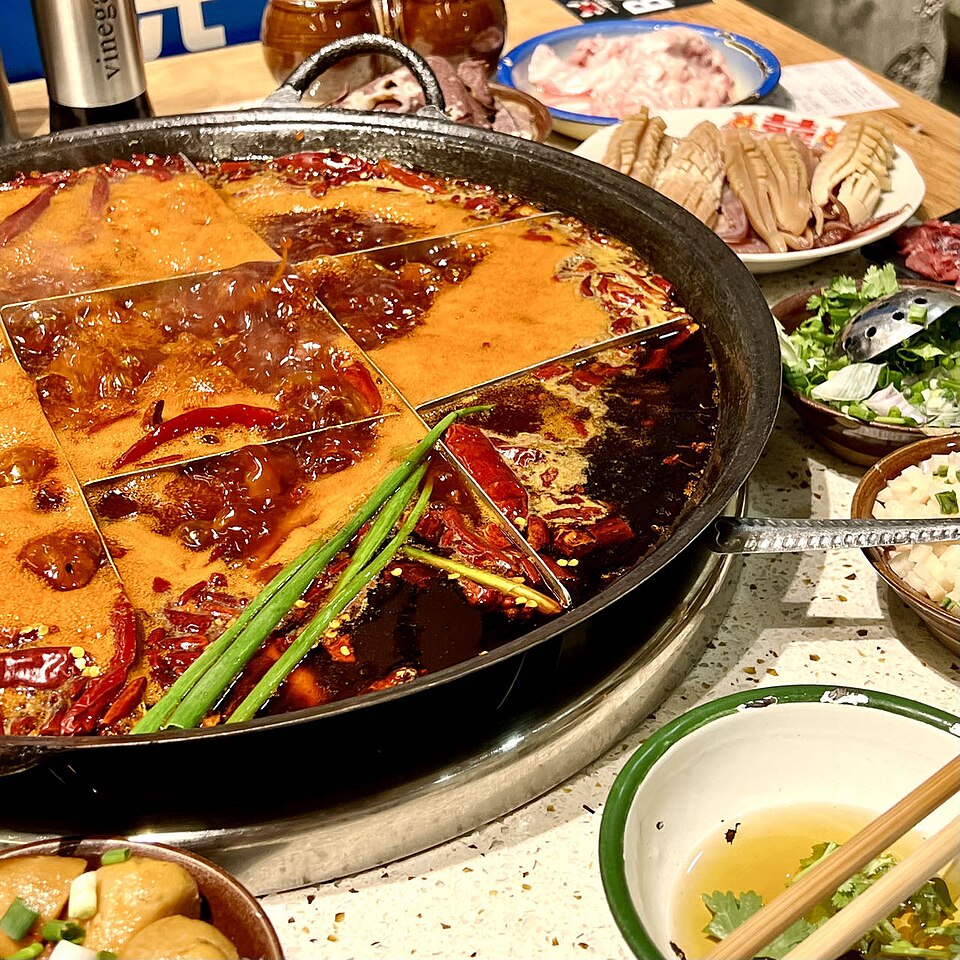
Chongqing's beef-tallow hotpot with a nine-grid rack; different grids, different heat.
Tripe and duck intestine cook in seconds; count, don't stew.
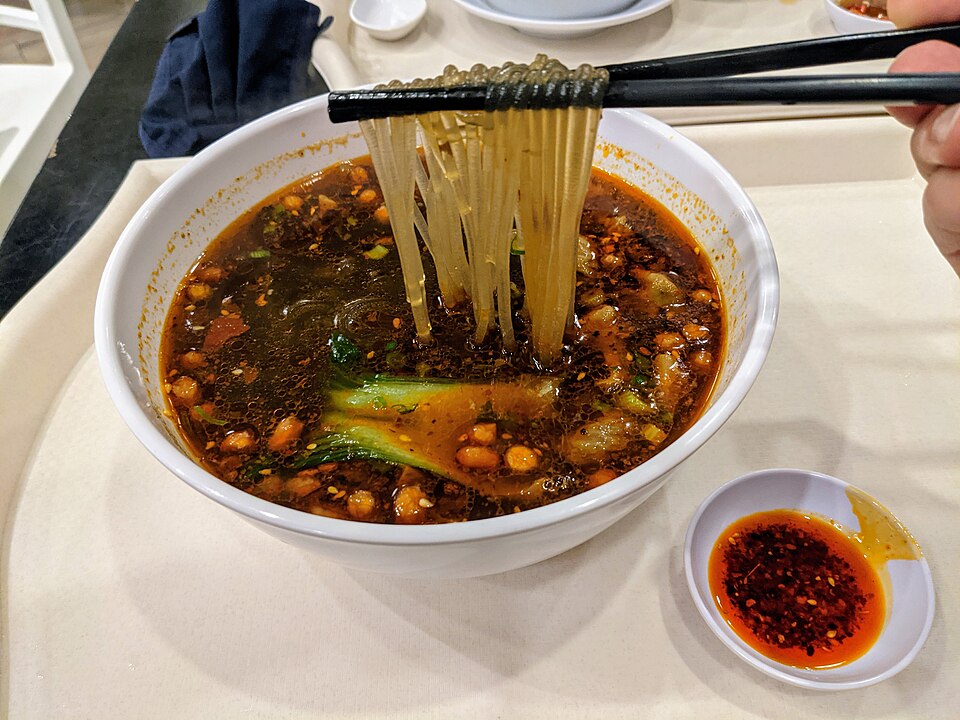
Slippery sweet-potato noodles in a hot-and-sour broth loaded with chili and vinegar.
A street snack, not a meal; tell them the spice level you can take.
Chongqing hotpot is oilier and harder than Chengdu's and the 'mild' here is most cities' spicy. The nine-grid pot isn't decoration; different grids cook at different heats. Order tripe and duck intestine if you're going local; count seconds, don't stew them.
The city's breakfast is xiaomian: ¥10-15 spicy noodles from shops with plastic stools and a queue at 8am. Say 'xiao la' (less spicy) and nobody judges. A shop that also sells twenty other dishes is not a xiaomian shop.
Chongzuo →
✓ checked 2026-06-13As across Guangxi, the default cheap, good meal is a bowl of rice noodles (粉, fěn) — every town has its own version, usually a few yuan to low double digits. In Chongzuo you'll find local noodle shops and rice-noodle joints all over Jiangzhou District and along the city food street; pick a busy local one over anything dressed up for tourists. It's the reliable, fast, authentic lunch between long drives to the sights.
Chongzuo is one of the heartlands of Zhuang culture, and the local table reflects it: Zhuang-style home cooking with steamed regional specialities, glutinous-rice dishes, passion-fruit and pork plates, and generous, homey portions at the city's Zhuang specialty restaurants. Look out too for Zhuang oil tea (油茶) — roasted tea leaves fried in oil with spices, sometimes served with peanuts and puffed rice — a rustic ethnic-minority drink you'll find in small tea houses and market stalls rather than branded chains. It's a genuine local experience, not a tourist invention.
Sitting on the Vietnam frontier, Chongzuo's food picks up cross-border notes — Vietnamese coffee is easy to find, and the markets near the falls and the city sell Vietnamese snacks, cashews and cigarettes brought across the line. The region is also a major sugarcane area (China's self-styled 'sugar capital'), so subtropical fruit, fresh juices and sweet drinks — longan sugar water, sour-plum drink, pineapple and watermelon juice from market stalls — are everywhere and exactly right in the humid heat. Eat seasonal and local and you'll do well; expect very little in the way of Western food or English menus, so a translation app earns its keep.
Chuzhou →
✓ checked 2026-06-13You're in Anhui, and the province's signature oddity is hairy tofu (毛豆腐 máo dòufu) — fermented tofu grown over with a downy white mould, then usually pan-fried till golden and served with chilli or a dipping sauce. It's funkier than it looks and a genuine regional thing rather than a tourist gimmick. Around Chuzhou the everyday eating is hearty eastern-Anhui home cooking — braises, freshwater fish, river-and-field vegetables — best found at busy local restaurants rather than anything dressed up for visitors.
This is watery country between the Yangtze and the Huai, and freshwater fish is the thing to order — often braised in soy and a little sugar, or done as a clear soup so the freshness carries. Ask for whatever's local and in season and let the kitchen cook it simply; the small river fish here reward plain treatment over heavy sauce. Pair it with rice and a green vegetable and you've eaten the way the region actually eats.
If you make the Fengyang trip, look for the county's local plates rather than generic tourist fare — Fengyang is known for its own braised and home-style dishes and for hearty north-Anhui country cooking, the food of the plains where the Ming founder grew up poor. Options thin out fast at the rural sites themselves, so eat in Fengyang town proper or carry snacks for the day. As with the rest of the area, the best meals are at full local restaurants, not the stalls at the gate.
Dali →
✓ checked 2026-06-08Erhai lake carp slow-cooked in a claypot with chicken, ham and mushrooms; a Dali table dish.
A shared pot for the table; the broth is as much the point as the fish.

Fans of Bai dried milk cheese grilled on a stick, brushed with rose jam or condensed milk and rolled into a tube.
A Dali street snack; the rose-jam version is the one to try.

Thin-cut strands of pressed rice cake in broth or stir-fried, a Dali everyday noodle.
Order it in broth with stewed pork for breakfast, or stir-fried (chao er si).
The local flatbread, xizhou baba, is a crisp griddled round that comes savoury (spring onion, pork) or sweet (rose-sugar). It's everywhere in town, but it's a few yuan and obviously fresher at the market stalls in Xizhou where it's made. A solid mid-ride snack on the Erhai loop.
Rushan is a stretched cow's-milk cheese pulled into thin fans, grilled or pan-fried until blistered and brushed with rose jam or sprinkled with sugar. It's a genuine Bai specialty, not a tourist invention, and it's good. Buy it grilled fresh from a stall, ¥5-10 a piece, not the vacuum-packed souvenir version.
On Renmin and Fuxing Road you pay tourist prices for average stir-fries. Walk a couple of lanes off the main strip, or eat in the villages, for proper Bai food: sour-spicy Erhai fish, clay-pot dishes, wild mushrooms in season. Fish and mushrooms are sold by weight, so agree the price before it's cooked.
Dalian →
✓ checked 2026-06-13This is a northern seafood town — clams, sea urchin, scallops, conch, prawns, and the famous local sea cucumber. It's at its best in the warm months. As anywhere seafood is sold 'by the catty,' confirm the price per unit and watch the weighing, especially on the tourist strips near the beaches; eat a few streets back from the water where locals do and you'll pay less for the same plate.
Dalian sea cucumber (海参) is a regional prestige food — prized, pricey, and often pushed hard to tourists. It's an acquired, gelatinous texture rather than a strong flavour, so order it once to try it, not by the kilo, and don't get talked into an expensive 'tonic' set unless you actually want it.
焖子 (menzi) is the homely Dalian thing to try: pan-fried mung-bean or sweet-potato starch jelly, crisped on the outside, soft inside, doused in sesame and garlic sauce. It's cheap, it's everywhere in old-town snack streets and markets, and it's the kind of local bite the seafood-tour crowd walks straight past.
Dandong →
✓ checked 2026-06-13Dandong's location makes it a genuine Korean-food town. A whole strip of restaurants faces the river, run by ethnic Koreans and, distinctively, a handful of state-owned North Korean restaurants (recognisable by the Chinese and DPRK flags over the door and the North Korean waitresses who sometimes perform). Order the things that travel from just across the water: Korean-style cold noodles (朝鲜冷面), bibimbap in a hot stone bowl (石锅拌饭), and ginseng chicken (人参鸡) — a whole young chicken in scalding ginseng broth. It's the real regional specialty here, not a tourist gimmick.
Dandong sits where the Yalu meets the Yellow Sea, so it's also a seafood town — the wider area is known for sea products, and the nearby port of Donggang (东港) is famous in northeast China for its clams and blue crab in season. You'll see fresh river and sea fish cooked simply at local places; ask what's local and in season rather than ordering off a generic menu. We couldn't pin down specific dish prices, so treat seafood as market-priced and confirm before ordering, especially anything sold by weight.
Beyond the Korean strip, Dandong is solidly Dongbei (northeast China): hearty stir-fries, hot pot — there's an old-school Beijing-style copper-pot place in town — and the snack-and-seafood mix of the rebuilt Andong Old Street (安东老街) with its enclosed night market. For a only-here souvenir of a drink, hunt down Daxiangjiao (大香蕉), a clear banana-flavoured soda sold in green glass bottles that locals are oddly fond of. Eat at the busy local spots over anything aimed squarely at tour groups and you'll do well.
Daocheng-Yading →
✓ checked 2026-06-13This is Kham Tibetan country, so the protein is yak, not beef - in stir-fries, dried into chewy jerky, and in hearty stews that go down well after a cold day on the trail. Yak yogurt turns up too, thick and tart, often sweetened to taste. It's the honest local food, not a tourist novelty, and the warm, fatty dishes genuinely help when you're tired and cold at 3,700m.
Po cha, the salty yak-butter tea, is polarizing - oily and savory, worth trying once even if you don't love it. The drink you'll actually keep ordering is sweet milk tea. Tsampa (roasted barley flour worked into a dough with butter tea) is the genuine staple; it's filling and travels well on a long day in the reserve. Brave the butter tea once for the experience, then stick with the sweet tea.
Inside the Yading reserve, food is captive-audience pricey and limited, so eat properly in Daocheng county town or Shangri-la town before you head up, and carry snacks for the long hours on the trail. Alongside Tibetan staples you'll find plenty of Sichuan cooking - hotpot and stir-fries - since this is still Sichuan province. A hot bowl of something at the end of a high-altitude hike is worth more than any view-point snack stand.
Datong →
✓ checked 2026-08-08
Wide, jagged wheat noodles shaved straight off a dough block into boiling water, served with a meat-and-vinegar topping.
A Shanxi staple; add the local aged vinegar yourself, locals do.

Lamb organs and broth simmered in one pot, a cold-weather breakfast Datong has eaten since the Yuan dynasty.
Order it with a piece of flatbread to dip; ask for chili if you want heat.
A dense, chewy steamed cake of yellow glutinous millet, eaten with a meat-and-vegetable sauce.
A homestyle staple; it is filling, so order it to share with a stew.
Shanxi is the heartland of daoxiao mian — noodles shaved off a dough block straight into the pot — and Datong does a hearty, often tomato-and-egg or braised-meat version. Cheap, filling, everywhere. Pick a busy local shop over anything inside the rebuilt Ancient City, where it's pricier for the same bowl.
This is old border country, and the food leans hearty and northern: mutton, yellow millet (huangmi), hot-pot and braises to handle the cold. Mutton is done well here. In winter especially, a mutton soup or hotpot is the right call, and it's local rather than a tourist menu item.
Datong sees relatively few foreigners and the dining is solidly local Shanxi. That's a feature, not a problem — but if you need Western food or English menus, you'll mostly find them only in the bigger hotels. Use a translation app, point at what looks good at busy noodle shops, and you'll eat well and cheap.
Dehong (Mangshi) →
✓ checked 2026-06-13Dai cooking is the reward here, and it's a world away from northern Chinese food: sour-and-spicy flavours, lemongrass and fresh herbs, grilled fish stuffed and charred over coals, sticky rice, and a lot of raw and pounded salads. Look for Dai-style grilled fish (烤鱼), pounded and grilled meats, and the herby cold dishes. It leans genuinely hot — if you don't take chilli well, say 'bu la' (不辣) when you order, but know the local default is properly spicy and toning it right down flattens the dishes worth coming for.
The signature local bowl is guoshou mixian (过手米线) — 'pass-through-the-hand' rice noodles, a Dehong and Jingpo speciality where you mix the noodles with a sauce and toppings in your hand before eating. Rice noodles generally are everywhere in Dehong, often in a spicy-sour broth, and they're the cheap, reliable, properly local breakfast and lunch. Pick a busy local shop over anything pitched at tour groups; you'll eat better and cheaper.
Because this is the Myanmar frontier, the food carries cross-border influence: Burmese-style milk tea, Jingpo barbecue and skewers, and Southeast-Asian touches you won't find further inside China. And it's the tropics, so the fruit is a highlight in its own right — mango, pineapple, passion fruit, and the classic mango-with-sticky-rice dessert. Graze the night markets in Ruili and Mangshi for the milk tea, the grilled skewers and the fruit; that's where the border's food culture is most fun and cheapest.
Dengfeng →
✓ checked 2026-06-13The regional comfort food: wide hand-pulled noodles in a rich mutton or beef broth with a little lamb, day-lily and wood-ear, often finished with chilli and coriander. Cheap, filling and everywhere in Dengfeng's town centre — a far better lunch than the captive-audience stalls right outside the Shaolin gate.
Henan's signature breakfast: a thick, peppery, slightly sour soup with bits of meat, wheat gluten and vegetables, eaten with a fried-dough stick or a flatbread. An acquired warmth that locals swear by — grab it at a busy morning shop in town before heading up to the temple.
The restaurants clustered at the Shaolin entrance charge a captive premium for ordinary food. Dengfeng town, a short ride away, has the same Henan noodles, dumplings and soups at normal prices. The gap is real and the trip back into town is short — plan to eat there.
Deyang →
✓ checked 2026-06-13This is core Sichuan country, so the default is properly numbing-spicy: liberal dried chillies and the local Sichuan pepper (huajiao) that gives food its tingly, mouth-numbing mala character. Hotpot, mapo tofu, twice-cooked pork, kung pao chicken — they're done here as everyday food, not tourist set pieces. If you don't take chilli well, say 'bù là' (not spicy) when you order, but know the local baseline is genuinely hot, and toning it all the way down flattens the dishes worth coming for.
If you're at the museum over lunch, the local Guanghan speciality to look for is its style of noodles and braised-beef dishes served at busy local shops rather than inside any tourist complex. As everywhere, the bowl is cheaper and better at a packed neighbourhood noodle joint than at the museum café. Point at what looks good, use a translation app, and you'll eat well for very little.
Realistically, most foreigners' best meals on this trip happen in Chengdu, not in Guanghan or Deyang — it's one of China's great food cities, with everything from street snacks in the old lanes to proper hotpot and tea houses. If you're day-tripping, plan the museum as a half-day and keep your big dinner for Chengdu. If you're overnighting in Deyang, eat local Sichuan home cooking at a busy spot near your hotel rather than hunting for Western food, which is thin on the ground outside the bigger chain hotels.
Dongguan →
✓ checked 2026-06-13This is Cantonese country, and Dongguan's own calling cards are roast goose (烧鹅 / sīungó), Chinese cured sausage (腊肠 / laahpchéung) and, in season, lychees — the city is famous for all three. A plate of crisp-skinned roast goose over rice, or the mixed roast meats (siu mei) you find across the Pearl River Delta, is the honest local lunch. Look for a busy local roast-meat shop rather than a hotel restaurant; the bird is the point, and the queue is the quality signal.
The everyday street dish to seek out is Dongguan-style laifen (濑粉) — soft, round rice noodles in a savoury broth, a Guangdong comfort food that's cheap, filling and very local. Beyond that, you're in dim-sum / yum cha territory: a leisurely morning tea of steamed dumplings, rice rolls (cheung fun) and small plates with tea is the Cantonese ritual and easy to do at any decent teahouse. Point-and-order works fine if there's no English menu, which there often won't be.
Because Dongguan draws so many business travellers, there are real expat-oriented pockets — Western bars and restaurants around Dongcheng's bar street and out in Changping — where you'll find English menus, burgers and a screen showing football. They're convenient but pricier than typical mainland China (still cheaper than Hong Kong). The better value, and the better food, is the local Cantonese: smaller restaurants where the staff may have little English and the menu none, but the roast meats, the noodles and the morning tea are exactly why you'd cross into Guangdong to eat.
Dujiangyan →
✓ checked 2026-06-13Sichuan loves a spiced rabbit head, and Dujiangyan has its own famous version — málà, garlicky, gnawed off the bone with gloves on. It looks alarming and tastes great; this is local snacking, not a tourist gimmick. Order one to try before you commit to a plate, and have a drink ready for the numbing peppercorn.
Up around Qingcheng the cooking leans to smoked, salt-cured pork (lǎ ròu) and mountain vegetables — heartier, less fiery than city Sichuan, built for the damp hills. A plate of sliced cured pork with garlic shoots is the thing to look for at a hillside farmhouse restaurant after the temples.
You're in Sichuan, so hotpot is everywhere, including in town after a day at the river. Order yuanyang (the split pot, half fiery and half mild clear broth) so the spice is your choice, mix your own oil-and-garlic dip, and don't try to drink the red broth. A busy local place beats anything aimed at tour buses near the scenic-area gates.
Dunhuang →
✓ checked 2026-06-11Hand-pulled alkaline noodles with braised donkey, Dunhuang's signature.
Cheaper and better a street off the night market.
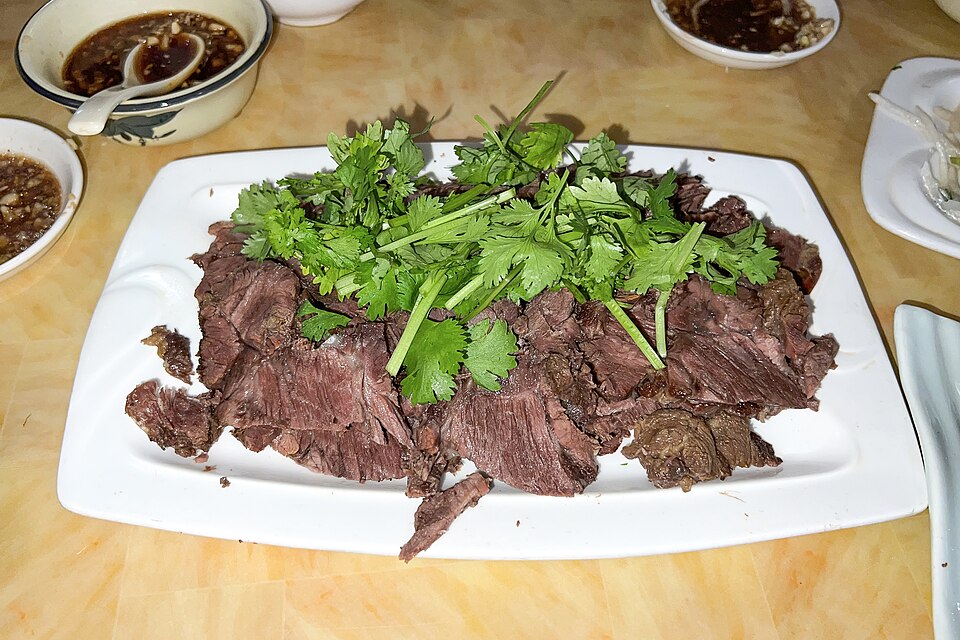
Hand-pulled yellow noodles served with a plate of braised donkey meat on the side.
The local signature; eat the noodles tossed and the meat as a topping.
A sweet-tart chilled drink boiled from dried local apricots, sold all over the night market.
The desert thirst-quencher; buy it cold by the cup, not the bottled kind.
Dunhuang's dish is huang mian: hand-pulled yellow noodles, often with donkey meat (a regional staple, not a dare). A bowl runs ¥15-25 in shops off the night market; the market stalls charge more for the same thing with a show.
Shazhou night market is genuinely fun but price-tag-free at some stalls, so ask the price before they pour, grill or wrap anything. Dried fruit is sold by the jin and adds up fast; agree the amount, not 'a bag'.
Emeishan →
✓ checked 2026-06-13The monasteries and many mid-mountain guesthouses serve Buddhist vegetarian meals — tofu, mountain greens, mushrooms, mock-meat dishes — and it's the authentic thing to eat up here. Temple meals are simple and cheap; the tourist restaurants near the gates do fancier 'mountain delicacy' versions at a markup.
This is still Sichuan, so expect má-là heat down at the base — local mushrooms, bamboo shoots, 'snow konjac', and Emei's mountain teas. Try the local Zhuyeqing green tea grown on the slopes. Eat your bigger Sichuan meals in Emeishan town or Baoguo rather than up high, where carry-up prices bite.
As on any big Chinese mountain, food and water near the summit carry a steep carry-up premium. Buy water, fruit and snacks at the base and carry them — but keep them out of sight in the monkey zone, or you'll be donating them to the macaques.
Enshi →
✓ checked 2026-06-13Enshi's everyday food is Tujia (土家) mountain cooking: tujia zhajiangmian (土家炸酱面) — noodles under a savoury minced-meat sauce — plus cured pork, glutinous-rice and corn dishes, and the sour-spicy notes the southwest does well. It's cheap and filling in town. Eat at a busy local shop rather than the stalls inside the canyon, where you pay mountain prices for an ordinary bowl.
Order heza (合渣) at least once — a humble Tujia dish of ground soybeans cooked down with chopped greens, sometimes spiced up as 'zhaguangjiao heza'. It's homely, warming peasant food that's genuinely local rather than a tourist menu item, and most small Enshi restaurants do a version.
Enshi Yulu (恩施玉露) is the regional pride — one of China's few surviving steamed green teas, with a clean, grassy cup. Buy it loose from a town tea shop where you can taste first, not from a glossy gift box at a scenic-area counter. It's a light, packable thing to take home and a fair sight cheaper bought in the city.
Fenghuang →
✓ checked 2026-06-13The local signature: duck stir-fried with chunks of glutinous-rice-and-duck-blood cake, ginger and chilli — rich, dark and properly spicy in the western-Hunan way. Order it in a busy local restaurant a lane back from the river rather than a tourist front, and pair it with rice and a vegetable.
This is Miao and Tujia country, and the cooking leans sour and spicy — sour-soup fish, pickled vegetables, cured pork and chilli everywhere. It's distinct from the rest of Hunan and worth seeking out in a plain local place. Say if you want it milder; the default is hot.
Two cheap street things: jiang tang, the hand-pulled ginger candy you'll see hammered and sold all over town (fine as a snack, just don't overpay for the gift boxes), and mi doufu, a soft savoury 'rice tofu' served cold with chilli, vinegar and garlic — a genuine local snack rather than a tourist invention.
Foshan →
✓ checked 2026-06-13This is core Pearl River Delta cooking — the same yum cha, roast meats and clear-flavoured Cantonese cooking as Guangzhou, often a notch cheaper and less touristed. Order dim sum in the morning, look for a siu mei shop with ducks and char siu hanging in the window, and you'll eat well without paying old-town prices. The food inside Lingnan Tiandi is convenient but charges for the setting; the better-value bowls are in the ordinary neighbourhoods.
Foshan's Shunde district is one of the most serious eating destinations in the country — UNESCO put it on its 'City of Gastronomy' list, and locals from Guangzhou drive over just to eat. This is the home of silky double-skin milk (双皮奶), of raw freshwater fish (鱼生) sliced paper-thin, and of long-simmered congee. If you're a food traveller, Shunde justifies the trip on its own.
Shunde's double-skin milk (shuangpinai) — warm or chilled steamed milk custard with a delicate skin on top — is the dessert to seek out, ideally at an old shop that does little else. It's cheap, it's everywhere in Shunde and Foshan, and it's the one sweet locals will tell you to try first. Plain, ginger or red-bean versions all work.
Fuzhou →
✓ checked 2026-06-13Fuzhou's signature is the fish ball (yuwan) — springy fish-paste spheres, often stuffed with minced pork, in a clear broth, sold cheap at hole-in-the-wall shops all over town. The grand local dish is fotiaoqiang, 'Buddha jumps the wall', a slow-simmered pot of seafood, meat and broth so rich the monk supposedly leapt the wall to get at it; it's a splurge done properly, so order it at a sit-down restaurant, not a stall, and check the price first.
Look for lizhirou ('lychee pork') — crosshatched pork fried so it curls into lychee-like nuggets in a sweet-sour glaze, a genuine Fuzhou classic rather than a tourist invention. For breakfast or a snack, guobian (rice-batter 'pot-edge' soup) is the local comfort food: thin rice sheets cooked on the edge of a wok and slid into a savoury broth. Both are everyday dishes — find a busy local place over anything dressed up for tourists in the lanes.
Sanfang Qixiang's South Back Street is lined with snack stalls, and they're fine for a fish ball on the move, but they're priced for the crowd. Step a block or two out into the ordinary neighbourhoods and the same bowl is cheaper and usually better. A translation app and pointing at what looks good will get you a long way; Fuzhou dining is solidly local, with little Western food outside the bigger hotels.
Fuzhou (Jiangxi) →
✓ checked 2026-06-13Fuzhou is Jiangxi, and Jiangxi cooking has a reputation as the hottest of China's regional cuisines — sometimes argued to out-spice even Hunan. The chilli here is woven through the braises and stir-fries, fresh and pickled, not just a garnish. If you don't take chilli well, say 'not spicy' (bù là) when you order, but know the local default is properly hot, and toning it right down can flatten the dishes worth coming for. Claypot vegetables and meats, a Jiangxi staple, are a good, reliable order.
Look for the local Fuzhou/Linchuan home cooking rather than generic tourist menus: river fish and freshwater dishes, smoked and cured meats, rice-based snacks and the hearty rural braises typical of inland Jiangxi. As everywhere in the province, a claypot of vegetables — with or without meat — is delicious and dependable. Eat at busy local places in the city; out in the counties near Liukeng or Dajue Mountain the choice narrows to simple village restaurants, which is part of the charm but means fewer English menus, so a translation app earns its keep.
The one thing the wider region is genuinely famous for is the Nanfeng honey tangerine (南丰蜜橘) from Nanfeng county in this prefecture — small, sweet, easy-peeling citrus that's a point of local pride and sold all over in season (late autumn into winter). If you're here at harvest, buy them fresh by the roadside; in spring the same orchards put on orange blossom. It's a cheap, local, only-here treat rather than a restaurant dish — grab a bag for the long drives between the scattered sights.
Ganzhou →
✓ checked 2026-06-13The signature local dish is xiaochaoyu — fresh river fish quick-fried with pickles, ginger and a hit of local rice vinegar, a Hakka classic said to have Ganzhou roots. It's tangy, savoury and not especially fiery, a good counterpoint to the heavier Jiangxi chili. Order it at a busy local Hakka restaurant rather than anything aimed at tourists; it's the most Ganzhou thing on the table.
Sanbeiji — 'three-cup chicken,' braised down with a cup each of rice wine, soy sauce and sesame oil plus basil until the sauce turns sticky and dark — is a Jiangxi staple you'll find done well here. It's rich, aromatic and comforting, milder than the chili-forward end of the local menu, and a safe, satisfying order if you want one dish that sums up the province's home cooking.
For a snack, look for aimiguo — green glutinous-rice dumplings made with mugwort, savoury or sweet, a Hakka treat especially around spring festivals but sold year-round at local shops and markets. They're cheap, a little chewy and properly regional rather than a tourist invention. Grab a couple from a busy stall to eat on the wall walk.
Guang'an →
✓ checked 2026-06-13You're in Sichuan, so the chilli-and-Sichuan-pepper málà numbing heat is the baseline, and it's real rather than toned-down. But Guang'an sits in the eastern basin near Chongqing, so the cooking leans toward hearty, home-style country dishes and Chongqing-influenced heat rather than the more refined Chengdu style. Order at busy local restaurants over anything inside the scenic area, where it's pricier for the same plate, and if you don't take chilli well, say 'bù là' (not spicy) when you order — though know the local default is properly hot.
Look for regional specialities tied to the prefecture's counties: Yuechi (岳池) within Guang'an is known for its mutton — a mutton soup or hotpot is a genuine local dish, especially welcome in cooler months — and you'll find plenty of free-range chicken, river fish and seasonal farm vegetables cooked simply and spiced hard. These are local fare rather than tourist-menu inventions, so they're worth seeking out over anything generic.
Being so close to Chongqing, Guang'an does a proper fiery hotpot and the small-eats culture that goes with it — skewers, noodles, cold dishes and street snacks. For a casual local meal, a hotpot evening or a busy noodle shop is the safe, cheap, authentic call. Don't expect much of a foreign-food or English-menu scene here: this is a domestic-tourism city, so use a translation app, point at what looks good, and you'll eat well for very little.
Guangyuan →
✓ checked 2026-06-13The signature local speciality is Jianmen tofu (剑门豆腐) — bean curd from the Jianmen Pass area, traditionally credited to the local mountain water, cooked into a whole spread of dishes: braised, stuffed, fried, in soup, sometimes dozens of preparations across a single 'tofu banquet'. It's a genuine regional thing tied to the pass, not a tourist invention, and the restaurants in and around the Jianmen Pass scenic area are where to try the full range. If you're doing the cliff-fortress day trip, plan lunch there and order the tofu rather than something generic.
Guangyuan's other local point of pride is its cold noodles — the 'Empress's steamed cold noodles' (女皇蒸凉面), a dish locals tie to the Wu Zetian legend: steamed rice-flour noodles served cool, dressed with chilli oil, vinegar, garlic and the rest of the Sichuan cold-dressing kit. It's a cheap, refreshing street and market dish, especially good in the warm months, and you'll find it at small shops and in the Feng Street night market by Huangze Temple. Ask for 蒸凉面 and try it the way it comes before deciding how much chilli you want next time.
You're in Sichuan, so the default is bold and genuinely hot: ma-la (numbing-hot) Sichuan pepper and chilli woven through hotpot, 'jianghu cuisine' (江湖菜, the punchy street-style local cooking the city prizes), grilled skewers, river fish and the riverside beer-and-barbecue stalls along the Jialing. Hotpot and jianghu places are the local going-out food; the night markets and the riverside BBQ streets are where the evening happens. If you don't take chilli well, say 'bu la' (not spicy) when you order — it's understood — but know that toning it down flattens the dishes worth coming for. Pair it with the local tea-house habit: a covered-bowl tea (盖碗茶) by the river is how locals slow down.
Guangzhou →
✓ checked 2026-06-11
The dim sum benchmark: crystal shrimp dumplings and open-topped pork ones.
Yum cha is a morning thing; tap two fingers when tea is poured for you.
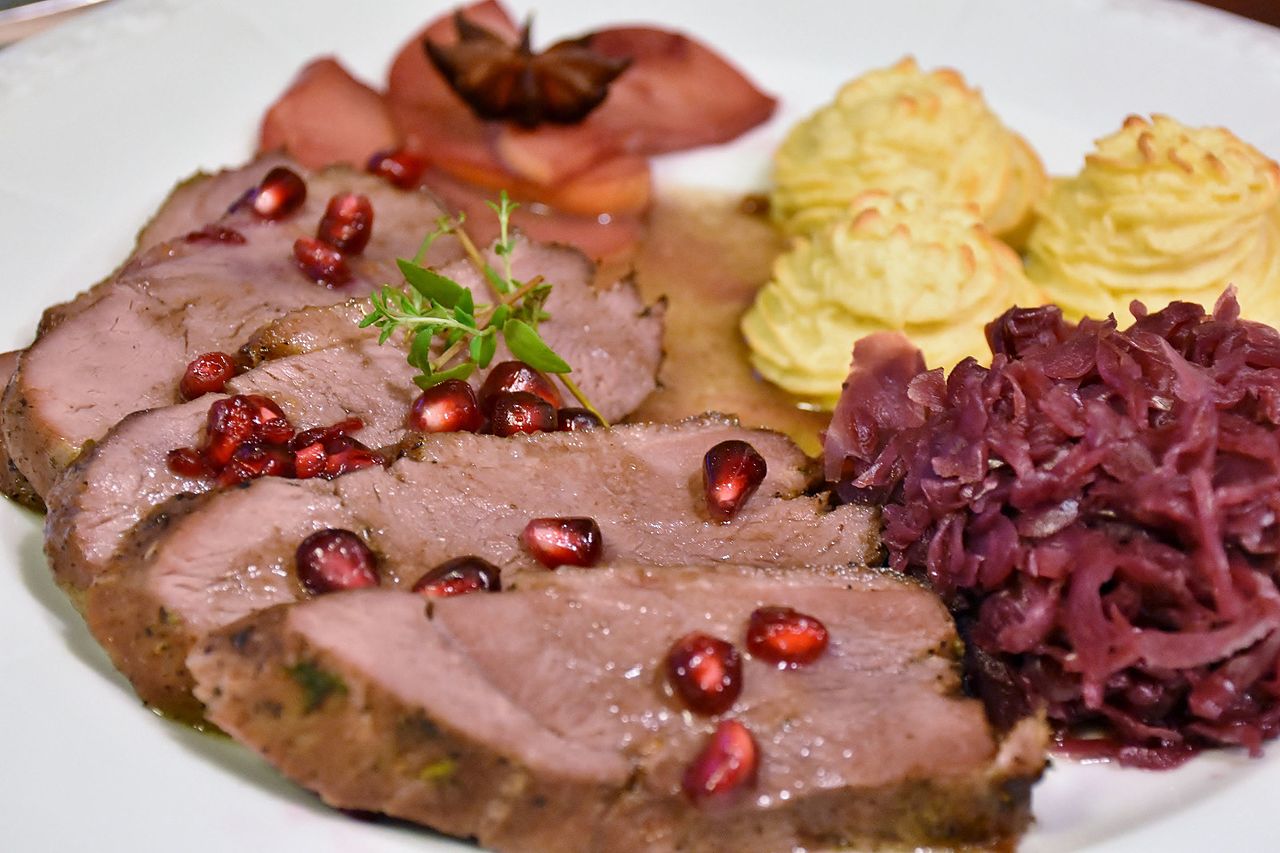
Lacquered roast goose, crisp skin over rich meat, hung in the shop window.
If it's still fully stocked at 8pm, pick another shop.
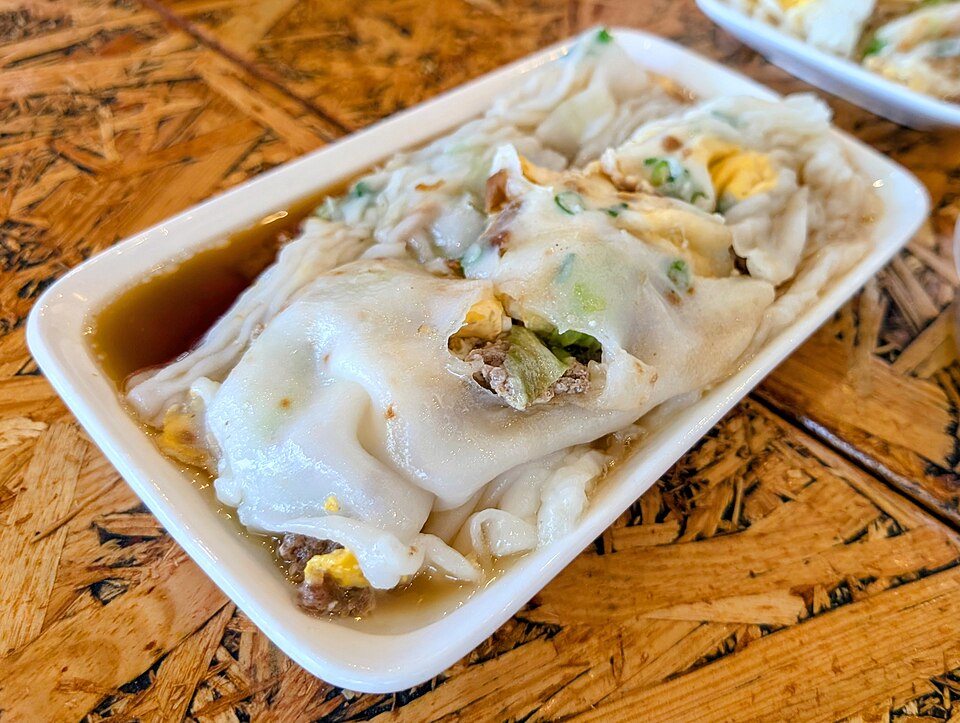
Silky steamed rice-noodle rolls around shrimp or beef, doused in sweet soy.
A breakfast and dim-sum staple; the plain zhaipai (with egg) version is cheapest.
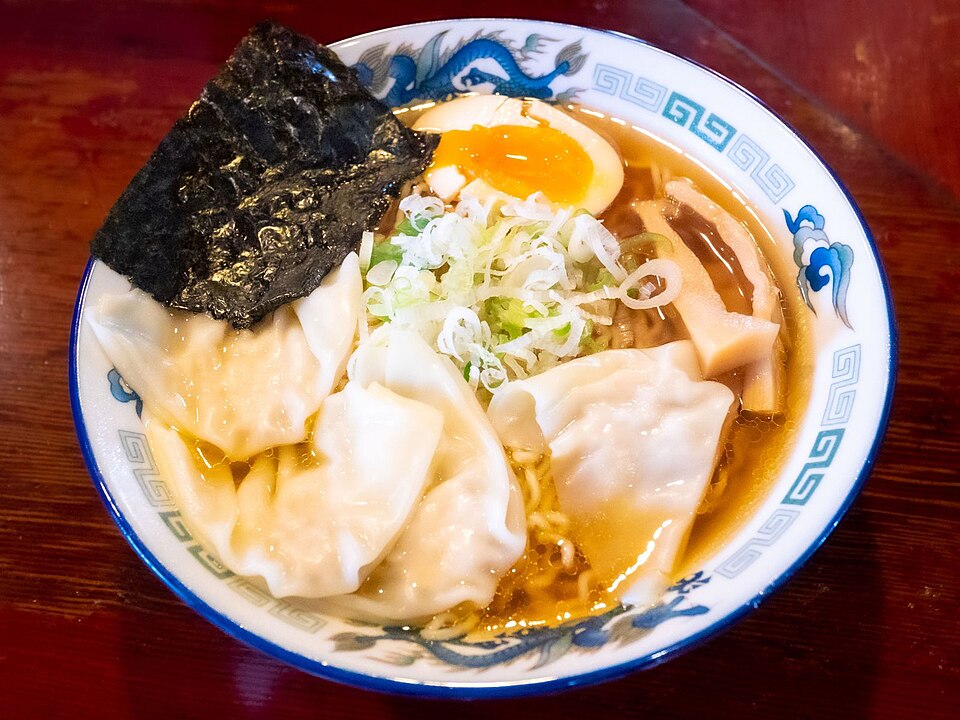
Springy thin egg noodles with shrimp wontons in a clear, savory broth.
Ask for the noodles slightly firm; a real shop floats the wontons on top of the noodles.
Yum cha starts early. The famous tea houses are full of locals by 9am and the carts thin out after 13:00. Order chrysanthemum tea, tap two fingers when someone pours for you, and get the har gow, siu mai and char siu bao before experimenting.
A proper siu mei shop hangs its ducks and char siu in the window and sells out by evening. Rice plate with roast goose runs ¥30-45; if it's still fully stocked at 20:00, that's not the shop.
Guilin →
✓ checked 2026-08-08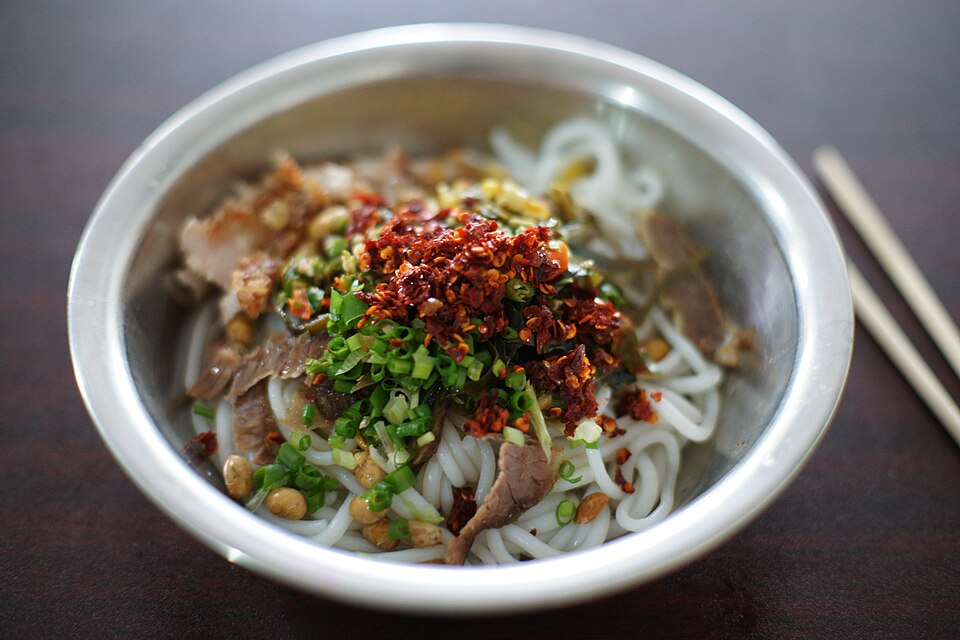
Round rice noodles with braised beef slices, peanuts and pickles; broth or dry-tossed.
Add pickled beans and chili yourself at the counter; go before 10am.
Yangshuo's river fish braised in beer, tomato and chili, sold by weight.
Agree price per jin and rough total BEFORE it goes in the wok.
River snails emptied, mixed with pork and herbs, stuffed back in and braised in a peppery sauce.
A Yangshuo specialty; use a toothpick to pull the filling and snail out together.
Guilin rice noodles (mifen) are a ¥8-12 morning ritual; locals are done by 10am. Choose broth or dry-tossed, then add pickled beans and chili yourself from the counter. A shop that's busy at 8am and empty at noon is doing it right.
Yangshuo's signature dish is sold by weight, and tourist spots weigh the fish after cooking when you can't argue. Agree the price per jin and the rough total before it goes in the pan. A fair beer fish for two runs roughly ¥100-160, not ¥400.
On West Street you pay for the neon. The same stir-fries and river snails cost half one street back, where the menus drop the English and the food gets better. Worth the 60-second walk.
Guoliang (Wanxianshan) →
✓ checked 2026-06-13Inside Guoliang you eat at农家乐 farmhouse kitchens — simple Taihang mountain home cooking, local chicken, wild greens, hand-pulled noodles. Portions and prices aren't always posted, so agree the price before you order, the same way you would for any rural China meal.
Choice up in the village is limited and everything is carried in over that one cliff road, so prices run higher than down in Huixian. Buy water, snacks and anything specific you need in Xinxiang or Huixian before you head up.
Haikou →
✓ checked 2026-06-08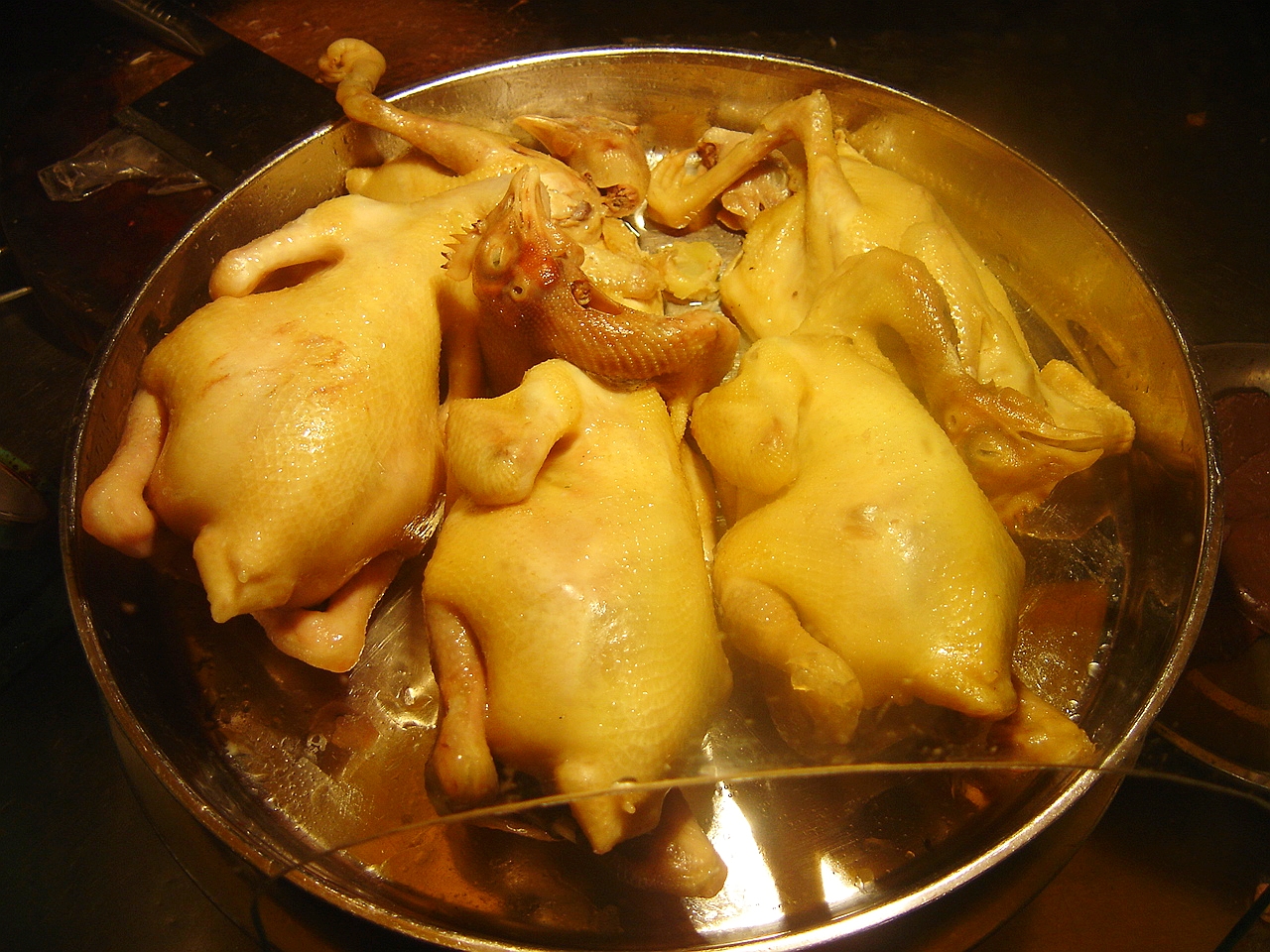
Hainan's pale poached free-range chicken served cold with a ginger-and-scallion dip; the island's foremost named dish.
Order it white-cut with the ginger sauce; the bird is meant to taste plain and clean.
Fat round rice noodles in a clear, faintly sweet broth with beef or pork and peanuts; a Hainan favorite from Baoluo town.
The broth is the draw; add the chili and pickles on the counter to taste.
A cold bowl of mixed beans, lotus seed, barley and fruit in coconut milk, Hainan's standard hot-weather sweet.
The coconut-milk version is the Hainan one; a cooling close to a meal.
Hainan's signature dish and the ancestor of 'Hainanese chicken rice' everywhere else: a free-range bird poached and served cool ('white-cut') with a ginger-garlic dipping sauce, the meat tender and the skin gelatinous. Eat it at a dedicated Wenchang-chicken or Hainan-chicken-rice restaurant rather than a generic canteen — the difference is in the bird.
The island's iconic cold dessert soup: beans, taro, jelly, fruit and peanuts in coconut milk or syrup, served chilled. In Haikou's heat it's less a dessert than a survival tool. Dengji (邓记) on Meiyuan Road is the famous name, but stalls all over town do a decent bowl for a few yuan.
Haikou's classic morning bowl is hainan fen (海南粉): thin rice noodles in the 'dry-mix' style, tossed with a savoury sauce, peanuts and toppings rather than swimming in soup. It's a street-and-stall breakfast, not a restaurant dish — follow the locals to a busy noodle counter early in the day.
Hancheng →
✓ checked 2026-06-13The dish to eat in Hancheng is yangrou hele (羊肉饸饹) — buckwheat or sorghum noodles pressed through a perforated press straight into the pot, served in a rich mutton broth, often with a fierce chilli oil on the side. It's hearty, cheap northern-Shaanxi food and the genuine local speciality, not a tourist invention. Find a busy local shop in the old town or the New City rather than anything aimed squarely at visitors, and ask for it with the mutton broth.
Two more local things to look for: da-li-pian (大刀面 / 大荔片-style broad knife-cut noodles you'll see written different ways locally), wide hand-pulled or knife-cut noodles in a savoury sauce; and Hancheng's tradition of steamed banquet dishes — the kind of multi-bowl steamed spread (often called the 'ten bowls', 十大碗) served at village feasts, with steamed pork, meatballs and vegetables layered in bowls. If you eat near Dangjia or at a village-style restaurant, this steamed style is the regional cooking to try over anything generic.
Being on the Yellow River, Hancheng does river fish — usually cooked simply, braised or in soup, so the freshness carries; it's a treat if you find a place that does it well, though confirm the price before ordering as fish is sold by weight. Beyond that, this is solidly local Shaanxi eating: noodles, mutton, steamed dishes, flatbreads. There's essentially no Western-food or English-menu scene here, which is the point — bring a translation app, point at what looks good in a busy shop, and you'll eat well and cheaply.
Handan →
✓ checked 2026-06-13Southern Hebei is donkey-meat country, and Handan does it two ways worth seeking out. The wider province is famous for donkey-meat flatbread (lürou huoshao) — braised donkey stuffed into a crisp layered bread — but Handan's own listed specialty is donkey-meat hotpot (lürou huoguo), tender meat in a rich herbal broth. Both are local staples rather than tourist inventions, both are cheap, and a busy local shop beats anything aimed at visitors. If donkey isn't for you, the same shops usually do plenty else.
For carbs, look for the local handmade noodles — you'll see them as Guangfu noodles or as zhuaimian (hand-stretched, torn noodles) — served with soy-based sauces and vegetables, the kind of honest northern bowl that fills you for a few yuan. The other dish to try is shengzhi gusu yu ('imperial-decree bone-crisp fish'), a slow-braised fish cooked so long the bones turn soft enough to eat, a Handan-area banquet specialty with a story attached. Order it where locals do rather than off a tourist menu.
Handan's best cheap eating is the morning street stall, roughly 06:00–09:00: soy milk and soup-style breakfasts — doujiang, doumo, douhua, millet congee, spicy hulatang — taken with youtiao dough sticks. There are vendors on most streets. Beyond that the dining is solidly local northern Chinese with little dedicated foreign or Western food outside the bigger hotels and malls. Use a translation app, point at what looks good where there's a queue, and you'll eat very well for very little.
Hangzhou →
✓ checked 2026-08-08
River shrimp stir-fried with Longjing tea leaves; delicate, barely seasoned.
Order with rice and one braised dish; it's a light plate.
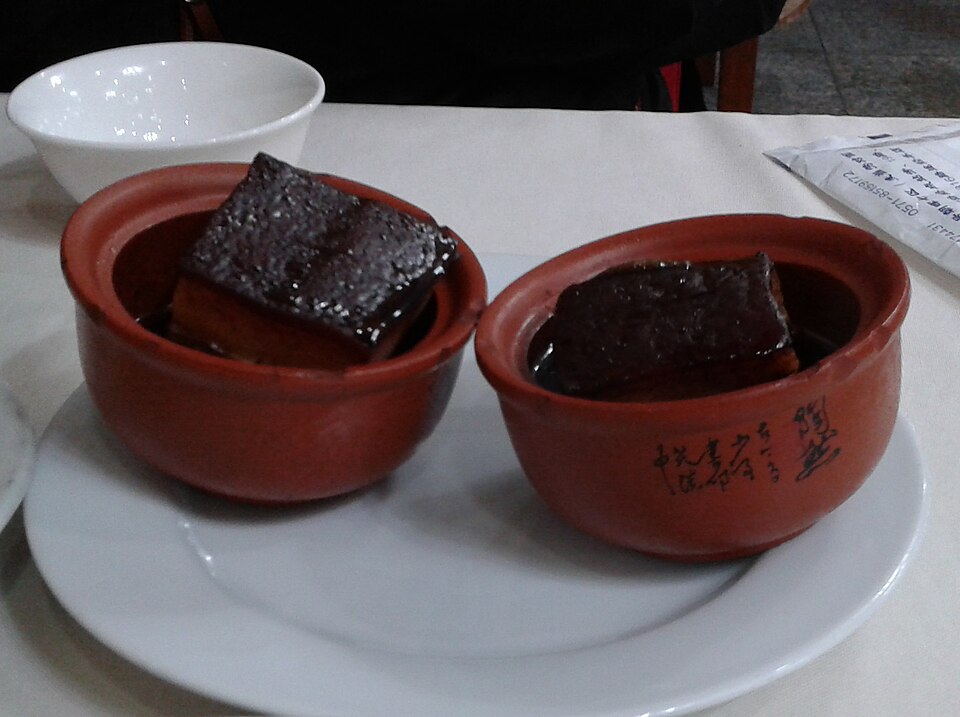
A glossy braised pork-belly cube named for the poet-governor Su Dongpo.
One cube per person; it's richer than it looks.
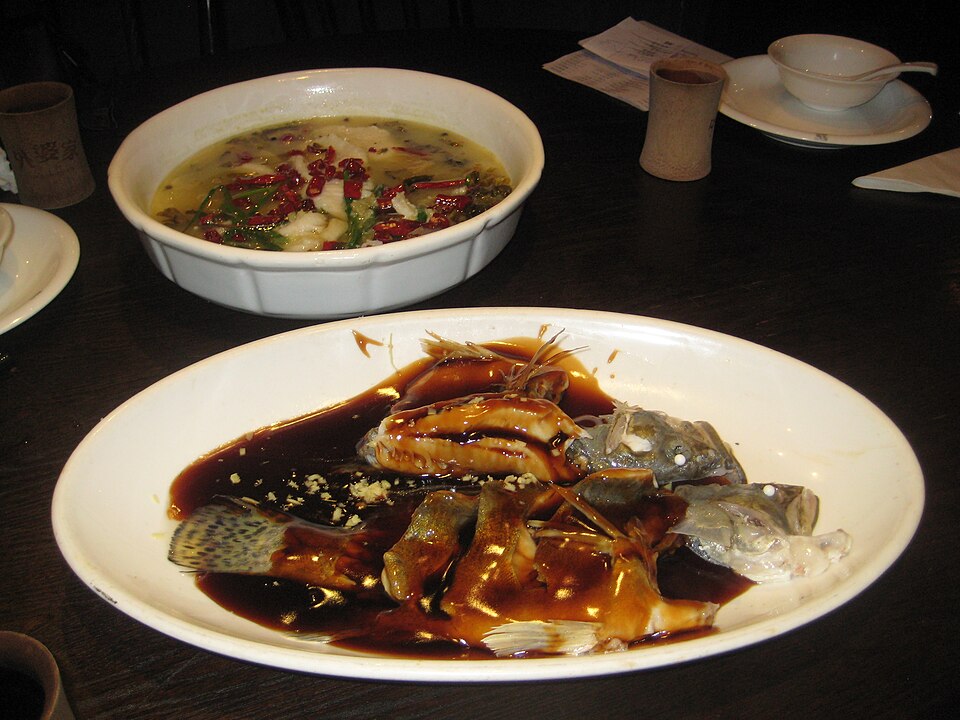
Whole grass carp poached and dressed in a bright sweet-and-sour vinegar glaze.
A classic that splits opinion; order it fresh, not pre-made, and eat it hot.
Longjing shrimp (tea-leaf stir-fried), dongpo pork (braised belly named for the poet-governor), and West Lake vinegar fish. The first two travel well to any decent restaurant; the fish is divisive, so order one for the table, not per person.
Restaurants with a lake view charge roughly double for the same dishes you'll get two streets inland. Pay it once for sunset if you like, then eat where the Hangzhou office workers do, around Hefang street's side lanes, not on the postcard strip itself.
Hanzhong →
✓ checked 2026-06-13Hanzhong mianpi (汉中面皮) is the local obsession and what the city is famous for across China: broad, slippery rice-flour 'noodle skins', steamed and sliced, dressed cold with a spicy-sour chilli-oil sauce and usually piled with cucumber, bean sprouts or other greens. It's eaten as breakfast and as a snack, cheap and everywhere. There's a hot/warm version too, generally considered a notch below the classic cold one but easy to find. Pick a busy local stall over anything dressed up for tourists — the plain neighbourhood shops do the best bowl, and it's the single thing you shouldn't leave Hanzhong without eating.
Hanzhong sits in a rice-and-tea basin — locals call it the 'Little Jiangnan of the Northwest' — so the food is softer and more rice-based than you'd expect from Shaanxi's wheat-and-mutton north. Look for the local vegetable-tofu soup (菜豆腐), a mild tofu-and-greens dish that's a regional staple, alongside cured Chenggu bacon, black and red rice from Yang County, and the usual street fare of rou jia mo (the 'Chinese hamburger') and beef noodles. It's a gentler, greener table than Xi'an's, and a nice contrast if you've been eating northern Shaanxi food.
Geographically and culinarily Hanzhong tips toward Sichuan just over the mountains, so the default seasoning runs genuinely spicy — chilli oil and heat woven through the mianpi sauce and the stir-fries, not just a garnish. If you don't take chilli well, say 'bu la' (not spicy) when you order, but know the local baseline is properly hot. Wash it down with the local green tea: Hanzhong's humid southern-Qinling slopes grow well-regarded green tea (you'll see 'Hanzhong xianhao' on menus), and the teahouses are a pleasant, cheap way to sit out the afternoon heat.
Harbin →
✓ checked 2026-06-11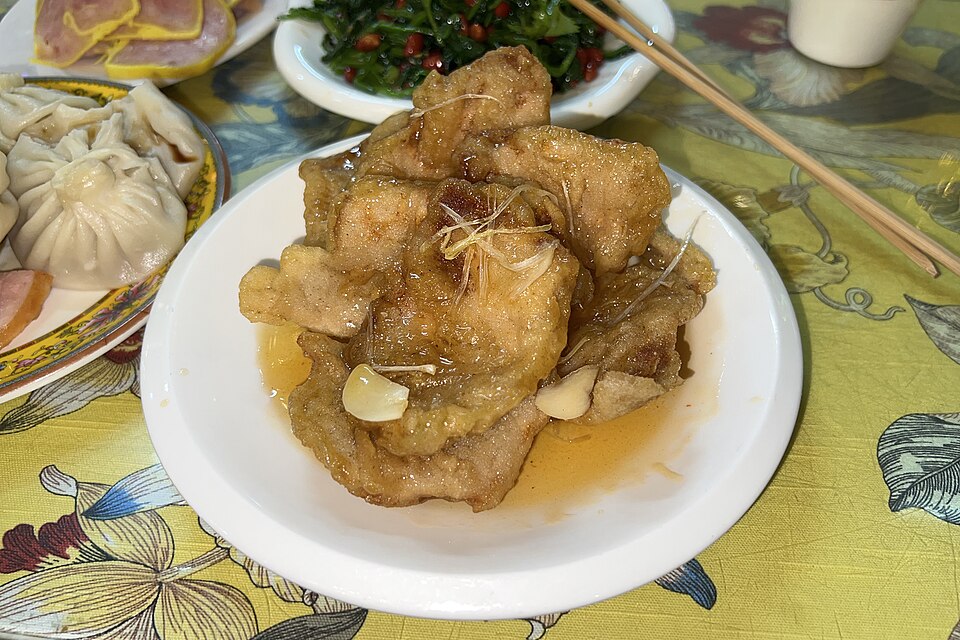
Northeastern sweet-and-sour crispy pork, pale and vinegary rather than red and sticky.
One plate per table; locals judge the whole restaurant by it.
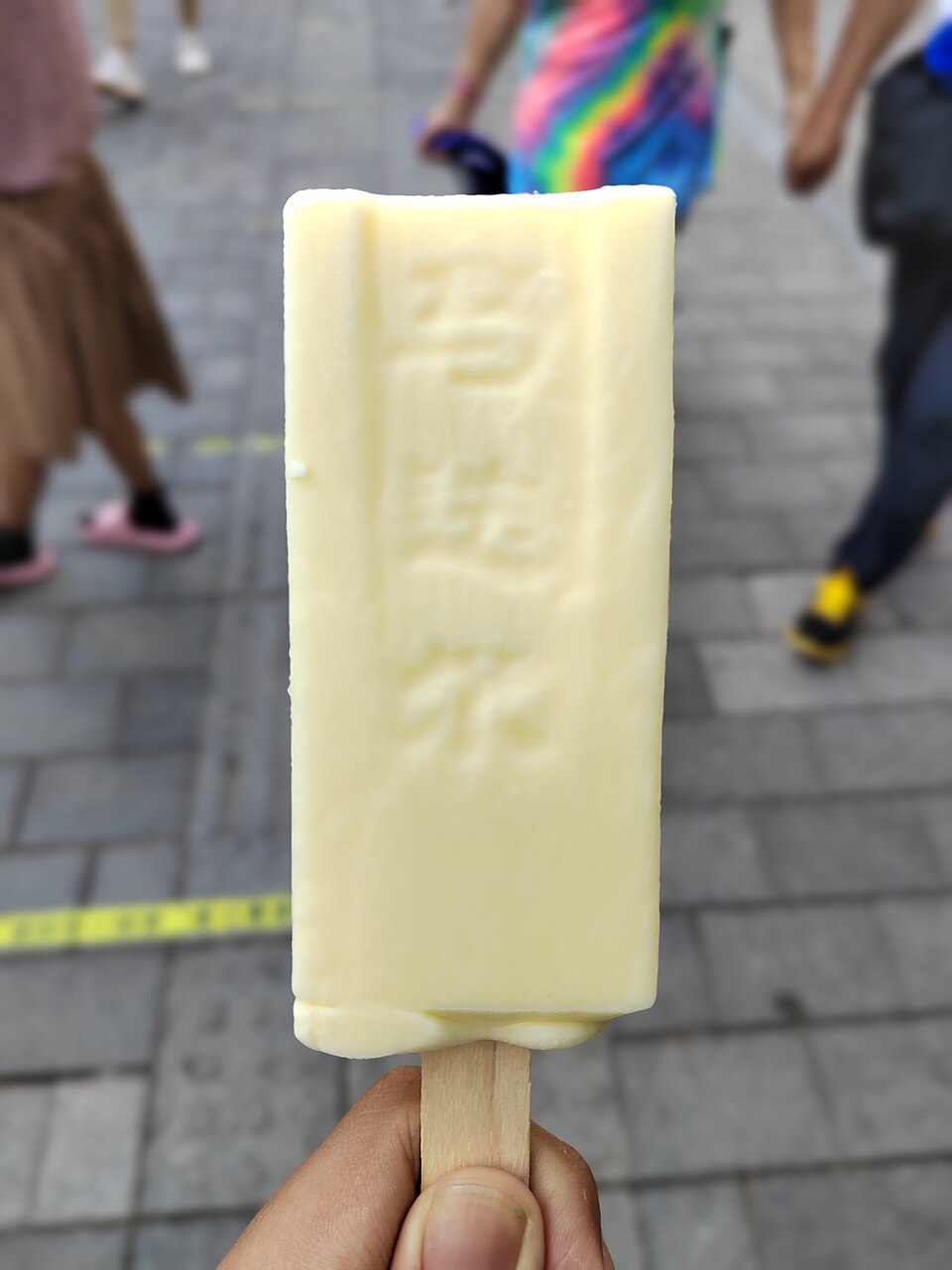
A dense, milky popsicle sold on Central Street, eaten outdoors even in deep winter.
Buy from the official street window on Zhongyang Dajie, not a roaming hawker.
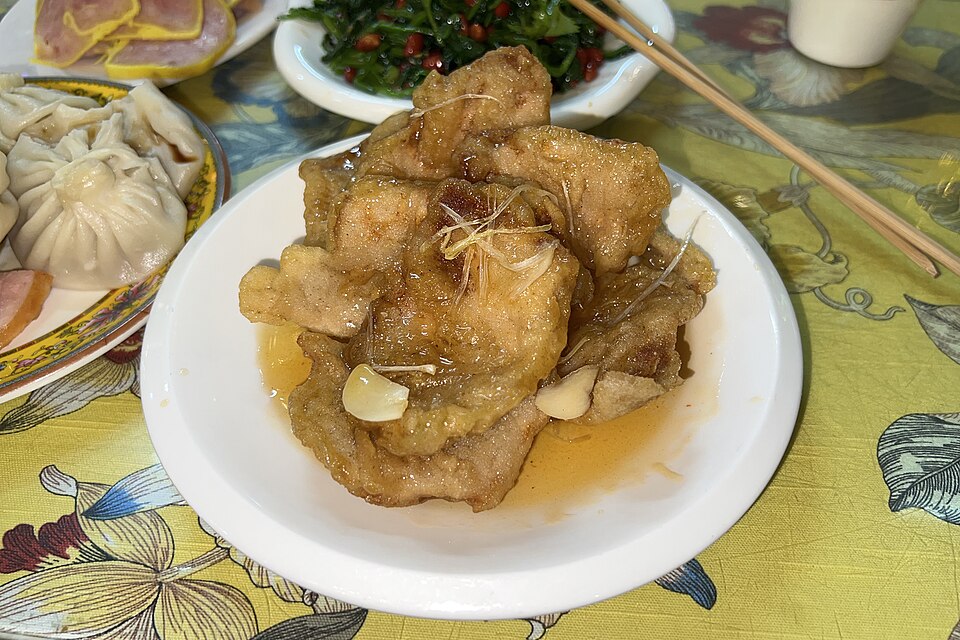
Crisp battered pork in a glossy sweet-and-sour sauce, the northeast's signature.
Eat it the moment it lands; the crunch fades fast once the sauce soaks in.
Harbin's dish is guobaorou: sweet-and-sour crispy pork in the pale, vinegary northeastern style, not the red Cantonese one. Locals judge restaurants by it. Order one for the table with cucumber salad and you've eaten like the city.
The Russian inheritance is hongchang, a smoky red sausage sold whole at delis, and lieba, a dense sourdough loaf the size of a wheel. Both travel well and make the train picnic. The Qiulin brand queues are locals, not tourists.
Hefei →
✓ checked 2026-06-13Hefei's old name is Luzhou, and its hometown roast duck is the local point of pride — leaner and more savory than the Beijing style, often sold by the half from neighborhood shops. It's the dish to order if you want one thing that's genuinely Hefei rather than generic. Skip the versions inside polished tourist streets and find a busy local place.
From the canal town of Sanhe just outside the city: a crescent dumpling with a rice-flour skin, pan-fried crisp on the outside and stuffed with pork and greens. They turn up at snack stalls and breakfast counters around Hefei, and they're cheap, filling and very local. A good thing to point at when you don't know what else to order.
Hefei sits at the edge of Hui (Anhui) cuisine, the rich, braise-and-ferment cooking from the Huangshan region you may be heading to. Expect bolder, oilier, more pungent dishes than the coastal cities — braised meats, freshwater fish, the famously stinky-but-delicious mandarin fish (chou guiyu) and bamboo. Treat a Hefei meal as a preview of what you'll eat deeper in Anhui.
Heshun →
✓ checked 2026-06-13This is far-western Yunnan on the old Burma trade road, and the food shows it. Look for daji (大救驾, a stir-fried rice-cake dish), Tengchong tou-tou rice noodles, and the local hotpot. It's hearty borderland cooking, not refined dining — eat where locals eat.
Tengchong's '土锅子' clay-pot hotpot layers meat, egg rolls and vegetables in a clear broth — a warming, worth-it meal, especially in the cooler months. It's a sit-down local tradition more than a tourist gimmick.
Inside the most photographed lanes of Heshun you pay the view tax. Walk a couple of streets back, or eat in Tengchong city, for the same Yunnan home cooking at a fraction of the price.
Hezhou →
✓ checked 2026-06-13Huangyao's signature product is its douchi (黄姚豆豉) — fermented black soybeans, one of the town's celebrated 'three treasures'. These aren't a tourist gimmick: Huangyao douchi has a real local reputation, cured the slow way and used to lift stir-fries, steamed fish and tofu with a deep, savoury, slightly funky saltiness. You'll see open jars and bagged douchi sold all along the old-town lanes; it's the obvious edible souvenir to take home, and dishes cooked with it — douchi steamed fish, douchi with bitter greens — are worth ordering in the town's restaurants. The other two 'treasures' are huangjing wine (黄精酒, a tonic rice liquor) and dried preserved plums (话梅).
Down in Hezhou city the food turns to local Guangxi and Hakka country cooking — Hezhou bills itself as a 'hometown of the Hakka'. A genuine local oddity to look for is niuchang suan (牛肠酢), a fermented-rice-and-offal speciality that's an acquired taste but a real Hezhou thing rather than a tourist invention. More broadly you'll eat well on stuffed tofu (酿豆腐, a Hakka staple), clay-pot dishes — river-snail clay pot is a regional favourite — sour-soup fish, chopped-chilli fish head, and the oil-tea (油茶) of the surrounding counties. Skip the fancy-looking tourist restaurants and follow the busy local places near the markets.
As everywhere in Guangxi, the cheap, reliable everyday meal is a bowl of rice noodles. You'll find the regional styles — broth noodles, dry-mixed bowls, and the cured-meat and pickled-vegetable toppings Guangxi does so well — at noodle shops all over Hezhou city and around the bus and train stations, often for a handful of yuan. It's the right breakfast or quick lunch, especially on a travel day heading out to Huangyao. Point at what looks good, and you'll eat cheaply and well; the food here is solidly local, with little in the way of a Western-food scene outside the bigger hotels.
Hohhot →
✓ checked 2026-06-13The signature drink here is salty, not the sweet milk tea you may expect: brick tea boiled with milk and salt, sometimes with fried millet or butter stirred in. It's offered to guests as a gesture of hospitality, so try it the way it's served before judging. Inner Mongolian yogurt and milk skin are local too — Hohhot is literally China's 'dairy capital,' home to Yili and Mengniu — so the milk-based everything is the genuine local taste, not a gimmick.
This is mutton country done the northern way: shoumeng yangrou (hand-grabbed mutton — boiled on the bone, eaten with a knife and your hands), roast lamb, and the local 'ice-boiled mutton' hotpot that uses ice rather than water for a firmer, sweeter meat. It's hearty, simple and meant to be shared. Eat it at a busy local restaurant rather than a grassland tour's set lunch, where it's cooked to a tour schedule.
Hohhot's shaomai (烧麦) are a local breakfast institution — open-topped steamed dumplings, here typically stuffed with mutton and spring onion, ordered by weight of wrapper (liang) and eaten with vinegar and tea. The city's large Hui Muslim population also means plenty of halal places (look for a green or yellow sign, or the Arabic حلال) doing lamb, noodles and flatbreads well and cheaply, especially around the Great Mosque near the old town.
Hongcun & Xidi →
✓ checked 2026-06-13Huizhou cuisine (徽菜) is one of China's eight great traditions, and its signature here is chou guiyu — lightly fermented mandarin fish that smells pungent and tastes deep, savoury and tender, nothing like its reputation suggests. It's the regional must-try. Order it at a busy local place rather than the first lane-side tourist spot, where the same dish costs more for less fish.
Look for mao doufu (毛豆腐) — 'hairy' tofu cultured with an edible white mould, then pan-fried crisp and eaten with chilli — a proper local specialty, not a tourist gimmick. The wider Huizhou table leans into preserved meats, bamboo shoots, wild greens and slow earthen-pot braises; it's hearty mountain-and-river cooking. A translation app and pointing at what locals are eating will serve you better than any English menu.
As in every photogenic Chinese old town, the restaurants right on the Moon Pond and the main lane charge a view tax. Step one or two lanes back, or eat in Yixian county town or Tunxi, and the same Huizhou plates cost noticeably less, with menus aimed at locals rather than tour buses.
Huai'an →
✓ checked 2026-06-13If you order one thing to understand Huaiyang cuisine, make it dazhu gansi (大煮干丝): a firm block of dried tofu sliced by hand into hair-fine threads, then simmered in a rich chicken-and-ham broth with shredded ham, chicken and sometimes shrimp. It is a signature of the style and a showcase of the obsessive knife skills the cuisine is built on — the whole point is that the tofu is cut so fine it drinks up the broth. It's delicate, savoury and not spicy, and it's a regional speciality rather than a tourist invention.
Huai'an's most famous snack is the Wenlou soup dumpling (文楼汤包) — an outsized, gossamer-thin-skinned bun filled with hot, rich broth, traced to the old Wenlou restaurant in the late Qing, eaten carefully with a straw so you don't scald yourself. Look too for Pingqiao tofu (平桥豆腐), silky tofu simmered with shredded chicken, ham and bamboo shoots in a thick broth; Qingong meatballs (钦工肉圆), a springy pork-ball cousin of Yangzhou's 'Lion's Head'; and cha san (淮安茶馓), crisp deep-fried twists of fine dough sold as a teahouse snack. These are genuinely local and easy to find around the old town and the markets.
Come in with the right palate: Huaiyang food is almost never spicy and leans slightly sweet, with each dish built around one main ingredient and the way it's cut. Freshwater fish, eel, river shrimp, pork and chicken dominate, usually cooked light and clean to let the ingredient carry, often finished with the local Zhenjiang (Chinkiang) black vinegar. If you've been eating Sichuan or Hunan food and expecting chilli heat, this is the opposite end of the Chinese spectrum — restrained, technical and broth-driven. That's the feature, not a shortcoming.
Huaihua →
✓ checked 2026-06-13Huaihua sits in the western, more mountainous half of Hunan, and the food carries the full Xiang punch of fresh and pickled chilli — but the regional signature is the layering of sour and smoked alongside the heat. Smoke-cured pork and bacon (腊肉), sour-pickled vegetables and fermented sour notes run through the braises and stir-fries, a style shaped by the Dong, Miao and Tujia kitchens of the surrounding hills. If you don't take chilli well, say 'not spicy' (bù là) when you order, but know the local default is properly hot, and toning it all the way down flattens the dishes worth eating.
Pickled vegetables (泡菜, pao cai) turn up on nearly every table here and are a genuine local habit rather than a tourist flourish — order them as a foil to the richer, smokier mains. The standout regional dish to seek out is Zhijiang duck (芷江鸭), a blood-and-spice braised duck from the Zhijiang county tradition that locals will point you to, often served as a hearty duck soup or stew; downtown Huaihua restaurants do credible versions. Pair it with a clay-pot of local stir-fried beef and you've eaten the area's character in two dishes.
As across Hunan, the everyday breakfast is a bowl of rice noodles (米粉) in a chilli-and-stock broth from a busy local shop — cheap, fast, and the most reliable thing you'll eat. Choose a packed neighbourhood noodle stall over anything inside the restored merchant town or the old-town gates, where you'll pay tourist prices for a lesser bowl. Huaihua sees few foreigners and English menus are rare, so use a translation app, point at what looks good, and you'll eat very well for very little.
Huangshan →
✓ checked 2026-06-07Lightly fermented mandarin fish, pungent on the nose but firm and savory once braised; the signature Huizhou dish.
The smell fades on cooking; order it braised and eat the firm, flaking meat with rice.

Tofu fermented until a white fuzz grows on it, then pan-fried golden and served with chili and soy; a Huizhou specialty.
The fuzz is the point; eat it fried and hot with the dipping sauce.
The signature Huizhou dish: mandarin fish lightly fermented until it smells strong, then braised. It tastes far milder than it smells, firm and savoury. Order it at a proper Huizhou restaurant in Tunxi, not a summit canteen. If a place leans into '臭鳜鱼' on the menu, that's the one to try.
This is famous green-tea country (Huangshan Maofeng). Buying loose tea on Tunxi Old Street is fine, but the hard-sell tea-tasting rooms inflate prices for tourists. Taste, then buy by weight at a price you've agreed, and don't feel obliged after a free cup. A modest bag of decent Maofeng shouldn't cost a fortune.
Around Tangkou and the villages you'll see 'stone frog' (shiji, a mountain frog) and fresh bamboo shoots on menus — genuine local cooking, usually priced by weight. As with any by-weight dish in a tourist area, confirm the per-jin price and rough total before they cook it, so the bill doesn't surprise you.
Huashan →
✓ checked 2026-06-13You're in Shaanxi, so eat like it at the base in Huayin or back in Xi'an: biangbiang and youpo noodles, roujiamo (the 'Chinese hamburger' of stewed pork in flatbread), liangpi cold noodles. Cheap, filling and far better than what's sold on the mountain.
Food and water on the mountain carry a steep carry-up premium, and options up top are limited and pricey. Buy noodles, bread, water and snacks at the base and carry them, especially if you're doing the long climb or an overnight sunrise push — you'll be glad of it on the ridge.
If you're day-tripping, save the real meal for Xi'an's Muslim Quarter and noodle houses rather than the captive-priced stalls at the mountain. The food gap between Xi'an and the Hua Shan gate is large and the train back is quick.
Huizhou →
✓ checked 2026-06-13Huizhou sits in Hakka country on the Dongjiang (East River), and the regional cuisine — Dongjiang or Hakka cooking — is the thing to seek out, distinct from the Cantonese food of nearby Guangzhou and Shenzhen. It's heartier and saltier than Cantonese, built on preserved and braised flavours rather than delicate steaming. Look for it in local restaurants rather than the Japanese and Western places that the city's expat and industrial population supports; those exist in quantity, but the Hakka table is what's actually of Huizhou.
Three Dongjiang Hakka classics anchor most menus. Dongjiang salt-baked chicken (东江盐焗鸡) is the signature — a whole chicken cooked in hot salt until the skin is golden and the meat intensely savoury. Niang doufu (酿豆腐), tofu pockets stuffed with seasoned minced pork, is the comfort dish Hakka people are known for everywhere. And meicai kourou (梅菜扣肉), belly pork braised with preserved mustard greens, is rich, sweet-salty and unmistakably local. Order these over anything generic and you're eating the real regional food.
Because Huizhou is close to Cantonese-speaking Guangzhou and Shenzhen and has decades of foreign investment, the everyday dining scene is broader than the Hakka core: Cantonese/Hong Kong-style food is hugely popular with locals, and Japanese and Western restaurants are easy to find, with Park'n'Shop, Vanguard and Walmart for self-catering. That's a relief if you need a break or an English menu — but don't let it crowd out the Dongjiang Hakka places, which are the reason to eat in Huizhou specifically rather than just anywhere in the delta.
Huludao →
✓ checked 2026-06-13This is the Bohai coast, and the eating is seafood-led: clams and razor clams, sea snails, small local fish, crab and shrimp in season, usually cooked plainly — steamed, boiled or quick stir-fried — so the freshness carries rather than buried under sauce. Xingcheng's beachfront and the harbour streets are the obvious places, and a plate of stir-fried clams (花蛤) with a cold beer is the local summer move. As everywhere, the seafront tourist strips and the inside-the-walls restaurants run pricier; a busy local place a street back is usually fresher and cheaper. If the seafood isn't priced, agree the per-jin (500g) rate before they cook it, the way the coast works.
Inland of the seafood you're in solid Northeastern (Dongbei) country, and the comfort food is the hearty stuff: pork-and-vermicelli stews, the classic 'pork, potato and green bean' braise (乱炖 / 小鸡炖蘑菇 chicken-with-mushroom), big plates of home-style cooking meant to be shared, and plenty of garlic, scallion and doughy staples. Portions are generous and prices are low. In the colder months, when the beach is no use to anyone, this is the food to lean into — a hot stew and a steamed bun beats a sad off-season seafood platter.
Xingcheng has its own small-eats reputation — grilled skewers, fried-dough and pancake snacks, and the standard Dongbei street-food line-up — best grazed in the evening around the old town and the beach. Just know the timing: in July, the Xingcheng 'Sea Festival' and the summer beach season pull big domestic crowds, so the popular places fill and prices climb. Eat a little off the main drag, go early or late to dodge the worst of it, and you'll do well on cheap, fresh, unfussy coastal food.
Hulunbuir →
✓ checked 2026-06-13Hulunbuir lamb is the real thing — animals raised on natural pasture, the meat genuinely tender — and the two dishes to eat are 手把肉 (shouba rou, 'hand-grabbed' boiled mutton you cut and eat off the bone) and roast whole lamb (烤全羊), the centrepiece of a prairie feast. Hailar has restaurants built around exactly this; order the mutton and don't overthink the rest. It's the local default, not a tourist gimmick, and it's done better here than almost anywhere.
Salty Mongol milk tea (奶茶), made with brick tea, milk and often a pinch of salt and fried millet, is the everyday drink of the steppe, and the dairy culture runs deep: yoghurt, dried cheese curds, milk skin, and fermented mare's-milk wine (马奶酒), a lightly alcoholic traditional drink you'll be offered at pastoral-family visits and around the Horse Milk Festival in early August. Try the milk tea and the curds even if the mare's-milk wine isn't to your taste; it's the flavour of the region.
Manzhouli's border-town identity shows up on the plate: with the Russian frontier right there, the city has Russian-styled restaurants serving things like borscht, bread and Russian-leaning dishes alongside the Chinese and Mongolian food, a genuine echo of decades of cross-border trade rather than pure theme-park dressing. And across Hulunbuir, watch for wild blueberries (蓝莓) from the Greater Khingan forests — fresh in season and sold everywhere as juice, jam and dried snacks. They're a real regional specialty worth buying.
Huzhou →
✓ checked 2026-06-13On the Lake Tai side, the dish to order is the Taihu Three Whites (太湖三白) — whitebait/silver fish (银鱼), white shrimp (白虾) and the white-flesh baitfish (白鱼), all from the lake, cooked simply so the freshness carries. The lakefront restaurants around Fisherman's Wharf and Binhu Street do them with a view; that view is a price premium, so if you only want the food, the same plates cost less a street back. It's a genuine regional speciality, not a tourist invention, and the best reason to time a meal to the shore.
Huzhou is in the Jiangnan heartland, so the cooking is light, slightly sweet and seafood-and-freshwater-fish-forward rather than spicy — a different world from, say, Jiangxi or Sichuan. Look for Huzhou-style wontons (湖州大馄饨), a local point of pride with a thin skin and a generous pork filling, and clear farm-chicken soups, which the city's old-style restaurants build their reputation on. Several downtown places lean into a Republic-of-China decor theme to match the era of Moganshan's villas; the food behind it is honest local fare.
Up on Moganshan, the food turns into mountain cooking: spring bamboo shoots dug fresh from the groves (the area sits among tens of thousands of hectares of bamboo), free-range 'soil chicken' simmered in clear soup with mountain-spring water, hand-made tofu, and local greens. Many guesthouses cook a set mountain meal for guests, which is often the easiest and best option given the language gap and the scattered village locations. Wash it down with the locally brewed Moganshan beer and the region's Mogan yellow-bud tea (莫干黄芽), both genuine local products rather than gift-shop filler.
Jiangmen →
✓ checked 2026-06-13Kaiping's signature is baozaifan — rice cooked in a covered clay pot with meat and vegetables piled on top, served with a sauce you stir through so the bottom layer crisps up. It's cheap, satisfying and everywhere; busy local restaurants in central Kaiping do it for around ¥20–30, well below the marked-up places out by the diaolou. Some kitchens will make a meat-free version if you ask. Order it where the locals are eating rather than at a tower-side tourist stall, and you'll get the real thing for half the price.
This is western-Pearl-River-Delta Cantonese food: fresh, light, not heavily spiced, leaning on good produce, river fish, poultry and clear soups. A regional snack to look for is tofu corners (豆腐角) — stuffed, pan-fried bean-curd pieces. The local dialect here (Kaiping/Sze Yup) is barely intelligible with standard Cantonese, but most younger people speak Mandarin, so a translation app and pointing at what looks good will get you fed easily. Don't expect a big foreign-food scene out in the countryside; a couple of cafés in Kaiping town do Western-ish dishes, but the food to seek out is the local Cantonese fare.
Round things off the Cantonese way. Sweet soup (糖水) — a warm or chilled dessert soup with red dates, lotus seeds, peanuts and the like — is the standard finish, and tea is taken seriously, from Pu'er to white tea. One genuinely local oddity is the area's half-fermented soft citrus peel: intensely sour and tart, eaten in tiny amounts alongside tea rather than as a snack in itself. It's an acquired taste and very much a regional specialty — try a little, but don't expect to love a whole bag of it.
Jianshui →
✓ checked 2026-06-13This is the town's signature snack and worth seeking out: small cubes of tofu, fermented and grilled over charcoal until they puff up, eaten hot off the grill with a dry or wet dipping mix. Vendors keep score with corn kernels or beans, counting how many you eat. Pull up a low stool at a busy grill in the old town, point, and eat as they come — it's cheap, local, and the thing people remember from Jianshui.
Locals will tell you the tofu tastes the way it does because of Jianshui's old wells — the big Dabanjing 'big-board well' and others around town. Whether or not you buy the science, the well-water story is part of the experience, and the old wells themselves, with their worn stone rims, are a quiet thing to wander past between sights. The same water tradition feeds the town's tofu and rice-noodle stalls.
Beyond the tofu, you're in Yunnan: clay steam-pot chicken (qiguo ji), rice noodles (mixian) in many forms, and wild-mushroom dishes in season. Eat at busy local places rather than the prettiest tourist-street frontages, use a translation app for the menu, and you'll eat well and cheaply. Don't leave without trying the steam-pot chicken at least once.
Jiaozuo →
✓ checked 2026-08-09The dish Jiaozuo is genuinely known for is Huaifu 'noisy-broth' braised donkey meat (怀府闹汤驴肉) — donkey simmered low and slow in a heavily spiced master stock until it's tender, served sliced with the rich broth. It's a regional speciality, not a tourist invention, and donkey is a normal, prized northern-Henan meat rather than a gimmick. Look for a busy local shop in the city (there are long-running family places named for the Dong and similar families); skip anything aimed at tour buses up the mountain, where the same plate costs more for less.
Two more honest local plates: jiang-mian (浆面条), a Henan staple of noodles in a tangy, slightly sour fermented bean-paste broth — an acquired taste that locals love — and, out in Wuzhi County, youcha (油茶), a savoury, porridge-thick 'oil tea' of toasted flour, peanuts and sesame that works as a warming breakfast. This is also the home of the 'Four Huaiqing herbs' (huai yam, rehmannia, achyranthes, chrysanthemum), so you'll see medicinal-herb and yam dishes and tonics everywhere; the iron-stick yam (铁棍山药) in particular is worth ordering.
Jiaozuo eats like the rest of northern Henan: wheat-led, hearty, big on noodles, braises and stews rather than chilli-forward Sichuan-style heat. Don't expect a Western-food or English-menu scene — this is a domestic-tourism city, and outside the bigger hotels it's local food, ordered by pointing or with a translation app. That's the upside, not the problem: you'll eat well and cheaply. Up at Yuntaishan, food inside the gate is pricier and more average, so eat your real meals in town and treat the mountain stalls as fuel.
Jiaxing →
✓ checked 2026-06-13Jiaxing is the zongzi capital, and the soy-sauce pork version is the one to try — a savoury, leaf-wrapped rice parcel that travels well as a snack. Wufangzhai (五芳斋) is the household-name brand with branches all over the city; its downstairs canteen is cheap and quick. Buy a couple from any busy local stall too — they're a few yuan each and better fresh than the vacuum-packed ones sold as gifts.
Two local things beyond zongzi are worth seeking out, even though guidebooks skip them. In autumn, dishes built around crab roe (蟹黄) — over noodles, tofu or rice — are a Jiangnan seasonal treat the region does well. And Wenhu soy-braised duck (文虎酱鸭), a sweet-savoury soy-sauced duck, is a Jiaxing specialty you'll see in delis and local restaurants; ask for 酱鸭. Both are local home cooking rather than tourist-menu items, so a busy neighbourhood restaurant beats anything in a scenic zone.
The everyday food here is good value: fresh-meat siomai (鲜肉烧麦), vermicelli pot dishes, congee and the canteen small-eats around Yuehe Street. To drink, the area makes a soft chrysanthemum tea (杭白菊) and a local yellow rice wine — pleasant, inexpensive, and genuinely regional rather than a tourist gimmick. Eat where the office crowd eats and you'll do well for very little.
Jiayuguan →
✓ checked 2026-06-13You're in Lanzhou-noodle country: clear-broth hand-pulled beef noodles (niurou lamian) are the cheap, reliable staple, done well in plain local shops all over the city. It's the breakfast and lunch of the Hexi Corridor — find a busy place and order the classic bowl.
Northwest Chinese eating means lamb: cumin-heavy skewers, big-plate dishes, hand-grabbed mutton, and Hui Muslim cooking. The night market and local restaurants do it cheaply and well — a good antidote to a dusty day at the Wall.
The Great Wall sites are out in the desert with little good food, so eat in the city centre and carry plenty of water and a snack to the fort and the outlying sites. The combo of sun, wind and walking dehydrates you faster than you'd expect.
Jinan →
✓ checked 2026-06-13The city's signature working lunch is bazi rou (把子肉): fatty pork belly slow-braised in soy until it nearly melts, draped over rice, usually with a few stewed sides like tofu skin, egg or tiger-skin chillies. Eat it at a busy, no-frills local shop, not at a tourist spot — it's cheap, filling and unfussy, and it's how Jinan actually eats at midday.
Jinan is a heartland of Lu (Shandong) cuisine — the savoury, stock-driven northern style behind a lot of classic Chinese cooking. For breakfast, look for tianmo (甜沫), a misleadingly named savoury millet-and-vegetable gruel with peanuts and a peppery kick, sold from morning stalls. It's a local thing you won't find done the same way elsewhere.
The famous banquet dish here is sweet-and-sour Yellow River carp (糖醋黄河鲤鱼), deep-fried whole and fanned out under a glossy sauce — a proper Lu-cuisine showpiece. It's a sit-down restaurant order, not street food, and it can be pricey, so check the price (it's often sold by weight of fish) before you commit. Worth doing once at a reputable local restaurant rather than a tourist-strip kitchen.
Jincheng →
✓ checked 2026-06-13You're in Shanxi, the noodle heartland, so eat noodles: hand-pulled, knife-shaved (daoxiao mian) and the local wheat-and-vinegar bowls are everywhere and cheap. The Jincheng-specific thing to seek out is the fried cold noodle (晋城炒凉粉) — a more-than-century-old street snack where set mung-bean jelly is pan-fried crisp and dressed with vinegar and raw garlic, soft inside and savoury. Pick a busy local stall over anything inside a scenic area, where the same plate costs more for less.
Two regional dishes to look for: Yangcheng roast/braised pork liver (阳城烧肝), pork liver worked with seasonings and cooked through several frying and steaming steps into something far better than 'liver' suggests, a genuine local specialty out near the Imperial Castle; and Jincheng guoyourou (晋城馈油肉 / 过油肉-style), tender lean pork in a light starch with carrot and black fungus, a homely Shanxi classic. Both are local rather than tourist-menu inventions, so order them over anything generic.
Shanxi runs on vinegar — expect it on the table and in the cooking, and lean into it rather than against it. For warm non-alcoholic drinks, the local oil tea (油茶), a thick savoury brew of flour, peanuts and sesame meant to warm the stomach, and sweet-sour plum soup (suanmeitang) are the traditional choices, alongside jujube (red date) and apricot teas made from local fruit. None of it is fancy, all of it is cheap and local, and it beats the chain coffee you'll otherwise default to in a small city.
Jingdezhen →
✓ checked 2026-06-11Thick chopstick-wide rice noodles served cool and tossed with sauce, a Jingdezhen breakfast standard.
On every breakfast menu here; order it alongside jiaozi ba.
Steamed rice-flour cake made with lye water, sliced and stir-fried; Jingdezhen's most traditional snack.
Usually stir-fried with vegetables and chili; a Jiangxi small-stir-fry classic.
Dumpling-shaped parcels with rice-flour wrappers around a savory vegetable or meat filling, steamed.
A breakfast staple; the wrapper is rice, not wheat, so it is softer than a normal dumpling.
The local obsession isn't fancy - it's leng fen, thick chopstick-width cold rice noodles tossed with chili, scallion, sesame oil, pickle and radish, eaten in the morning for a few yuan. A bowl is about ¥8. It's the everyday Jingdezhen breakfast; find a stall that's busy early and order it the way the line in front of you does.
Beyond noodles, the street snacks are jiaozi ba (steamed rice-flour dumpling cakes, spicy with radish filling or mild with chives and tofu) and jian shui ba, chewy alkaline rice cakes. These are the genuinely local cheap eats, found around the night-market streets, not in restaurants - point and buy.
Jingdezhen is in Jiangxi, and Jiangxi food is properly spicy - dry, fresh-chili heat rather than Sichuan's numbing kind. Local stir-fries lean hot and salty. If you've been told China's spice is overstated, Jiangxi will correct you; say bu la if you need it toned down and still expect a kick.
Jinggangshan →
✓ checked 2026-06-13The signature local plate is 红米饭南瓜汤 — red (unhusked) rice with pumpkin soup — a dish loaded with Red Army symbolism, since it's what the troops are said to have lived on up here. You'll see it everywhere on the mountain, often served as a themed 'red army meal'. It's genuinely local and worth trying once for what it is, just know you're partly buying the story; it's honest peasant food, not a refined dish, and the version on the main tourist strip is dressed up for visitors.
These are bamboo mountains, and the shoots are the defining ingredient — fresh and stir-fried in season, and dried or smoked (烟笋, smoked bamboo shoot) the rest of the year, often stir-fried with cured pork. It's the real regional thing rather than a tourist invention, and a plate of local bamboo shoots is the order that actually tastes of the place. Look for it in the small restaurants a street back from Ciping's busiest stretch.
You're in Jiangxi, one of China's quietly spiciest provinces, and the cooking up here carries it: a direct fresh-chilli burn rather than numbing Sichuan heat, in the stir-fries, the cured pork and the freshwater dishes. It surprises people who expected mountain food to be mild. A little chilli is part of eating here and the local pork dishes wear it well, but say so plainly if you want it toned down, and don't assume an English menu will warn you.
Jingmen →
✓ checked 2026-06-13This is reservoir-and-river country — the Zhang River especially — and the local point of pride is freshwater fish, usually steamed or done as a clear soup so the freshness carries rather than buried under heavy seasoning. If you order one thing in Jingmen, make it a whole local fish at a busy neighbourhood restaurant. It's a genuine regional staple, not a tourist-menu invention, and it's where the local cooking is at its best.
Hubei's breakfast standard, hot dry noodles (reganmian) — wheat noodles tossed with sesame paste — is a Wuhan original but eaten all over Jingmen, and it's the cheap, filling way to start the day. Pair it with the local dried tofu (a chewy, well-flavoured snack often served with chilli) and you've got the everyday street food sorted. Skip anything dressed up for tourists; the good versions are at plain local shops and morning stalls.
For something with more heat, look for duojiao yutou — fish head steamed under a blanket of chopped pickled chilli — which is classic central-Hubei comfort food and properly spicy. And for a local curiosity, Jingmen grows daylily (huanghuacai), the dried flower buds used in soups and stir-fries; it turns up as a light soup that's a refreshing counterpoint to the chilli and the fried breakfast. Neither is fancy, both are local, and they round out the region's flavours beyond the obvious noodles.
Jingzhou →
✓ checked 2026-06-13Jingzhou's signature dish is yugao (鱼糕) — a pale, springy steamed cake made from pounded white river fish, sometimes layered with a thin meat topping. It's a banquet staple here with a long local pedigree, mild and delicate rather than fishy. Order it in a proper local restaurant rather than buying the vacuum-packed gift version, and you'll understand why locals are proud of it.
Being on the Yangtze, Jingzhou does freshwater fish well — steamed, braised or in soup, depending on the catch. The sweet side to know is babaofan (八宝饭), 'eight-treasure' glutinous rice steamed with dried fruit, nuts and red-bean paste, a festive Jianghan-plain dish. Between a fish dish, a plate of yugao and a bowl of babaofan you've eaten genuinely local.
Jingzhou is solidly local Hubei eating and sees few foreigners, so English menus and Western food are thin outside the bigger hotels. That's a plus — the local food is the point. Use a translation app, point at what looks good in a busy restaurant, and you'll eat well and cheaply.
Jinhua →
✓ checked 2026-06-13Jinhua is to Chinese cured ham roughly what Parma is to Italian prosciutto: Jinhua ham (金华火腿) is a salt-cured, air-dried leg that's one of China's most prized hams. Manage expectations, though — it's used the way a cook uses a flavour-bomb, not eaten in raw slices like prosciutto. You'll meet it sliced into soups and steamed dishes, layered into 'honey ham', stewed, or folded through fried rice, where it lends a deep savoury-salty hit to everything around it. Look for it on local menus and in dedicated ham restaurants around Jinhua's old downtown; it also makes the obvious edible souvenir, sold vacuum-packed.
Beyond the ham, the everyday eating is solid Zhejiang home cooking. The local plate to seek out is Jinhua dry noodles (金华拌面) and meat noodles at an old-school noodle house, cheap and properly made; the city's traditional snack streets downtown are the easy place to graze on ham snacks, stinky tofu and sweet rice wine. Jinhua's crispy sesame cakes (酥饼) — small, flaky, dry-baked pastries, traditionally with a savoury dried-vegetable-and-pork filling — are the classic local pastry and travel well as a snack or gift. Pick a busy local shop over anything dressed up for tourists and you'll eat well for very little.
If you're spending the day at Hengdian you're eating in Dongyang, whose own speciality is 'Dongyang boy egg' (童子蛋) — eggs simmered in young-boys' urine, a genuine local custom that's more curiosity than crowd-pleaser, so it's fine to skip. More appealing day-to-day are the broader central-Zhejiang staples: freshwater fish and river shrimp, bamboo shoots, preserved and salted vegetables, and 'you noodles' (索面 / 手工索面) — fine hand-pulled sun-dried noodles served in a clear broth, a regional comfort dish. Inside the Hengdian parks the food is theme-park-priced and ordinary; eat in Hengdian town or back in Jinhua for the real thing.
Jiuhuashan →
✓ checked 2026-06-13As on China's other sacred Buddhist mountains, the local specialty is su-cai — clean vegetarian cooking served by temples and restaurants in the village, with mountain vegetables, bamboo shoots, tofu and noodles. It fits the setting and is reliably good. Order it deliberately rather than defaulting to generic tourist fare.
You're in Anhui, so look for local mountain ingredients — wild vegetables, freshwater dishes, bamboo and the region's stronger, fermented flavours. The village restaurants do hearty post-hike food; ask what's local rather than ordering off a photo menu.
Restaurants concentrate around Jiuhua Street; once you're climbing towards Tiantai or out on the further cable-car lines, options thin and prices rise. Eat properly in the village and carry water and a snack for the stairs and the higher temples.
Jiuzhaigou →
✓ checked 2026-06-11Food inside the park is canteen-grade and expensive — the Nuorilang service centre buffet is the main option and it's a captive-audience price. Carry water, fruit and snacks in, and save the real meal for Zhangzha town outside the gate, where you get proper Sichuan and Tibetan-Qiang dishes for a fraction of the cost.
You're still in Sichuan, so the local food brings the heat: mala hotpot, dry-pot (ganguo) dishes, cumin yak or beef, and barley-flour Tibetan-Qiang staples. After a cold day on the boardwalks a hotpot in Zhangzha is the move. Say your spice level clearly — default here is genuinely spicy.
Zhangzha is a one-purpose tourist town, so dining is functional, not a scene: hotpot, Sichuan stir-fries, a few Tibetan places, and hotel restaurants. Eat well and simply, keep expectations modest, and treat the park's own food as emergency-only.
Kaifeng →
✓ checked 2026-08-09Kaifeng's signature: delicate steamed buns filled with soup and pork, eaten carefully so you don't burn yourself on the broth. The old-name restaurants in the centre do the famous versions; the night market does cheaper, rougher ones. Either way it's the dish most associated with the city.
Beyond the soup buns, the Drum Tower market is built on sweet peanut soup, almond tea (xingren cha) poured from long-spouted pots, mutton and beef skewers, 'barrel chicken' and fried snacks. It's grazing food — cheap per item, best sampled widely. This is the eating experience of Kaifeng.
The sit-down restaurants aimed at tour groups are fine but pricier and less fun than the street. Kaifeng's whole food identity is the night market, so lean into it — a couple of evenings of stall-grazing tells you more about the city's flavours than any formal meal.
Kaili & Xijiang →
✓ checked 2026-08-09Southeast Guizhou runs on sour (酸), and the dish to order at least once is suan tang yu (酸汤鱼) — a tomato-and-fermented-rice sour-soup fish hotpot. It's a genuine Miao and Dong staple, not a tourist invention, and a small family kitchen in Kaili or a side-lane in the villages usually does it better, and cheaper, than the show restaurants on Xijiang's main drag.
Sticky (glutinous) rice is the staple, often steamed in bamboo, alongside pickled vegetables and preserved or smoked meats. In Xijiang you'll be sold the 'long-table banquet' (长桌宴) — a row of shared dishes with rice wine and Miao toasting songs. It's a real custom turned into a paid set-piece here; fun once if you're in a group, overpriced for a solo traveller, and the same food turns up cheaper à la carte.
Rice wine appears at almost any meal that turns social, and the villages make a performance of pressing it on you — the 拦门酒 'roadblock' toasts at Langde, the singing toasts at a long-table feast. It goes down easy and is stronger than it tastes. Pace yourself, and know you can decline politely; nobody actually requires you to drink.
Kanas →
✓ checked 2026-06-13Up in Hemu and Baihaba the food leans pastoral and northern — milk tea (the salty, buttery kind), home-made dairy, dried curd, smoked or boiled mutton, and naan. It's herder cooking, simple and hearty rather than the polished kebab-house spread you get in the cities. Eat at the village guesthouses where it's cooked fresh, expect dairy and lamb to do the heavy lifting, and don't come hunting for variety or English menus this far out.
Burqin town, your gateway and likely overnight on the way in, gives you the familiar Xinjiang repertoire — big-plate chicken (da pan ji), laghman hand-pulled noodles, lamb skewers and fresh tandoor naan — cheap and good at busy local spots. The local twist is fish from the Irtysh, China's only river flowing toward the Arctic, often grilled or in a hotpot; it's a genuine regional specialty and a change from all the mutton.
The drive north is long and empty, and remote village stalls and small fees don't always do mobile pay smoothly even when foreign cards are linked to Alipay or WeChat. Carry some cash for the road, stock snacks and water before the remote stretches, and don't count on finding much choice between towns. Milk tea and naan at a village stop is often the meal on offer — lean into it.
Kangding →
✓ checked 2026-06-13This is eastern Tibet (Kham), so the protein is yak, not beef - in stir-fries, dried into chewy jerky, and in hearty warming stews that genuinely help after a cold day at altitude. Yak yogurt turns up too, thick and tart, often sweetened to taste. It's the honest local food, not a tourist novelty, and the fatty, warm dishes earn their keep when you're tired and cold up high.
Po cha - the salty yak-butter tea - is polarizing: oily and savory, worth trying once even if you don't fall for it. The drink you'll actually reorder is sweet milk tea. Tsampa, roasted barley flour worked into a dough with butter tea, is the genuine staple and travels well for a long day out in the grasslands. Brave the butter tea once for the experience, then settle into the sweet tea.
Garze is a Tibetan region but it's administratively Sichuan, so alongside the Tibetan staples you'll find proper Sichuan cooking - hotpot, stir-fries, the numbing-spicy stuff - in Kangding town. Eat well in town before you head up to the high sights, where food gets captive-audience pricey and limited, and carry snacks for the long hours on mountain roads and boardwalks.
Kashgar →
✓ checked 2026-06-08Cubes of lamb and fat charcoal-grilled over a long brazier and dusted with cumin and chili; the Silk Road street classic.
Order several at once; the fatty cuts are the good ones, eat them straight off the skewer.
Lamb, carrot and chickpea slow-cooked in an enamel mug over charcoal, broth and all; a Kashgar bazaar dish.
Comes one mug per person; tear naan into the broth to soak it up.
A whole young pigeon simmered with chickpeas into a clear, fragrant broth; a Kashgar favorite.
Sold at dedicated pigeon-soup shops; drink the broth first, then the meat.
Kashgar polo - rice cooked with carrot, onion and lamb, often a chunk of fatty mutton on top - is the regional anchor dish, ladled from huge cast pots. It's heavy, savory and cheap, best at a busy local place that sells out by early afternoon. A bowl with tea is a full meal for well under ¥20. The pot that's empty by 2pm is the one to chase.
Laghman - hand-pulled noodles topped with stir-fried lamb, peppers and tomato - is the workhorse meal, fresh-pulled to order. Pair it with naan (nan), the big chewy bread baked stuck to the side of a tandoor oven; it's sold everywhere fresh and warm for a couple of yuan and travels well for the road. Watch the bread ovens in the Old City - the baking itself is half the experience.
Samsa are baked lamb-and-onion pastries pulled hot from a tandoor - the perfect ¥3-5 snack while you walk. Add skewers of cumin-heavy grilled lamb (kawap) and, in season, the famous Xinjiang melons and figs from market stalls. Eat where the locals queue, point at what's coming out of the oven, and pay cash for the small stuff.
Korla →
✓ checked 2026-06-13The thing Korla is genuinely famous for nationwide is the xiangli, the Korla fragrant pear — small, thin-skinned, intensely sweet and perfumed, grown in the oasis around the city and shipped all over China. They're at their best in the autumn harvest (roughly September into October), sold fresh by the box at markets and roadside stalls. It's the one edible souvenir worth carrying out, and eating one straight off a market stall in season is a small, real pleasure of being here rather than a tourist gimmick.
Korla's everyday food is Xinjiang Uyghur cooking, and it's excellent and cheap. Look for chuanr (cumin-and-chilli lamb skewers grilled over coals), big chewy rounds of naan (nang) baked on the spot, polo (the Xinjiang lamb-and-carrot rice pilaf), and laghman (lamian) — hand-pulled noodles tossed with peppers, tomato and lamb. Dapanji, the 'big plate chicken' of chicken, potato and wide noodles in a spiced sauce, is the dish to share if there are a few of you. These are the local default, found at small Uyghur restaurants all over town, not a special-occasion menu.
This is the Bayingolin Mongol Autonomous Prefecture, so alongside the Uyghur food you'll find Mongol touches — milk tea, dairy, and hearty mutton dishes — particularly out toward the lake and the grasslands. Two practical notes: much of the Uyghur food scene is halal, so pork is off many menus and alcohol may not be served in Uyghur restaurants, which is normal here; and the local clock often runs informally on 'Xinjiang time', about two hours behind Beijing, so meals and shop hours can feel late by the official clock. Point at what looks good, use a translation app, and you'll eat very well for very little.
Kunming →
✓ checked 2026-06-11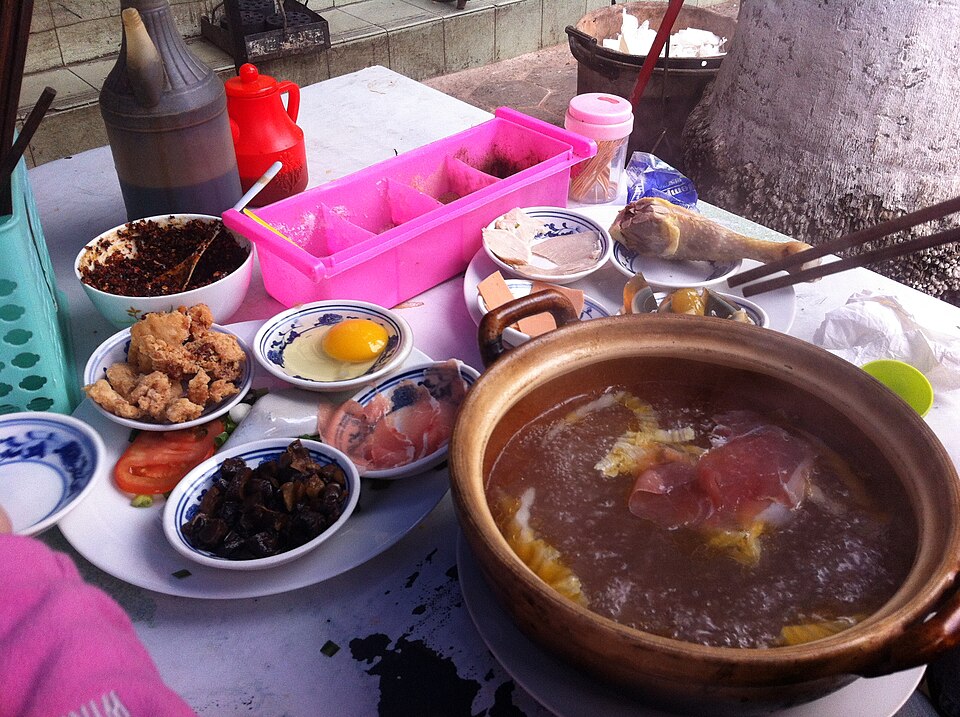
Scalding chicken broth served with raw toppings you cook yourself at the table, noodles last.
Cook in order: meats first, vegetables next, noodles last.

Pressed rice cake, grilled and folded around fillings or stir-fried with ham.
The grilled street version (shao erkuai) with sauce is the quick local breakfast.

Chicken steamed in a special clay pot so the broth forms from its own condensed juices.
Yunnan's comfort dish; drink the clear soup first before eating the meat.
The Yunnan dish is a bowl of scalding broth that arrives with raw toppings you cook yourself, in strict order: meats first, vegetables next, noodles last. A proper version runs ¥20-40 and the broth stays steaming to the end. Versions with everything pre-dumped are cafeteria shortcuts.
From roughly June to September, Yunnan eats wild mushrooms and talks about little else. Hotpot restaurants will time the boil and tell you when it's safe to eat; respect the timer, it exists because some species need real cooking. Out of season, 'wild mushroom' usually means frozen.
Langzhong →
✓ checked 2026-06-13Langzhong is a vinegar town. Baoning vinegar — a dark, slightly medicinal bran vinegar brewed here for centuries — is in everything, sold in bottles up and down the main lanes, and even turns up as a vinegar drink and vinegar-themed snacks. Taste before you buy a souvenir bottle; it's a real local product rather than a tourist invention, but the gift-boxed versions on the main street are marked up. A splash on noodles or cold dishes is how locals actually use it.
The town's signature cured beef, sold vacuum-packed everywhere as a gift — dark on the outside, red within, named for the general buried here. Like Pingyao beef, try a plate in a restaurant as a cold starter before you commit to boxes of it on the main street, where it's priced as a souvenir. Decent and genuinely local; you don't need the gift-box version to have tasted it.
The most reliable cheap meal here is a bowl of local beef noodles — hearty, a touch of Sichuan heat, and a few yuan in a busy local shop. Pick a place packed with locals over anything dressed up for tourists on the main lane, and finish it with a dash of that Baoning vinegar on the table; that's the Langzhong way to eat it.
Lanzhou →
✓ checked 2026-06-13This is the birthplace, and the bowl you've had abroad as 'Lanzhou ramen' is usually nothing like it. The local standard is summed up as yi qing, er bai, san hong, si lü, wu huang — one clear, two white, three red, four green, five yellow: a clear (never cloudy, never reddened) beef broth, white radish slices, a slick of red chilli oil floating on top, green garlic shoots and coriander, and bright yellow hand-pulled noodles. You order your noodle gauge at the counter, from hair-thin to wide and flat. Eat it for breakfast like a local, in a busy no-frills shop, not from a hotel menu — and a splash of vinegar at the end is the move.
Lanzhou isn't only noodles. Huidouzi (灰豆子) is a warm, slightly smoky sweet porridge of peas cooked down with rock sugar and jujube — a cheap street-stall classic that pairs oddly well with the morning beef-noodle bowl. Look for it alongside other local sweets like tianpeizi (fermented sweet rice). These are stall foods, a couple of yuan, found around the markets and the older streets rather than on any tourist menu.
The quality gap between a real Lanzhou noodle shop and the chain 'lamian' stalls you'll see elsewhere is enormous, and even in Lanzhou the tourist-strip and station versions are weaker. Follow the morning crowds to a busy neighbourhood shop, watch the noodles get pulled to order, and you'll eat one of China's great cheap meals for a handful of yuan. Mobile pay works everywhere; a translation app helps with the noodle-width choices.
Laojunshan →
✓ checked 2026-06-13Luanchuan is tofu country: local bean curd is held up as a classic of China's 'northern tofu' tradition, with a making technique that locals trace back to the Song dynasty and that's still done in village workshops across the county. It comes braised, stuffed, in clay-pot and in hotpot, and it's a genuine regional speciality rather than a tourist invention. Look for it in the restaurants around the foot of the mountain and in Luanchuan town, and pick a busy local place over anything inside the scenic gates, where you'll pay mountain prices for the same dish.
The area is known for hand-made noodles — including a local 'Tantou' style made entirely by hand through a multi-step milling, drying and pressing process with no additives, prized for a clear colour and a smooth, springy bite. You'll also see hearty shredded-pork noodle bowls sold around the mountain foot, the kind of cheap, filling, properly local food that's exactly right after a cold day up top. Point at what the next table is having if the menu defeats you.
Luanchuan markets itself as a summer cool-retreat, and the cooking matches: hearty western-Henan mountain fare, free-range chicken, river fish, mountain vegetables and mushrooms, the food of a place people come to escape the lowland heat. It's local and unfussy, with little in the way of Western food or English menus, so lean on a translation app. And carry some cash — up on the mountain and in the smaller villages, mobile-pay signal and card acceptance get unreliable, and a few notes save you a headache.
Leshan →
✓ checked 2026-06-13Leshan is a serious Sichuan food town. Bobo ji — cold poached chicken and vegetables on skewers, dunked in a numbing chilli-oil sauce and charged by the stick — is the local signature. Find a busy local shop in town rather than a stall by the Buddha gate, and pace yourself: the má-là numbing heat sneaks up.
Two more Leshan things worth hunting down: tianpi ya, a 'sweet-skin' roast duck glazed sweet-savoury, and qiaojiao niurou, beef and offal poached in a spicy broth at hole-in-the-wall counters. Both are cheap, local and better in the city than near the scenic area.
The restaurants right by the Buddha entrance charge a captive premium for ordinary food. Leshan city — a short ride or train stop away — is where the real Sichuan snacks are, at normal prices. Plan to eat in town before or after, not at the gate.
Lhasa →
✓ checked 2026-08-08
Brick tea churned with yak butter and salt into a rich, savory drink built for the high-altitude cold.
It is salty and buttery, not sweet; sip it slowly with tsampa as locals do.
Roasted barley flour kneaded with butter tea into small balls by hand, the Tibetan everyday staple.
Eaten with butter tea; mix and pinch it into a dough ball with your fingers.

Soft yellow wheat noodles in a hot yak-bone broth topped with a little yak meat and scallion.
A teahouse breakfast; the broth is mild, add the chili sauce on the table.
The everyday Tibetan trio: tsampa (roasted barley flour, mixed by hand with butter tea into a dough), momos (steamed or fried dumplings, yak meat or veg), and thukpa (hand-pulled noodle soup). Momos and thukpa travel well to a foreign palate; tsampa is more of an acquired, genuinely-local experience. All cheap, all everywhere in the old town.
Po cha (yak-butter tea) is salty and oily - polarizing, worth trying once, often not loved by visitors. The thing you'll actually keep drinking is sweet milk tea, served by the glass in Lhasa's tea houses, which are great cheap places to sit among locals. Order the sweet tea, brave the butter tea once for the experience.
Most 'beef' here is yak - in momos, dried into chewy jerky, stir-fried, or in stews. It's leaner and a little gamier than beef and it's the regional meat, not a novelty. Yak yogurt is also a real local thing, thick and tart, sold plain to sweeten yourself. Eat the yak; it's the honest local protein.
Lianyungang →
✓ checked 2026-06-13Lianyungang is a coastal port, and its honest food identity is seafood rather than anything monkey-themed. Out at Liandao and around the Lianyun harbour there are clusters of seafood restaurants where you pick from tanks — local fish, clams, crabs, conch, shrimp, the small shellfish of the northern Jiangsu coast — cooked simply so the freshness carries. As Wikivoyage warns, the ones with the best sea views are often overpriced and pushy on price, but there are so many of them that you can compare and bargain. Eat where the local families are eating, agree the price before they cook, and you'll do well.
The signature city dish is Huaguoshan goose (花果山凤鹅), a local braised/cured goose marinated with a long list of herbs — a genuine regional speciality you'll see sold as a gift food as well as on menus, not just a tourist gimmick. Pair it with the mountain's teas: Huaguoshan 'cloud-mist' tea (花果山云雾茶) is grown on the misty slopes and is the local cup worth trying, and Yuntai-mountain kudzu (arrowroot) starch is a traditional local product. These are the things actually from here, rather than the generic stuff on a景区 tourist menu.
If you want to eat like a local with an open mind, two northern-Jiangsu oddities stand out. Guanyun doudan (灌云豆丹) is a regional delicacy made from the larva of a moth that feeds on soybean plants — protein-rich, prized locally, and very much an acquired idea for most foreign visitors, but a real point of local pride. Guannan liangfen (灌南凉粉) is a cooling mung-bean jelly noodle, an easier and very refreshing summer snack. Neither is a tourist invention; both tell you more about the place than the themed snacks up the mountain.
Libo →
✓ checked 2026-08-09Libo eats like the rest of Guizhou: sour-and-spicy first, with a fermented sourness that's a regional signature rather than a gimmick. The dish to chase is sour-soup fish (酸汤鱼) — fish simmered in a tangy, chilli-spiked fermented broth — and you'll also see 'shrimp sour' hot pots and hot-and-sour soup set menus all over the county town. It's properly sour and properly spicy; if you don't take heat well, say 'not spicy' (bù là) when you order, but know that toning it right down flattens exactly what makes the food here worth eating.
Because Libo is 93% ethnic-minority, the local table leans Buyei and Shui: sticky glutinous rice in many forms, grilled river fish, and yangyu (芋头, taro) worked into hot pots and braises. The Mengliu Buyei-style night market by the Xiaoqikong east gate is the easy place to graze — grilled fish, glutinous-rice patties, barbecue skewers and rice wine — while the Yaoshan and Shuiyao ethnic townships out in the county serve the more authentic versions. Yao-style braised pork is a local standout; look for it at the bigger tourist restaurants near the scenic gates.
As everywhere in China's scenic areas, food inside and right beside the park gates runs pricier and more touristy than what you'll find a short ride away. The county-town sour-soup and hot-pot places (along the Tangdi Road and Lida Road area) are cheaper and more local for the same dishes, and the night market is for grazing and atmosphere rather than a proper sit-down meal. Use a translation app or just point at what's busy and looks good — you'll eat very well and cheaply, and the local rice wine and Guizhou's famous Maotai are everywhere if you want a drink.
Lijiang →
✓ checked 2026-06-11Naxi cured pork ribs stewed with tomato and mint; Lijiang's table dish.
Order vegetables to add to the pot as it cooks down.
A layered griddled flatbread, sweet or savory, from the local Naxi kitchen.
Eat it fresh and warm; the savory ham-and-scallion one travels best.
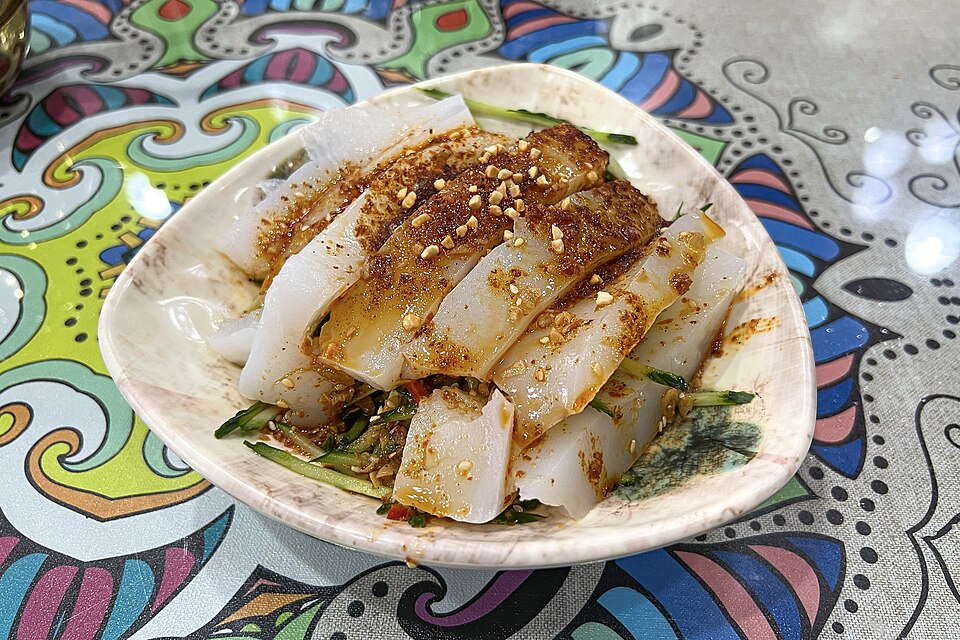
Cool grey chickpea jelly in chili and vinegar, or pan-fried into soft squares.
A Lijiang specialty; try it both cold and fried to see which you prefer.
The dish worth the table is laparigu hotpot: Naxi cured pork ribs stewed with tomato and mint. The flower cakes sold on every corner are airport gifts; buy one, not a suitcase. Yak jerky by the bag is mostly markup.
Canal-side cafes in the old town charge city-center-Shanghai prices for average pours. Two lanes uphill the same coffee is half price and the rooftop views are better. Same rule as everywhere: the prettier the seat, the worse the deal.
Linfen →
✓ checked 2026-06-13The Linfen signature to hunt down is niurou wanzi mian — a bowl of noodles in a spiced, often chili-tinged broth with springy beef meatballs. It's a local breakfast-and-anytime staple, cheap and warming, and it's genuinely a Linfen thing rather than a generic Shanxi noodle. Pick a busy local shop over anything aimed at tour groups and you'll eat well for a handful of yuan.
Shanxi does a fried glutinous-millet cake called yougao (油糕): little dough rounds, often filled with sweet bean or date paste, fried crisp on the outside and chewy within. It's a market and street-stall snack, slightly sweet, portable, and a regional taste rather than a tourist-menu item. Grab one hot from a vendor — they're best straight out of the oil.
You're in vinegar country. Shanxi aged vinegar (laochencu) is dark, mellow and on every table, and locals splash it generously on noodles, dumplings and cold dishes — do the same rather than treating it as a garnish. With a bowl of hand-pulled or knife-shaved noodles and a good dose of vinegar you've eaten the way southern Shanxi actually eats, for very little money.
Lishui →
✓ checked 2026-06-13Lishui is inland, mountainous Zhejiang, so the food is hill-country fare rather than the seafood-and-sweet style of coastal Hangzhou or Ningbo. Think free-range mountain chicken, river fish from the streams, bamboo shoots, wild vegetables and dried/preserved goods that suit a damp, forested region. It leans earthy and savoury. Eat where the locals eat — a busy neighbourhood restaurant or the food courts around Western Plaza or Wandi Plaza in the city — over anything dressed up for tourists inside the scenic areas, where you pay more for less.
Under its old name Chuzhou, Lishui has its own local plates worth seeking out: look for lotus-and-brown-sugar style desserts and porridges, hearty braises, and the preserved-meat dishes that mountain Zhejiang does well. Each county has its own things — the prefecture even runs to a mushroom culture out in Qingyuan, which has a museum devoted to the local shiitake-growing tradition. Point-and-order with a translation app is the move; menus are Chinese-first and English is rare once you're outside a hotel.
Lishui sees very few foreigners, so the dining is solidly local. That's a plus if you came to eat regional food, but if you need Western dishes or English menus you'll mostly find them in the bigger city hotels or a handful of expat-leaning spots (there's a known craft-beer joint near the city riverfront). Two practical notes that bite here more than in big cities: international cards are often refused, so carry cash for meals, and the tap water isn't potable — drink bottled or boiled.
Liupanshui →
✓ checked 2026-06-13The dish to seek out is Shuicheng yangrou fen (水城羊肉粉), mutton/lamb rice-noodles in a rich, peppery broth with sliced mutton on top — a Guizhou breakfast-and-anytime staple that Shuicheng (the district that's part of Liupanshui) is locally famous for. It's cheap, warming and exactly right for the cool highland mornings. Pick a busy local noodle shop over anything dressed up for tourists; the plain, packed ones do the best bowl.
Two more local plates: luoguo (烙锅), a Liupanshui-style griddle where you cook skewers and vegetables on a hot iron plate at the table, and luoguo yangyu (烙锅洋芋), griddled potatoes — Guizhou is potato country and does them small, crisp and dusted with chilli and spice. Shuicheng laoguo (水城烙锅), the local griddle-hotpot, is recognised as a local cultural speciality. It's social, cheap and very much a local-eats experience rather than a tourist menu.
Underneath the local dishes you're eating Guizhou food, which means sour-and-spicy (酸辣) rather than the pure numbing heat of Sichuan: fermented-sour soups, pickled chillies, and that distinctive tang from sour-soup (酸汤) bases woven through the cooking. It's a defining regional character, not a single dish, and it's genuinely different from the Sichuan food most visitors expect from southwest China. If you don't take chilli well, say 'not spicy' (bù là) when you order — it's understood — but know the local default is properly hot and sour, and that's the point.
Liuzhou →
✓ checked 2026-06-13Liuzhou is the birthplace of luosifen (luósīfěn, 螺蛳粉) — snail rice noodles — the dish that went viral across China and turned into a packet-noodle phenomenon. Eating it fresh at the source is the single best reason to be here. It's rice noodles in a deep, sour-spicy broth simmered with river snails, loaded with pickled bamboo shoots, peanuts, fermented tofu, wood-ear and a fierce chilli kick. Cheap, fast, everywhere, and far better than any packet version. Find a busy local shop and order it fresh.
The smell is real and it's notorious: the funk comes from the pickled bamboo shoots (suan sun), not the snails, and it hits before the bowl arrives. Locals love it precisely for that sour-fermented punch. Don't let the aroma scare you off — that pungent broth is exactly what you came to try, and the taste is more savoury-sour-spicy than 'bad'. If you can eat strong fermented food anywhere, you can eat this.
Once you've done luosifen, Liuzhou's wider food leans into Guangxi river-and-rice cooking: rice noodles in other guises, river fish, and the snacks of the surrounding Zhuang and Dong areas if you head out to Sanjiang. You'll also find the regional 'oil tea' (youcha) of the northern hill minorities — a savoury, slightly bitter tea-broth poured over puffed rice and bits, an acquired but genuinely local taste. Eat where the locals queue and use a translation app on the menus.
Longhushan →
✓ checked 2026-06-13The thing to eat around Longhushan is Shangqing tofu (上清豆腐) — bean curd from Shangqing town, prized for a smooth, springy texture locals credit to the local water, and cooked braised, stuffed or in clay-pot. It's a genuine regional speciality rather than a tourist invention. You'll find it in the restaurants of Shangqing old town and at No Mosquito Village (无蚊村), where most houses have turned into eateries — though, as everywhere here, prices inside the park run higher than outside the north gate.
The other plates to look for are 'Celestial Master' chestnut braised free-range chicken (天师板栗烧土鸡) — local chicken slow-cooked with chestnuts, a dish tied to the Taoist-master mythology of the mountain — and the small freshwater fish pulled from the Luxi River, usually cooked simply so the freshness carries. Both are local Jiangxi mountain fare, hearty and worth ordering over anything generic on a tourist menu.
You're in Jiangxi, and the cooking leans genuinely hot: fresh chilli and pickled-chilli heat woven through the braises and stir-fries, not just a sprinkle on top. It's a defining character of the food here rather than a single dish. If you don't take chilli well, say so when you order — 'not spicy' is understood — but know that the local default is properly spicy, and toning it down can flatten the dishes that are worth coming for.
Longyan →
✓ checked 2026-06-13Hakka cooking is the reason to eat here, and its signature is the tofu — silky bean curd served braised or, classically, stuffed (niang doufu / 酿豆腐), pockets of tofu filled with minced pork and steamed or pan-fried. It's homely, savoury comfort food that's genuinely regional rather than a tourist invention. You'll find it in the restaurants around Hongkeng and in Longyan's walking-street eateries; village places will stir-fry whatever meat and veg look good, often slaughtering the chicken on the spot for freshness.
The other dish to seek out is the local beef ball — hand-pounded, springy, bouncy beef meatballs served in a clear soup, a Hakka and wider Fujian speciality that's a world away from a soft Western meatball. Hakka beef-ball soup turns up on most local menus around the tulou and in Longyan city. Pair it with the Hakka bamboo dishes (some find the fermented bamboo smelly at first — push through, it grows on you) for a properly regional spread.
Hakka kitchens do chicken well — look for salt-baked or salt-buried chicken, and slow-cooked free-range birds, the meat firm and flavourful. In the villages, the default is a no-menu country meal: point at the fresh vegetables and meat on display and they'll stir-fry it in plenty of oil, usually for not much money, though restaurants right inside the touristy clusters charge several times more for the same food. Wash it down with the local homemade glutinous-rice wine (nuomijiu / 糯米酒) — most tulou brew their own, and you'll often be offered a taste; it's sweet and deceptively strong. Fujian is also serious tea country, so expect to be poured oolong or Tieguanyin almost everywhere you sit down.
Loudi →
✓ checked 2026-06-13You're in the heart of Hunan, one of China's eight great regional cuisines and one of its spiciest, and the cooking here doesn't dial it down for visitors: fresh and pickled chilli are woven through the braises and stir-fries, smoked cured pork (腊肉) turns up in everything, and 'a little spicy' on a local menu is not what you think it is. If you don't take chilli well, say 'bù là' (not spicy) when you order — it's understood — but know the local default is genuinely fiery, and toning it all the way down can flatten the dishes worth ordering.
The signature of Xinhua, the county the terraces sit in, is san he tang (三合汤) — a hot, sharp, peppery soup built from beef or its offal, blood and a heavy hit of local chilli and Chinese prickly-ash, eaten scalding and meant to wake you up. It's a true regional speciality rather than a tourist invention, and the cold mountain air at Ziquejie is exactly when you'll want it. Around the terraces you'll also see the local Shuiche cured pork (水车腊肉), claypot 'jar' steamed pork with rice flour (坛子米粉肉), loach-and-tofu, snowflake meatballs (雪花丸子) and glutinous rice cakes (糍粑) — order off what the farmstay kitchens are actually cooking that day rather than a printed menu.
The thing the terraces actually produce is the thing to eat: the local rice — including red, purple and black heirloom varieties grown on the hill — is the regional point of pride, and it shows up alongside genuinely free-range mountain chicken, river fish set into a cold 'fish jelly' from the spring water, wild fern shoots and konjac. It's hearty upland Hunan home cooking, not refined restaurant food, and it's best eaten at the farmstays (农家乐) up at Ziquejie or in Shuiche town, where it's local and cheap. Prices inside or right at the scenic area run higher than in the towns below, as everywhere.
Lu'an →
✓ checked 2026-06-13Lu'an's single most famous export is a tea: Lu'an Guapian (六安瓜片), literally 'Lu'an melon-seed slices', counted among China's ten most famous teas. It's an unusual green tea made only from the leaf — no bud, no stem — so the flat, deep-green pieces look like melon seeds, grown in the Dabie Mountain belt of western Anhui around Jinzhai and Huoshan. This is the place to drink it at source and to buy it as a gift; spring (pre-Qingming and just after) is the prized picking. Be a little wary of roadside 'authentic Guapian' at tourist prices — buy from a reputable tea shop in town or a known producer rather than the first stall at the gate, and taste before you commit to a tin.
Up in the Dabie hills the cooking is hearty mountain-farmhouse fare, served at the 农家乐 (farmstay restaurants) around the gates. Look for wild mountain vegetables and bamboo shoots foraged in season, freshwater fish and crayfish from the reservoirs and streams (Wanfo Lake fish is a local point of pride), free-range chicken slow-cooked in clay pots, and the Anhui habit of smoking and curing pork and bean curd. It's honest, generous, not fussy — and far better value and more local than anything on a polished tourist menu. Order what the farmstay is actually cooking that day rather than a printed menu, and you'll eat well.
Don't expect the chilli wall of a Hunan or Jiangxi meal. Anhui cuisine (Huizhou cooking is its famous southern branch) leans instead on fermenting, smoking, curing and braising, with stronger, funkier flavours than heat — the province's signature oddity is 'hairy tofu' (毛豆腐), a fermented bean curd grown furry with white mould and then pan-fried, which is a lot better than it sounds. The Dabie-region food up here is its own rustic, mountain version rather than refined Huizhou banquet cooking, but the same logic holds: the bold flavour comes from curing and fermenting, not from a pile of dried chillies.
Luoyang →
✓ checked 2026-08-08The breakfast institution: beef soup with flatbread torn in, from shops that do nothing else.
Before 9am; tear the bread small and add chili oil.
A long parade of soupy dishes served one after another, a Luoyang banquet tradition.
Go with a group and order the set; the "false sea cucumber" soup is the famous one.
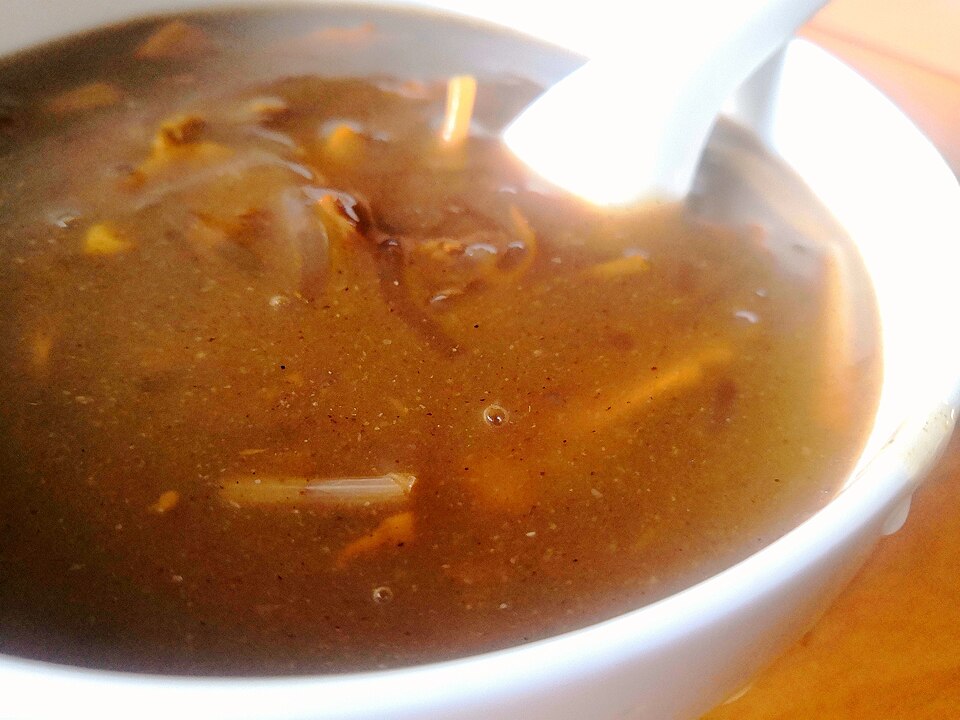
A thick, peppery breakfast soup with wheat gluten, meat and a vinegar kick.
A Henan morning standard; eat it with a fried flatbread dipped in.
Luoyang breakfast is a bowl of beef or lamb soup with flatbread torn in, served from shops that have done nothing else for decades. Locals argue about which one matters the way other cities argue about football. Go before 9am, pay around ¥10-15, add the chili oil.
The famous 'water banquet' is a parade of soupy banquet dishes with a thousand-year backstory. It's worth experiencing once at a proper restaurant, ordered as a half set for two people. Ordering the full set solo is how you end up with twelve bowls of warm regret.
Lushan →
✓ checked 2026-06-13The local specialities share a 'stone' name: stone fish (石鱼, tiny river fish), stone ear (石耳, a black mountain fungus a bit like wood ear), and stone chicken (石鸡, actually a mountain frog). They turn up stir-fried, in soups and in egg dishes all over Guling. They're the genuine regional thing rather than a tourist gimmick — order at least one and you've eaten Mount Lu properly. Lushan cloud-mist tea (云雾茶) is the matching drink.
You're in Jiangxi, one of China's quietly spicy provinces — not numbing Sichuan heat but a direct fresh-chilli burn that surprises people who expected mild. Expect plenty of dried and fresh chilli in the stir-fries and braises. Say so if you want it toned down, but a little heat is part of eating here, and the local pork and freshwater dishes carry it well.
Guling town is where you'll eat on the mountain, and the small restaurants there do the local dishes well. As with any mountain-top settlement, prices are higher than down in Jiujiang and the spots right on the main tourist strip lean pricey for what they are. Walk a street back from the busiest stretch, pick somewhere full of locals, and you'll eat the Three Stones for a fairer price.
Ma'anshan →
✓ checked 2026-06-13The one genuinely local thing to seek out is Caishiji dried tea (采石矶茶干 / 'chá gān') — pressed, seasoned dried tofu, dark red and chewy, flavoured with things like chicken stock, star anise, cinnamon and osmanthus. It's a Qing-era specialty with a couple of centuries of history behind it, sold packaged all over the city, and it makes a cheap, very portable edible souvenir. Buy it as a snack for the train; it travels far better than anything you'll eat hot.
Ma'anshan sits where Anhui (Hui) cooking blends with neighbouring Jiangsu flavours, and being a Yangtze port, freshwater fish is the thing to order — locals prize dishes like the fish heads from Xuejiawa, and river fish cooked simply so the freshness carries. You'll also see hearty local plates like old-goose soup (老鹅汤), famously cooked near Taihu Mountain. Order the river fish and a soup over anything generic; this is where the city quietly eats well.
Ma'anshan barely sees foreign diners, so don't expect English menus or a Western-food scene outside the bigger hotels — and that's fine. The food streets (Gu Street and the busy restaurant clusters in the residential districts) are where the real eating happens, cheaply. Use a translation app, point at what looks good, and skip the marked-up stalls inside the Evernight City night street unless you just want a snack with the lights. Osmanthus is the city flower and turns up in sweets in autumn — worth trying if you're here in season.
Meizhou →
✓ checked 2026-06-13If you eat one thing in Meizhou, make it salt-baked chicken — a whole chicken cooked buried in hot salt until the skin goes golden and the meat stays juicy and faintly savoury-sweet. It's the most famous Hakka dish and it travels (you'll see it sold across China), but this is its home turf, so have the real thing here. Order it at a proper Hakka restaurant rather than a tourist counter and it's a different animal.
Two more Hakka staples worth seeking out. Yong tau foo (酿豆腐) is tofu blocks pocketed with seasoned minced pork — the story goes that Hakka migrants who couldn't get wheat flour for dumplings stuffed tofu instead, and it stuck. Meicai kourou (梅菜扣肉) is fatty pork steamed over the region's preserved mustard greens until it's meltingly soft; aim for a bit of meat and a bit of greens in each bite so the saltiness balances the richness. Both are home-cooking, not banquet show-pieces, which is exactly the point.
Beyond the headliners, eat like a local. Suanpanzi (算盘子) — 'abacus beads' — are chewy little taro-and-tapioca dumplings shaped like the discs of an abacus, stir-fried savoury, a properly Hakka texture you won't find everywhere. Breakfast in Meixian is yan mian (腌面), a bowl of dressed noodles with a side soup of goji leaf and pork. Wash it down with local Hakka tea (oolong or green) and, in season, the famous Meizhou pomelos that pile up in the village orchards from late summer. The food leans hearty and home-style; that's the regional character, not a flaw.
Mianyang →
✓ checked 2026-06-13The city's signature dish is Mianyang rice noodles — fine, soft rice vermicelli in a clear, long-simmered broth, topped with beef, tripe or a fried 'crispy' garnish, eaten most often for breakfast. Locals are genuinely attached to it, with a backstory tying it to a Three Kingdoms-era official, and it's a few yuan a bowl at any busy local noodle shop. It is not the same as Sichuan's better-known dan dan or 'small noodles' — it's a distinct, lighter, broth-forward style. Have it in the morning at a packed neighbourhood place rather than a tourist spot, point at what others are eating, and ask for it as la (spicy) or not to taste.
Alongside the noodles, look for guokui (锅盔) — a crisp, layered griddle-baked flatbread, sometimes split and stuffed with marinated or cured meat — sold from small street stalls all over town. For a proper graze, head to a snack street such as Majiaxiang (马家巷): skewers, spicy hot-pot bowls, cured-meat skewers and a wide spread of cheap small eats, busiest and best late in the evening. Share dishes to try more, pick the standardised, hygienic-looking stalls, and reckon on a very modest spend for a full meal of snacks.
Mianyang is northern Sichuan, so the default cooking leans on chilli and the numbing Sichuan peppercorn (the mala tingle), in hotpot, stir-fries and braises. If you don't take heat well, say bu la (not spicy) when you order — it's understood — but know that toning it all the way down flattens the dishes worth coming for. Mianyang has a small foreign-food and Western-cafe scene downtown (you'll find Western dishes, coffee and the odd pub near Iron Ox Square and the riverwalk), but the local Sichuan food is the reason to eat here, and it's cheap and good.
Mingyueshan →
✓ checked 2026-06-13You're in Jiangxi, which has a reputation for the spiciest cooking in China, hotter even than neighbouring Hunan. The chilli here — fresh and pickled — is woven through the braises and stir-fries, not sprinkled on top. It's a defining character of the food rather than one dish. If you don't take chilli well, say 'not spicy' (bù là) when you order; it's understood, though toning it right down can flatten the dishes that are worth coming for. Around Mingyueshan and Wentang the cooking is hearty mountain Jiangxi fare, and it will not be shy with the heat.
The local cooking leans on what the hills and forest provide: free-range chicken slow-braised in clay pot, bamboo shoots (fresh in season, and dried the rest of the year) cooked with pork or in soups, river fish, and mountain greens. The bamboo shoots in particular are a genuine local product of the bamboo seas on the slopes, not a tourist add-on. Look for these in the family restaurants of Wentang town rather than ordering anything generic, and expect prices inside the scenic area to run higher than down in town.
Down in Wentang's town centre, around the public hot-water channel, you'll find eggs and other bits cooked or kept warm in the mineral spring water — a small local ritual tied to the hot springs the town is built on. It's cheap, it's a snack rather than a meal, and it's the kind of genuinely local thing worth trying while you soak your feet. Pair it with a wander of the town's hot-spring street rather than treating it as a sit-down meal.
Mudanjiang →
✓ checked 2026-06-13Mudanjiang is solid Northeastern (Dongbei) eating: big, hearty, generous plates built for the cold. Look for guo bao rou (锅包肉), the sweet-and-sour fried pork that's a regional signature, di san xian (三鲜, braised potato, aubergine and pepper), and the classic 'pork stewed with vermicelli and sauerkraut' (猪肉炖粉条酸菜). Portions are large and meant for sharing — order fewer dishes than you think you need. Pick a busy local restaurant in the city over anything inside a tourist site, where it's pricier for the same food.
The defining winter ingredient up here is suancai (酸菜) — Northeastern fermented cabbage, tangier and softer than the German kind, born of the need to preserve vegetables through a long frozen winter. It turns up in pork-and-vermicelli stews, in dumplings, and in suancai bai rou (酸菜白肉) with sliced pork belly. It's the taste of a Heilongjiang winter table and worth seeking out rather than avoiding — it cuts the richness of all the meat.
This corner of Heilongjiang has a sizeable ethnic-Korean (Chaoxianzu) population, and the food shows it: cold buckwheat noodles (lengmian / naengmyeon), Korean-style barbecue, kimchi, glutinous rice cakes and spicy stews sit comfortably alongside the Han Dongbei staples. A Korean-Chinese cold-noodle house is a genuinely local choice, not a tourist gimmick, and a good counterpoint to all the heavy braises — especially welcome in summer.
Out at Jingpo Lake, the thing to eat is the freshwater fish pulled from the lake itself — often a whole fish cooked simply, braised or in a clear soup, so the freshness carries. It's the local speciality of the lakeside restaurants and a fitting meal after the waterfall. As everywhere at a scenic spot, ask the price before you order, since fish is usually sold by weight and lakeside tourist pricing can climb.
Nalati →
✓ checked 2026-06-13Out here the food is Kazakh-Uyghur borderland fare, and on the pastures it narrows to the essentials: lamb and naan. Naan (nang) — the big chewy bread baked stuck to the side of a tandoor — comes with every meal, sells fresh and warm for a couple of yuan, and is built to travel for a long grassland day. Lamb is the protein in every form: cumin-heavy skewers off a street grill, big-plate boiled mutton, or hand-pulled laghman noodles. On the grasslands you'll often eat what a herding family is cooking rather than off a menu, so go where the locals are and point at what's coming out of the oven or off the fire.
Up on the Kazakh pastures the table turns to dairy and horse. Look for nai geda (奶疙瘩) — hard, intensely sour dried-milk curds the herders carry — fresh yoghurt, milk skin, and butter-rich naan; they're an acquired taste but the genuine article. The other grassland speciality is horse-meat sausage (kazy / 马肠子), a cured Kazakh sausage that turns up sliced cold or in a noodle dish, especially around festivals. This is herder food, not a tourist menu, and a grassland family's table is where you'll meet it at its best — say yes when it's offered.
Three regional drinks are worth knowing. Salted milk tea (奶茶) is the everyday grassland drink, poured all day in herders' yurts and the right thing to accept when offered. Fermented horse-milk (kumis / 马奶酒) is the classic Kazakh pastoral drink — tangy, fizzy, mildly alcoholic, and a genuine acquired taste. And kvass (格瓦斯), the bread-fermented soft drink you'll see bottled and on tap all over Ili, is a Russian legacy in this border valley and an easy, refreshing yes on a hot afternoon. None of these is a tourist gimmick; all three are everyday here, so try the milk tea and the kvass at least, and brave the kumis if you're curious.
Nanchang →
✓ checked 2026-06-13The city's signature breakfast is ban fen — rice vermicelli tossed cold with chili oil, peanuts, pickles and seasonings, eaten fast and cheap at corner shops. It's usually paired with a small clay-pot soup. Pick a busy local noodle shop with turnover over anything inside a tourist block; it's a one- or two-yuan-feeling everyday dish, not a sit-down event, and it's the most Nanchang thing you can eat.
Waguan tang is the other local fixture: small earthenware pots of soup — egg-and-meat custard, lotus root and rib, and the like — slow-steamed for hours over coals in a big communal pit. You order a little pot to go with your noodles. It's a genuine Nanchang street-food ritual, milder than the rest of the local table, and a good way to eat well for very little. Look for a shop with the buried-pot setup rather than a generic restaurant version.
Jiangxi food leans seriously spicy, sometimes outdoing its better-known neighbours, with fresh and dried chili used as a base rather than a garnish. 'A little spicy' will still bite. If you can't take heat, say bu la clearly and still expect some; if you can, this is good chili country. The local table is hearty, chili-forward and cheap — lean into it rather than hunting for Western food, which is thin on the ground outside the bigger hotels.
Nanjing →
✓ checked 2026-08-08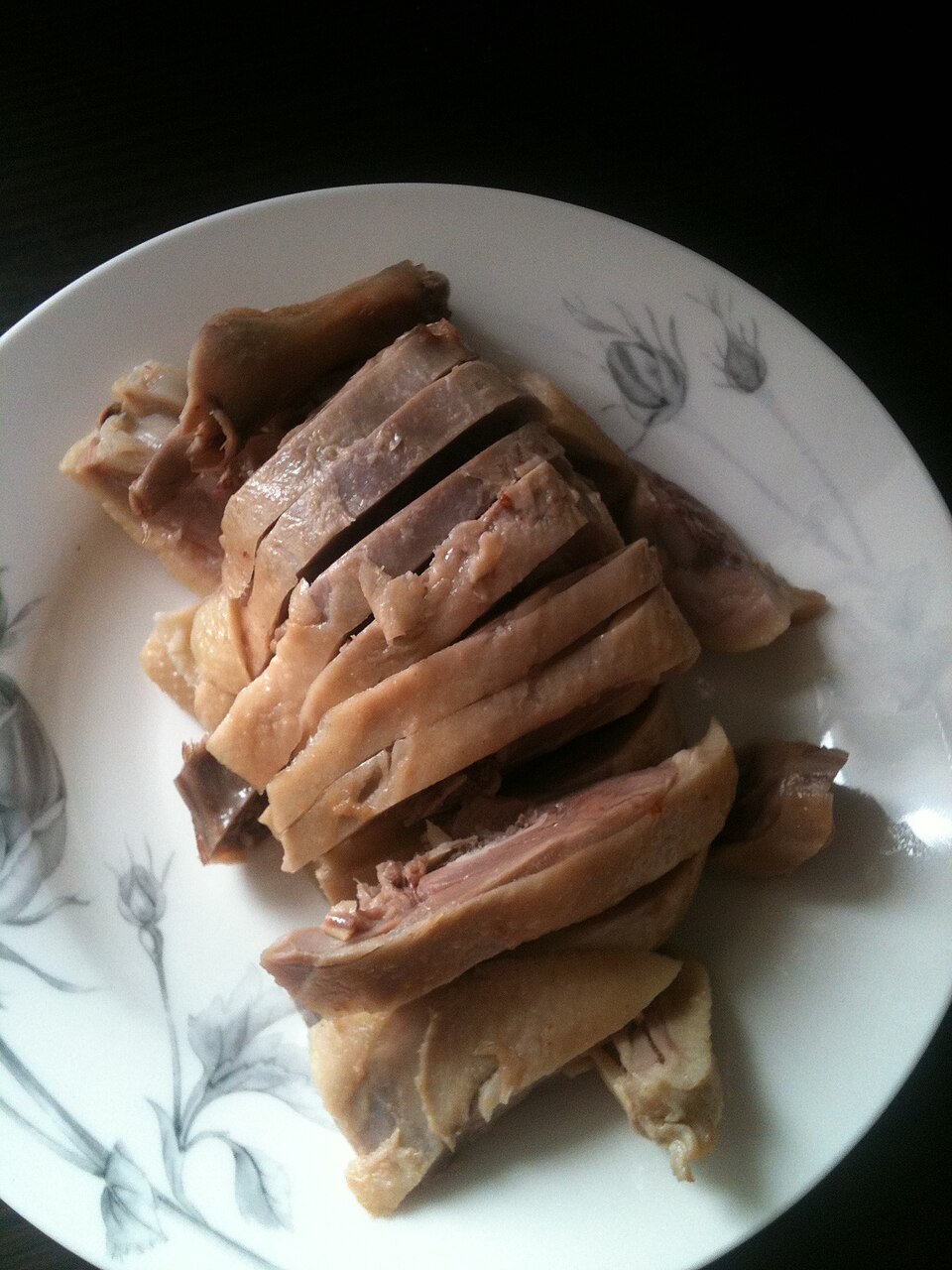
Nanjing's cold brined duck: pale, fragrant, nothing like roast duck.
Buy by the half from shops with a dusk queue.

Glass noodles in duck broth with tofu puffs and curd; better than it reads.
The everyman lunch; add chili oil to taste.

Large soup-filled dumplings, sipped through a straw before you eat the wrapper.
The crab-and-pork (xiehuang) version is the local pride; sip first, slowly.
Forget roast duck; here it's salted duck (yanshuiya), sold by the half from shops with queues at dusk, and duck blood vermicelli soup, which tastes far better than it reads. Both run cheap; the famous chains are fine but the neighborhood shops are better.
Nanjing's soup buns are bigger and soupier than Shanghai's. The straw is not a gimmick; drink first, then eat, or wear it. Confucius Temple area sells the photogenic version; the better ones hide in the lanes east of it.
Nanning →
✓ checked 2026-06-13Nanning's signature is laoyou fen (or laoyou mian) — 'old friend' rice noodles in a sour, spicy, garlicky broth sharp with fermented black beans, pickled bamboo and a hit of chilli. It's a cheap, pungent, wake-you-up bowl and very much a Nanning thing rather than generic Guangxi mifen. Find a busy local shop, order it fresh-fried (the chao version) if you see it, and don't judge it by the smell. This is the taste of the city.
Beyond the noodles, the dish to seek out is ningmeng ya — lemon duck — duck stir-fried with sour pickled lemon, ginger, garlic and chilli into something tangy and savoury that cuts through the heat. It's a Guangxi home-style classic done well around here. Order it for a table to share with rice; it travels less well as a solo dish, but it's a far better souvenir of the place than anything in a gift shop.
This is Zhuang heartland, so the food leans fresh, sour and herbal — rice noodles in many forms, sticky-rice and coloured-rice dishes, plenty of pickling and souring rather than heavy northern richness. Lean into it: the cheap local noodle shops and night-market stalls are where Nanning eats, and they're better and far cheaper than anything aimed at tour groups. A translation app and pointing at what's busy will get you a long way.
Nantong →
✓ checked 2026-06-13Nantong sits where the Yangtze meets the sea, and its cooking reflects that double larder: freshwater river fish and crab on one side, coastal sea fish and shellfish on the other. The local kitchen leans on this 'river-and-sea' bounty, cooked in the gentle, fresh-forward Jiangsu (Huaiyang) style that prizes the natural taste of the ingredient over heavy seasoning. Order the fish simply done and you're eating the thing the region is actually known for, rather than a generic tourist plate.
This is Jiangsu, so expect a soft, lightly sweet, delicate palate rather than chilli heat — knife-work, clear broths and careful braises. Nantong is associated with white-gourd (winter melon) dishes among its local specialities, and the everyday street food is good and cheap: 'maladang' (a build-your-own hot-pot bowl where you pick your veg and meat off the shelf and it's cooked for you) and savoury pancake rolls with egg, pickle and coriander are classic quick local meals for a few yuan. Point at what looks busy and you'll eat well.
Nantong has had a long-running foreign community tied to the port and the colleges, so you can find Western food — steaks, fish and chips, the odd bar-and-grill — more easily than in many cities its size. That's handy on a tired evening, but it's not why you're here. The river-and-sea fish, the Huaiyang braises and the cheap street bowls are the genuine article; save the Western menus for a fallback and spend your appetite on the local kitchen.
Nanxun →
✓ checked 2026-06-13Nanxun's old-town snack stalls do a hearty double-topping noodle and chewy 桔红糕 (rose-tinted glutinous sweets). Eat where the locals queue on the lanes rather than the first photogenic shop on the main drag, where you mostly pay for the view.
As in most Jiangnan water towns, the canal-front restaurants charge a view premium. Step a lane back and the same lake fish, river shrimp and noodles cost noticeably less, with menus aimed at locals rather than tour buses.
Nanyue Hengshan →
✓ checked 2026-06-13As a long-standing Buddhist-Taoist centre, Nanyue has a real tradition of temple-style vegetarian cooking — mushroom and tofu dishes, mock-meat braises, bamboo-shoot and mountain-vegetable plates — served around the Grand Temple and in the town's vegetarian halls. It's a genuine local speciality tied to the pilgrimage, not a tourist gimmick, and a welcome change from the heavier mountain fare. Eat it down in Nanyue rather than from the captive-priced stalls up the slope.
You're in Hunan, home of some of China's spiciest cooking — dried and fresh chilli, smoked pork, pickled and fermented heat run through the local dishes. If you don't want your mouth set on fire, learn to say 'not spicy' (bù là) and still expect a kick, because mild here isn't mild elsewhere. The upside: the local food in Nanyue town is bold, cheap and far better than anything sold up the mountain.
Everything sold partway up and near the summit carries the usual steep carry-up premium and a captive-crowd markup. The real eating is down in Nanyue at the foot — vegetarian halls near the Grand Temple, local Hunan restaurants and snack stalls at normal prices. Have your proper meal in town before you head up or after you come down, and carry your own water and snacks for the climb.
Ningbo →
✓ checked 2026-06-13Ningbo is the home of tangyuan — glutinous rice balls in a thin syrup, the classic filling being black sesame and lard — and you should eat them where they were invented rather than from a freezer back home. The other staple is Ningbo niangao (年糕), sliced rice cake stir-fried with greens and pork or in soup, chewy and comforting. Both are cheap, everywhere, and best at an old local shop near Moon Lake or Tianyi Square.
This is a port on a great seafood coast, and the local style leans into salted, fermented and 'stinky' preparations — salted fish, pickled crab, the famous raw marinated red-roe crab (红膏蟹/hongming xie) eaten cold. It's an acquired taste and not a tourist-menu thing; if you like it, this is the place to try it. Point at what the next table is eating at a busy local seafood restaurant rather than ordering off an English picture menu.
The Old Bund and the malls around Tianyi Square are pleasant but charge a premium for the setting. The better Ningbo food is in ordinary neighbourhood restaurants where the city's own office workers eat — fresher seafood, real niangao, half the price. Use a translation app, and treat the riverside bars as a place for a drink and the lights, not the main meal.
Nyingchi →
✓ checked 2026-06-13The one local dish to seek out is Lulang stone-pot chicken (鲁朗石锅鸡): free-range Tibetan chicken slow-simmered with medicinal herbs and often handmade matsutake or other mushrooms, cooked in a pot carved from local soapstone that's said to hold heat and minerals. It's hearty, warming and genuinely tied to the Lulang area rather than a tourist invention — the obvious thing to order if your itinerary stops in the forest-sea region, and a good reason to time a meal there.
Even in greener Nyingchi the everyday Tibetan food is the plateau standard: tsampa (roasted barley flour worked by hand into a dough with butter tea), yak in its many forms — in momos, dried into chewy jerky, stir-fried or stewed — and the two teas. Po cha, yak-butter tea, is salty and oily and polarizing, worth braving once for the experience; the sweet milk tea is the one you'll actually keep drinking. Most 'beef' here is really yak, leaner and gamier than beef, and that's the honest regional protein rather than a novelty.
Nyingchi's milder, forested climate gives it produce the high plateau doesn't have. It's prized matsutake-mushroom country — the wild fungus grows in the local primeval forest and is famous for its fragrance, sold fresh and dried in the Bayi farmers' markets in season (and it's expensive, so check the price). The other local specialty is Tibetan pork (藏香猪), small free-ranging highland pigs, often grilled or roasted whole so the skin crisps. Between the mushrooms, the pork and the stone-pot chicken, Nyingchi eats richer and greener than the rest of Tibet — lean into the local forest produce here rather than expecting a foreign-food scene.
Ordos →
✓ checked 2026-06-13This is mutton country, and the local signature is shou ba rou (手把肉, hand-grabbed mutton) — lamb boiled on the bone and eaten with a knife and your hands, plain and clean-tasting, the way the steppe does it. Roast lamb and lamb skewers are everywhere too. Eat it at a busy local restaurant in Dongsheng or Kangbashi rather than at a desert resort's set lunch, where it's cooked to a tour schedule and priced for a captive crowd.
The everyday drink here is suutei tsai: brick tea boiled with milk and salt, sometimes with fried millet or butter stirred in. It's salty, not the sweet milk tea you may expect, and it's offered to guests as hospitality, so try it as served before judging. The dairy in general — milk skin, dried curd, milk-based snacks — is the genuine local taste in this corner of Inner Mongolia, not a gimmick laid on for visitors.
For something cheap and filling away from the meat platters, look for menmian (焖面) — flat noodles braised in one pot over beans and a little meat until they soak up all the sauce — a homely northern staple that does the job after a cold, windy day at the dunes. As with the mutton, the honest local versions are in the ordinary noodle shops of Dongsheng, not the scenic-area food courts.
Panjin →
✓ checked 2026-06-13Panjin is crab country. The river crab raised in the wetland's flooded rice paddies is the dish the city is known for across China, and autumn — crab season — is peak time, conveniently the same window as the Red Beach colour. Locals eat it simply steamed so the sweetness carries, often alongside the rice. It's a genuine regional speciality, not a tourist invention; order it fresh at a local restaurant rather than settling for whatever's fastest near the scenic-area gate, where it'll cost more for less.
The other thing the city is famous for is its rice — Panjin rice is a prized grain grown in the same brackish wetland, and you'll literally see travellers hauling sacks of it home through the train and bus stations. Here it's not a side you ignore; a bowl of properly cooked local rice with steamed crab is the classic Panjin plate. It's the kind of regional staple that's genuinely better at the source, so lean into it rather than reaching for noodles.
Beyond crab and rice, the estuary delivers the rest of the table: clams and shellfish from the tidal flats and the Bohai shallows, and freshwater fish from the Liao River, usually cooked plainly so the freshness does the work. This is hearty northeastern Chinese (Dongbei) cooking at heart — generous portions, not much in the way of English menus or a foreign-food scene — so use a translation app, point at what looks good in a busy local place, and you'll eat well and cheaply.
Penglai →
✓ checked 2026-06-13The town's signature bowl is Penglai xiaomian (蓬莱小面) — thin hand-pulled noodles in a light, glossy seafood-stock gravy, often with a little fish or clam, eaten as a small breakfast portion. It's cheap, it's everywhere, and it's the thing to have first thing before the pavilion rather than a heavy sit-down. Pick a busy local shop over anything inside the scenic area, where it's pricier for the same bowl.
This is northern Shandong sea-food country: clams, sea snails, flatfish, the cold-water shellfish the Bohai strait does well. Eat it simple — steamed or quick-fried — and it's excellent. The catch is the tourist-strip habit of pricing seafood 'by the catty' and then weighing it loosely or swapping the fish; confirm the price per unit and watch the scale, or eat a few streets back from the scenic-area gate where locals do.
Penglai is small and sees few foreigners, so dining is solidly local — fresh seafood, noodles, northern home cooking. That's the point. If you need Western food or English menus you'll mostly only find them in the bigger hotels; otherwise use a translation app, point at what's good at a busy seafood place, and you'll eat very well for very little.
Pingliang →
✓ checked 2026-06-13You're in Gansu, the heartland of Lanzhou-style beef hand-pulled noodles (niurou lamian) — clear beef broth, hand-stretched noodles, chilli oil, a scatter of coriander and white radish. A proper bowl at a busy local Muslim-run noodle shop is the cheap, reliable, everywhere breakfast-or-lunch of the region, and Pingliang does it well. Pick a packed place over anything dressed up for tourists; the standard here is high and the price is low.
This is northwestern China, and lamb is done seriously — hand-grabbed mutton (shsouzhua yangrou), mutton soups, and skewers off the grill in the evening. The meat is good and the cooking is hearty to suit the climate, especially welcome after a cold day on the mountain. Order the mutton where you see locals eating it rather than off a generic menu, and you'll eat like the place actually eats.
Beyond the regional staples, look for the local specialities: Pingliang is known for a few of its own dishes and noodle styles, and over in Jingchuan county you'll find local country cooking tied to the farming villages along the Jing River. Don't expect a foreign-food scene or many English menus — Pingliang sees few foreign visitors and the dining is solidly local Gansu. Use a translation app, point at what looks good in a busy place, and you'll eat well and cheaply.
Pingyao →
✓ checked 2026-06-07Salt-cured then simmered beef, sliced cold; tender and fragrant, sold in nearly every shop in the old town.
Sold cold by weight and vacuum-packed as a gift; try a slice before buying a box.
A firm steamed flour jelly cut into strips and dressed cold with vinegar, garlic and chili oil; an old Pingyao snack.
Eaten cold and tart; a light bite to order alongside the beef.
The local specialty: cured, sliced cold beef, sold everywhere in vacuum packs as a gift and served as a cold starter in restaurants. Try a plate in a restaurant before you commit to buying boxes of it on the main street, where it's marked up as a souvenir. Decent and genuinely local, but you don't need the gift-box version.
This is Shanxi — noodle and vinegar country. Order the hand-pulled or knife-shaved noodles (daoxiao mian) and use the dark Shanxi aged vinegar (laochencu) on the table generously; locals do. A bowl is a few yuan and it's the most reliably good cheap meal in town.
Wantuo (碗托) is a local cold dish of set buckwheat or wheat 'jelly' cut into strips and dressed with vinegar, garlic and chili oil. Cheap street-snack stuff, an acquired texture, but it's genuinely a Pingyao thing rather than a tourist invention. Grab a bowl from a busy stall.
Pu'er →
✓ checked 2026-06-13This is the home of Pu'er tea (普洱茶), the fermented tea pressed into cakes that once rode the caravan routes to Tibet and Myanmar, and tasting it here is half the point of the trip. Learn the basic split: raw or 'green' Pu'er (生普) is unfermented, brighter and more astringent young, mellowing and sweetening as it ages over years; ripe Pu'er (熟普) is deliberately wet-fermented to a soft, earthy, woody cup that's easy to drink straight away. City tea shops will happily sit you down for a proper gongfu tasting across several steepings — accept, take your time, and buy a cake only after you've tasted, since quality and price vary wildly.
The everyday eating here is solid Yunnan fare. Crossing-the-bridge rice noodles (过桥米线) — rice noodles you cook at the table in a bowl of scalding broth with thin-sliced meats and vegetables — are a Yunnan institution and easy to find in Pu'er. The local cured speciality is Pu'er sausage, pork sausage air-dried and smoked in the region's mild climate until it's firm and fragrant, eaten with rice or as a snack. Both are cheap, local and a better bet than anything generic on a tourist menu.
Pu'er sits in a corner of Yunnan that borders Laos and Myanmar, and its food carries strong Dai and other ethnic-minority influence: sour-and-spicy flavours, grilled and pounded dishes, banana-leaf wrapping, fresh herbs you won't see further north. If you visit a Dai village or hit the water-splashing festival season, the hospitality and the food are a highlight in their own right. Yunnan is also famous for wild mushrooms in the summer rainy season (roughly June to September here, when most of the year's rain falls) — if you see a wild-mushroom hotpot or stir-fry on offer in season, it's a regional treat, though always eaten cooked-through and from a place that knows its fungi.
Putuoshan →
✓ checked 2026-06-13The monasteries serve simple Buddhist vegetarian food — noodles, tofu, vegetables, mock-meat — and eating a temple meal here is part of the pilgrimage experience, cheap and authentic. The bigger temples have dining halls open to visitors at set times; it's the most fitting thing to eat on the island.
Zhoushan is one of China's great seafood regions, and back on the mainland side (Shenjiamen, Zhujiajian) the fish markets and seafood restaurants are superb — crab, shellfish, fresh catch. On Putuoshan itself, vegetarian dominates near the temples; save the big seafood feast for the Zhoushan side of the trip.
Because everything is ferried in, food and water on Putuoshan cost more than on the mainland. Carry some snacks and water from the Zhoushan side, and treat island meals — especially the temple vegetarian ones — as part of the experience rather than a budget choice.
Qiannan (Duyun) →
✓ checked 2026-06-13Duyun eats like the rest of Guizhou: sour-and-spicy first, with a fermented sourness that defines the province's cooking rather than being a gimmick. The dish to chase is sour-soup fish (酸汤鱼) — fish simmered in a tangy, chilli-spiked fermented tomato-and-rice broth — and you'll find sour hot pots and hot-and-sour rice-noodle bowls all over the city. It's properly sour and properly spicy; if you don't take heat well, say 'not spicy' (bù là) when you order, but know that toning it right down flattens exactly what makes the food here worth eating. Street barbecue (烧烤) in the evening and rice noodles by day are the cheap, reliable everyday eats.
Qiannan is a Buyei and Miao autonomous prefecture, and the minority table shows up in the food: lots of glutinous (sticky) rice in many forms — steamed, in coloured 'five-colour' rice, in patties — alongside grilled river fish, cured and preserved meats, and the pickled, fermented sour flavours the Buyei and Miao kitchens lean on. Out in the villages and tea-country, look for home-style cooking and rice wine rather than a tourist menu. It's hearty, sour-leaning mountain food; graze it at busy local places and night-market stalls rather than the polished restaurants on the rebuilt old-town strip, which run pricier for the same dishes.
Duyun's real edible-and-drinkable claim to fame isn't a dish, it's a tea: Duyun Maojian (都匀毛尖), a fine downy green tea counted among China's ten most famous teas, grown on the misty hills around the city. Sit in an old-town tea house and have it brewed properly, or — better — head out to the Luosike (螺蛳壳) tea mountains in spring picking season to taste and buy it at source, where it's fresher and cheaper than a city tourist stall. Guizhou's famous Moutai (Maotai) liquor and local rice wine are everywhere too if you want a drink, but Maojian is the thing that's genuinely of Duyun — don't leave without a cup.
Qingdao →
✓ checked 2026-06-11Stir-fried local clams with a bag or pitcher of unpasteurized Tsingtao, the Qingdao table default.
Fresh 'raw' beer is sold by weight; drink it the same day.
Plump boiled dumplings filled with mackerel or pork, a Qingdao home staple.
The mackerel (bayu) filling is the local one; order them boiled, not fried.
Small clams stir-fried with chili and garlic, the standard partner to draft beer.
Order with fresh draft from a bag; locals call the pairing "ha pi jiu".
The city meal is gala (clams) stir-fried with chili, plus fresh beer. Yunxiao Road and the streets behind the brewery do it for ¥20-40 a plate. The clams should taste of the sea, not the sauce; if everything arrives drowned in chili paste, you've found a tourist kitchen.
Tuandao market sells the morning catch, and the nearby stalls will cook what you buy for a small fee. It's the cheapest seafood education in the city. Agree the cooking fee per dish before handing anything over.
Qinhuangdao →
✓ checked 2026-06-13Qinhuangdao is a working port, and the eating leans on Bohai-Sea seafood — clams, sea snails, small crabs, flatfish, prawns, often steamed or stir-fried without much fuss. Pick a busy local seafood place over the obvious tourist spots inside the Shanhaiguan old town, where you'll pay more for the same plate. Ask the price by weight before you order so the bill doesn't surprise you.
In summer, Beidaihe runs on holiday-resort food: grilled skewers, seafood barbecue, cold beer and ice on the seafront, plus the usual northern-Chinese staples. It's cheerful and cheap if you eat where the domestic holidaymakers do rather than at the most touristed beachfront stalls. Out of season a lot of it shuts, so don't count on the beach-food scene if you visit off-peak.
Away from the seafood, this is solid northern Hebei eating — dumplings, hand-pulled and knife-cut noodles, flatbreads and braises — cheap and everywhere across the Haigang district and around the stations. There isn't much of a foreign-food scene outside the bigger hotels, so use a translation app, eat at busy local places, and you'll do well for very little money.
Qinzhou →
✓ checked 2026-06-13Qinzhou farms oysters on a huge scale in its bays and runs an Oyster Festival every December (traditionally the first 1–28 of the month), so this is the place to eat them. The local style is straightforward and fresh: grilled over charcoal with garlic and chilli at the night stalls, or steamed and eaten plain to taste the gulf. Order them at a busy seafood place or a street grill rather than a tourist restaurant, point at what's on ice, and agree the per-jin price before they cook — fresh seafood is sold by weight and that's where bills surprise people.
Sitting on the Gulf of Tonkin, Qinzhou eats well from the sea generally — prawns, mantis shrimp, clams, crab and the day's fish, usually cooked plainly so the freshness carries rather than buried in sauce. The move is to pick a place where locals are eating, choose from the tanks and ice, and let them steam or quick-fry it. As with the oysters, settle the by-weight price up front. It's some of the best-value fresh seafood on this coast precisely because Qinzhou isn't a polished tourist town.
Like every Guangxi city, Qinzhou has its own rice-noodle culture — cheap bowls of fen for breakfast, a few yuan, found at busy local shops. The city is also known for its pork-and-vegetable 'horse-foot cakes' and other local snacks, and you'll see Beibu Gulf fish-paste and seafood worked into the street food. Skip anything aimed at tourists and eat where the queues are: a noodle bowl plus a plate of grilled oysters is the honest Qinzhou meal, and it costs very little.
Quanzhou →
✓ checked 2026-06-07
Fine rice vermicelli cooked into a thick savory broth with shrimp, oysters and clams, a Quanzhou breakfast.
Point at the add-ins (offal, fritters) you want stirred in; they price by what you add.

Duck braised in a claypot with a heavy hand of old ginger and rice wine; warming and strongly gingery.
A Minnan cold-season dish, ordered to share; the broth-soaked ginger is part of the point.

Marine sandworms boiled down and set into a clear savory jelly, eaten cold with a dip; a Quanzhou curiosity.
The worms are nearly tasteless, it is the texture; eat it with the garlic-vinegar sauce.

A soft fresh wrapper rolled around pork, vegetables, tofu and oysters, finished with peanut powder; an unfried spring roll.
A festival and everyday snack here; eaten cold, not fried, so do not expect a crisp roll.
The signature dish: duck braised hard with aged 'mother' ginger and sesame oil over an open flame, warming and intense. The cluster of ginger-duck shops near Tumen Street and the Qingjing Mosque is the place to try it. Order a small one first - it's rich, and a half-duck goes a long way.
Breakfast or anytime: mianxian hu, fine wheat noodles cooked into a silky savory porridge with oyster, shrimp or pork offal, white pepper on top, a fried-dough stick on the side to dip. And the oyster omelette (o-a-tsian / haozai jian) - small local oysters bound with egg and sweet-potato starch, crisp-edged. Both are Minnan staples invented around here, both cheap, both better in a busy hole-in-the-wall than a tourist restaurant.
Quanzhou's eating is a graze, not a sit-down: pork-rib soup, vinegar-braised pork (curo/rougeng), peanut soup, tu sun dong (savory worm jelly - more pleasant than it sounds). Walk a food street like Xijie near Kaiyuan and order small from busy stalls. Per-item prices are low, so try a lot rather than committing to one big meal.
Qufu →
✓ checked 2026-06-13Qufu's claim to culinary fame is the elaborate banquet cooking that grew up to feed the Kong family and visiting emperors — ornate, lightly seasoned Shandong dishes with grand names. The full banquet versions in tourist restaurants are pricey and theatrical; you can taste the style more cheaply in ordinary local Shandong restaurants without the imperial markup.
Around the sights you'll find the honest everyday food of Shandong: wheat-flour jianbing (savoury pancakes), big steamed buns, braised dishes and plenty of garlic and scallion. A jianbing from a busy morning stall is the cheap, reliable breakfast before a day of courtyards.
The restaurants right by the Confucius Temple entrance charge a captive premium for ordinary food. Walk a few streets into the old town for the same Shandong dishes at local prices. The old town is small and the better, cheaper places are an easy stroll away.
Quzhou →
✓ checked 2026-06-13Quzhou's calling card is 'three heads and one paw' (三头一掌): rabbit head, duck head, fish head and duck paw (webbed foot), each braised and stir-fried in a blunt, mouth-numbing wall of chilli and spice. This is not mild Jiangnan cooking — Quzhou is famous across China for some of the fiercest heat in the east, closer in spirit to Hunan or Sichuan than to the sweet, delicate Zhejiang food people expect from the province. The rabbit head in particular is the local obsession: you gnaw the small bones for the spiced meat, beer in hand. If you take chilli well, this is the eating experience to seek out; if you don't, brace yourself.
The local default is properly, seriously spicy — chilli woven through the braise, not sprinkled on top — so toning it down is a real conversation, not a formality. 'Bu yao la' (no chilli) or 'wei la' (mild) is understood, but be aware that with the three-heads-and-a-paw dishes the spice is the dish, and stripping it out leaves something flat. If you're heat-shy, you'll do better ordering around them: Quzhou and the wider Quzhou countryside also turn out plenty of simpler local fare — freshwater fish, bamboo shoots, mountain vegetables, tofu and braised pork — that doesn't depend on the chilli onslaught. Pair the fierce plates with rice or a cold beer, and pace yourself.
Quzhou sees few foreign tourists, which is good news at the table: the food scene is solidly, unselfconsciously local, and the best rabbit-head and spicy-braise joints are busy neighbourhood places rather than anything aimed at visitors. Skip the polished restaurants attached to the scenic areas, where you pay more for a tamer version, and follow the crowds to a packed local spot in the city. Point at what looks good, use a translation app for the menu, and expect to eat very well and very cheaply. Out in Jiangshan and the country towns the cooking leans the same way — hearty, spicy mountain fare rather than refined provincial Zhejiang cuisine.
Sanmenxia →
✓ checked 2026-06-13The local set-piece meal tied to the Shanzhou sunken courtyards is the 'ten-bowl banquet' (十碗席) — a traditional folk feast of ten dishes served in bowls, the spread that courtyard families historically laid on for weddings and big occasions. It leans on braises, meatballs, stewed vegetables and the hearty loess-country cooking that suits the cave-dwelling life, and you'll find versions of it served right at the Shanzhou Underground Courtyards park and in restaurants around Shanzhou District. It's a genuine regional tradition rather than a tourist invention, and eating it on-site is part of the point of the visit.
Sanmenxia sits next to Luoyang and shares its food culture, so look for Luoyang cuisine here — much of it tied to the famous 'water banquet' tradition of soupy dishes. Two to try: liantang roupian (连汤肉片), tender sliced meat in a slightly sour, appetising broth, and hutu mian (糊涂面), a sticky, stomach-warming noodle. There are long-established Luoyang noodle houses in town serving this provincial-heritage cooking; it's the regional comfort food and a better bet than anything generic.
This is the Henan–Shaanxi–Shanxi tri-border, and the food shows it. Alongside Henan staples you'll find Shaanxi-leaning dishes like 'big plate chicken' (大盘鸡) — chicken braised with potatoes, peppers and wide hand-pulled noodles, hearty and meant for sharing — at long-running local specialist shops. It's a good pick when you want something filling and you've got a couple of people to split it. Henan's signature breakfast, hu la tang (胡辣汤), the peppery beef-and-bone broth, is also worth seeking out at a busy morning shop.
Sanmenxia is solidly local. There's one McDonald's, one Starbucks and a few KFCs, all in the downtown shopping malls, and that's about the extent of the familiar Western options. The dining is otherwise Henan and Shaanxi-border home cooking, which is the whole appeal. Use a translation app, head for busy noodle houses and local specialist restaurants rather than the malls, and you'll eat well and cheaply.
Sanming →
✓ checked 2026-06-13Sanming is the home of Shaxian snacks (沙县小吃) — the cheap, nationwide noodle-and-dumpling chain you've probably walked past in every Chinese city. Here you're at the source. The honest hits are the wontons (扁肉) in clear broth, the steamed dumplings, the peanut-butter-sauce mixed noodles (拌面) and the slow-cooked herbal clay-pot soups. It's everyday food, cheap and reliable, and a good safe default when you don't read the menu — point at the wontons-and-noodles combo and you'll eat well for very little.
In Taining itself, look for the local specialities rather than generic tourist plates. 'Biyu' leek rolls (碧玉卷, basically a leek-and-rice-flour rolled pancake) are the famous Taining snack, tied to a local imperial-scholar legend; xiancao 'grass jelly' (仙草/凉粉) is the summer cooler everyone eats; and the small 'white-strip' fish (白条鱼) pulled from Golden Lake are deep-fried crisp and eaten with a salt-and-pepper or vinegar-garlic dip. These are genuine regional dishes you won't find back home, and worth ordering over anything that looks like a national chain menu.
Forget the coastal Fujian seafood image — this is the mountainous, inland, Hakka-influenced side of the province. The cooking leans towards braises, clay-pots, river fish, bamboo shoots, dried and preserved vegetables and hearty rice-and-glutinous-rice cakes (the locals pound glutinous-rice ciba for weddings and festivals). It's homely, filling country food. There's almost no Western-food scene out here, and English menus are rare, so lean on a translation app, eat where the locals eat, and treat the lack of a tourist-food machine as a feature.
Sanqingshan →
✓ checked 2026-06-13Food on the mountain is available but pricey — the major hotels have restaurants, and away from them it's small huts selling instant noodles, snacks and fried chicken at altitude markup, since everything is hauled up. Eat a proper meal down in the hotel village or in Yushan town before you go up, and carry your own water and snacks for the trail rather than paying mountaintop prices.
This is Jiangxi, and the local food leans genuinely spicy — fresh chilli and pickled-chilli heat, not just numbing — alongside hearty mountain fare. Look for dishes built on local bamboo shoots (fresh in season, dried the rest of the year) and freshwater fish, cooked plainer and hotter than the sweeter eastern-China style. If you don't take chilli well, say so when you order; 'not spicy' is understood, but the default here is hot.
Around the spring tomb-sweeping season you'll see qingmingguo (清明粿) — soft green dumplings of glutinous rice flour tinted and flavoured with mugwort or similar wild greens, stuffed sweet or savoury. It's a regional seasonal snack rather than a year-round restaurant dish, so grab one from a market stall or village shop if you're there in spring.
Sanya →
✓ checked 2026-06-07Soft rice noodles with fish-cake slices, peanuts and pickles in a pork-and-sea-snail broth, Sanya's own noodle.
Named for the old fishing port of Gangmen; a fresh-seafood broth, best at a dedicated shop.
Hainan's pale poached free-range chicken, lightly cooked and served with a ginger dip; the island's top named dish.
Order it white-cut (bai qie) with the ginger-and-scallion sauce; the meat is meant to be plain.
A cold bowl of beans, lotus seed, barley and fruit in coconut milk or iced syrup, Hainan's hot-weather sweet.
The coconut-milk version is the local default; a cooling end to a beach-heat meal.
The fun way to eat here is buy-and-cook: pick live seafood at a market stall, pay a restaurant to cook it. The trap is the weighing. Insist on the per-jin price up front, watch them weigh, and confirm the cooking ('processing') fee per dish before you commit. Done right it's great value; done blind it's the most common Sanya rip-off.
Hainan's signature is poached Wenchang chicken - plain-looking, dipped in ginger-and-kumquat sauce, the point is the bird not the heat. It's one of the island's 'four famous dishes' along with Dongshan lamb, Jiaji duck and Hele crab. A local restaurant doing the chicken right beats any seafood tower for a real taste of the place.
In the heat, the local dessert is qing bu liang: a bowl of sweet beans, jelly, fruit and crushed ice in coconut milk, a few yuan from street stalls. Coconut shows up in everything here - coconut rice, coconut chicken hotpot, coconut candy - and it's actually local, not a tourist gimmick. Cheap, cold, everywhere.
Shanghai →
✓ checked 2026-08-08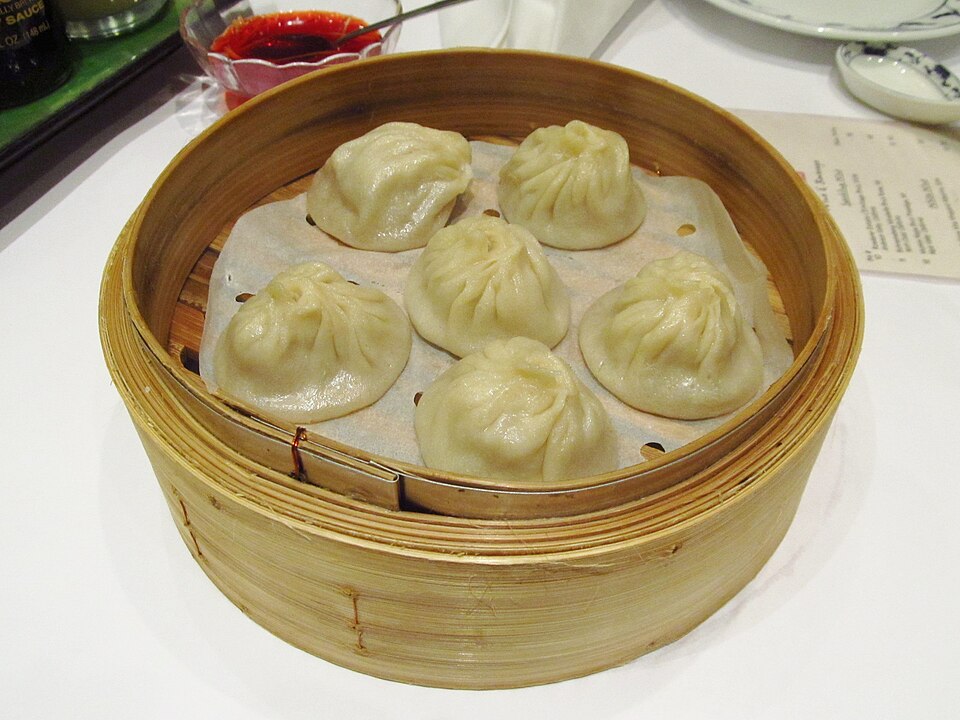
Steamed soup dumplings; the broth inside is scalding.
Bite a small hole, sip the soup first, then eat.

Pan-fried pork buns with a crisp bottom and even more soup than xiaolongbao.
Sold by the liang (four buns); same sip-first rule applies.

Dry noodles tossed in slow-fried scallion oil and a little soy; plain and addictive.
Order it with a side of wonton soup; toss well before the first bite.
Xiaolongbao are steamed with hot soup inside: bite a small hole and sip first or you'll burn your mouth. Shengjianbao are pan-fried with a crisp bottom and even more soup. Locals queue at unglamorous shops; much above ¥30 a basket downtown is tourist pricing.
Jianbing, youtiao (fried dough), warm soy milk and scallion pancake: the classic four, sold from corner windows before 9am. Follow the office workers. A full breakfast costs less than a downtown coffee.
The photogenic 'old street' restaurants by Yu Garden charge triple for average food. The rule that works: eat where the queue speaks Shanghainese, skip where the menu has six currencies.
Shangluo →
✓ checked 2026-06-13Shangluo's food is Shaanxi mountain cooking, and the province is noodle heartland. The famous one is biangbiang noodles (biángbiáng miàn) — very wide, thick, hand-pulled and slapped chewy ribbons, dressed with chilli, garlic and vinegar — whose name uses one of the most complex Chinese characters in regular use. You'll also find the wider Shaanxi staples: youpo mian (chilli-oil noodles), liangpi cold skin noodles, and roujiamo, the 'Chinese hamburger' of chopped braised meat in a flat bun. Pick a busy local shop, point if you need to, and you'll eat well and cheap.
Shangluo is Qinling mountain country, and the local table leans on what the hills give. Walnuts (核桃) are a regional speciality — Shangluo is a major walnut-growing area — turning up roasted, in sauces and in sweets. Look for nuomi / glutinous-rice cakes and ciba (糍粑), pounded sticky-rice cakes that are a mountain comfort food, and for seasonal wild mountain greens (山野菜) gathered locally and stir-fried or blanched. These are the things that taste of here rather than of a generic tourist menu, so order them when you see them.
Like the rest of Shaanxi the cooking is hearty, wheat-and-chilli forward, and warming for cold mountain nights — not Sichuan-numbing, but the chilli is real, so say 'bu la' (not spicy) if you want it toned down. What you won't find much of up here is Western food or English menus; this is solidly local country with very few foreign visitors. Carry a translation app, lean on the noodle shops and farm-stay kitchens (农家乐) along the valleys, and treat the lack of a foreign-food scene as part of the point.
Shangri-La →
✓ checked 2026-06-08This is yak country: yak hotpot (a clear, herby broth you cook yak meat and mountain vegetables in), yak-meat stir-fries, dried yak jerky and yak-butter tea. The hotpot is the warming, worth-it meal after a cold high-altitude day. Butter tea is an acquired taste — salty and rich — but worth one bowl to know.
Skip the big song-and-dance 'Tibetan banquet' halls aimed at tour groups. Look for plainer Tibetan and Naxi places for tsampa (roasted barley), momos (dumplings), barley wine and matsutake mushrooms in late summer. Simpler room, better food, a third of the price.
If you're here in the July-September matsutake season, the prized pine mushrooms are everywhere and genuinely good — grilled or in soup. Outside that, keep food expectations modest: this is a small high-altitude town, the strength is hearty Tibetan home cooking, not refined dining.
Shannan →
✓ checked 2026-06-13Out here the everyday food is solidly Tibetan. Tsampa - roasted barley flour worked by hand with butter tea into a dough - is the genuine local staple, more an acquired, authentic experience than a crowd-pleaser. Po cha, the salty yak-butter tea, is polarizing and worth trying once; the thing you'll actually keep ordering is sweet milk tea by the glass. In the smaller towns of the Yarlung Valley the dining is simple and local, so lean into the barley, the tea and a translation app rather than hunting for a Western menu.
Most of the 'beef' here is yak: in momos (steamed or fried dumplings), dried into chewy jerky, stir-fried, or in stews. It's leaner and a little gamier than beef and it's simply the regional meat. Thukpa - a hand-pulled Tibetan noodle soup - is the warming, traveler-friendly staple that goes down easily at altitude, and yak yogurt, thick and tart, is a real local thing. Eat the yak and the noodle soups; they're the honest local food and they sit well when the altitude has dulled your appetite.
Because you're on an organized tour, a lot of your eating is arranged for you, often at places used to feeding visitors. That smooths the language barrier but can flatten the food into safe tourist fare. When you get a free meal, point at what looks good in a busy local spot, try the tsampa and butter tea once for the experience, and ask your guide where they actually eat. In a small place like Tsetang the genuinely local noodle and momo shops are the better bowl, and your guide is your shortcut to them.
Shantou →
✓ checked 2026-06-13This is what Shantou is famous for. The local beef hotpot (牛肉火锅) is built around a clean beef broth and paper-thin cuts sliced to order by part of the animal — each cut has its own name and its own seconds-long dip time, so let the staff or a local guide the order rather than dumping everything in at once. The hand-pounded beef balls (牛肉丸) are the real, springy, bouncy thing the frozen supermarket version is a sad imitation of. Expect queues at the well-known places and budget roughly ¥100–150 a head for a proper hotpot dinner. Have both.
Beyond beef, Shantou is a grazing city. The oyster omelette (蚝烙, oh-luah in Teochew) is crisp-edged and egg-forward; kway teow noodles (粿条, stir-fried or in soup) are everywhere; and the whole family of Teochew 粿 — steamed and pan-fried rice-flour cakes with savoury or sweet fillings — is worth working through stall by stall. Add fish balls, braised goose and taro paste. Order small from busy stalls and try a lot rather than committing to one big plate.
Two Chaoshan rituals to seek out. Gongfu cha (工夫茶) — strong oolong brewed in a tiny pot and poured through a row of thimble cups in a precise, repeated round — is offered everywhere, often free as hospitality; sit for a cup rather than waving it off. And Shantou eats late: the local 夜糜 (yè mí), a savoury rice congee spread served with dozens of small cold and braised side dishes, is a proper late-night institution. Finding a busy 夜糜 stall after dark is one of the most local things you can do here.
Shaoshan →
✓ checked 2026-06-13The dish to order in Shaoshan is hongshaorou done the local way — fatty pork belly braised dark and glossy in a sweet-savoury, lightly spiced sauce, the version Mao supposedly loved and that every restaurant in the village now puts front and centre. It's genuinely good Hunan comfort food and the one thing worth eating here for its own sake rather than novelty. Order it once; just know the menus and the whole tourist strip are pitched at domestic groups, so prices near the sights run higher than in town.
Shaoshan eats like the rest of Hunan: chili as a base ingredient, not a garnish, plus the region's smoked and cured meats and the inevitable stinky tofu among the snack stalls. 'A little spicy' here will still have heat. If you can't take it, say 'bu la' (no chili) clearly when you order and still expect some colour in the dish. Lean into it — the local cooking is the better half of a day that's otherwise about history.
The restaurants around the sights are built for groups who order a tableful of communal dishes, and you'll struggle to find a picture menu, let alone English. If you're one or two people, the move is to walk a little away from the main strip and find a noodle shop — point, use a translation app, and you'll eat well and cheaply without ordering for six. Don't expect a foreign-food scene; there isn't one, and that's fine.
Shaoxing →
✓ checked 2026-06-13This is the home of huangjiu — Shaoxing yellow rice wine, the amber stuff that flavours half of eastern China's cooking. Here you drink it as a drink, often warmed, sometimes by the bowl in an old tavern. Try the 'taidiao' or aged 'huadiao' styles, go gently because it slides down easier than it should, and don't confuse the cooking wine on supermarket shelves with the drinking grade you'll get poured in a Shaoxing wine house.
Two things define a Shaoxing snack stop. Stinky tofu (臭豆腐), deep-fried black and pungent, eaten hot with chilli sauce — far better than its smell, and a local point of pride. And 茴香豆, aniseed-braised broad beans, the very beans the character Kong Yiji counts out in Lu Xun's story, sold all over his hometown. Order both, eat them on a canal step, and you've had the literary tasting menu.
Shaoxing cooks with its wine as much as it pours it: drunken chicken, drunken river shrimp, 'zaolu'-marinated dishes steeped in wine lees. They're cold, boozy, savoury and very Jiangnan. Eat them at a proper local restaurant a lane back from the main tourist drag, where the same dishes cost less and taste like they're made for residents rather than tour buses.
Shaoyang →
✓ checked 2026-06-13The dish to eat here is blood duck (血鸭 / xuě yā): duck stir-fried hard with fresh chilli, garlic and ginger, finished with the bird's own blood mixed with a little rice wine so it coats the meat in a dark, glossy, intensely savoury sauce. It's a defining plate of southwestern Hunan and the Xinning–Shaoyang area in particular, hearty and properly spicy rather than a tourist gimmick. If the idea of the blood unsettles you it's worth getting past it — cooked this way it reads as rich and umami, not gamey — and it pairs perfectly with plain rice to take the edge off the heat.
You're deep in Hunan, one of China's eight great regional cuisines and arguably its most uncompromisingly spicy. The heat here is fresh and pickled chilli woven through the cooking rather than a numbing Sichuan tingle — sharp, bright and everywhere, in the stir-fries, the braises and the smoked meats. If you don't take chilli well, say so when you order ('bù là' / not spicy is understood), but know the local default is properly fiery, and toning it all the way down can flatten the dishes worth coming for. A bowl of rice and something cooling alongside is your friend.
Beyond the chilli, southwestern Hunan's mountain larder leans on smoked and cured pork (làròu / smoky bacon) cooked with dried vegetables or fresh greens, river fish from the Fuyi and Zi rivers cooked simply, and the foraged and farm produce of a hilly, minority-influenced countryside — this is Miao and Yao country in the Xinning and Chengbu uplands. Order the local smoked meats and the small river fish over anything generic, and up at Nanshan look for the dairy and beef the grassland is known for. It's honest, hearty fare; eat where the locals are eating and you'll do well and cheaply.
Shenyang →
✓ checked 2026-06-13Shenyang's signature is Laobian Jiaozi — a dumpling house with a history stretching back to the 1820s, known for a richer, looser filling than the usual boiled jiaozi. The original branches are near Zhongjie, walkable from the palace. It's touristy and not the cheapest dumpling in town, but it's the local landmark dish; go once, order a mixed steamer, and judge for yourself.
Dongbei food is the real eating here: huge portions, sweet-savoury braises, pork-and-cabbage stews, 锅包肉 (guobaorou — crispy sweet-and-sour pork) and the heavy 'big plate' dishes built for cold winters. Order fewer dishes than you think you need; portions are enormous. Any busy neighbourhood Dongbei restaurant will feed two people very cheaply and very well.
Northeastern China runs on chuan'r — cumin-and-chilli grilled skewers eaten late with cold beer — and Shenyang's night spots do them well. There's also a Manchu and Muslim-Hui thread to the local food, with mutton and grilled meats prominent. Skip the polished tourist restaurants near the sights and find a busy, smoky skewer joint where the locals eat.
Shenzhen →
✓ checked 2026-06-11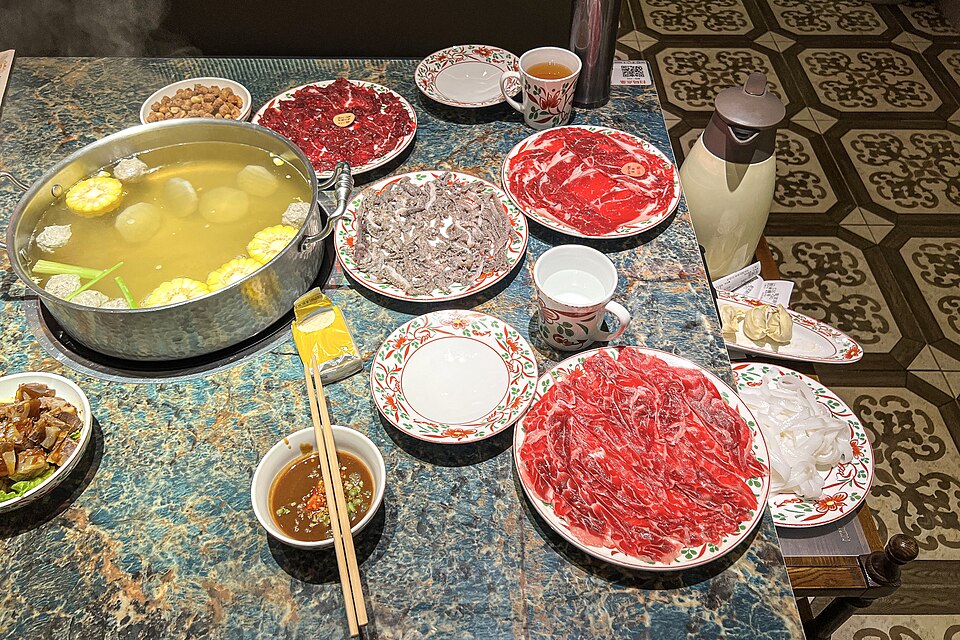
Clear-broth hotpot of fresh beef cuts named by muscle, cooked in seconds.
Let the waiter time each cut; dip in sha cha sauce.
Roast goose with crackling skin and juicy meat, served over rice or on its own.
Ask for a leg portion (xia tui) if you want the best meat-to-bone ratio.
Smooth rice porridge cooked with fresh seafood, a late-night favorite here.
A good post-bar meal; the dapeng coastal spots do the freshest version.
A migrant city means every Chinese cuisine done properly somewhere. Skip 'Shenzhen specialties' (there barely are any) and hunt by region instead: Chaoshan beef hotpot and hand-pulled Lanzhou noodles are the local consensus picks.
The thing locals actually queue for. Cuts arrive named by muscle and cook for seconds, not minutes; the waiter will time it for you if you look lost. Dip in sha cha sauce, order the beef balls, and let the broth stay plain.
Shigatse →
✓ checked 2026-06-08Same plateau trio as Lhasa: momos (steamed or fried dumplings, yak or veg), thukpa (hand-pulled noodle soup) and tsampa (roasted barley flour worked into a dough with butter tea). Momos and thukpa go down easily for most visitors; tsampa is the genuinely local, acquired one. All cheap and everywhere in Shigatse's old town and around the monastery.
Po cha - salty yak-butter tea - is the authentic plateau drink and polarizing; worth trying once. The one you'll actually keep ordering is sweet milk tea, served by the glass in tea houses that double as cheap, warm places to sit among locals. Brave the butter tea for the experience, then settle into the sweet tea.
Most 'beef' here is yak - in momos, dried into chewy jerky, stir-fried or stewed. It's leaner and gamier than beef and it's the regional meat, not a novelty. Yak yogurt is also a real local thing, thick and tart. At this altitude a hot, fatty yak-and-noodle meal is exactly what your body wants - eat the yak, it's the honest local protein.
Shijiazhuang →
✓ checked 2026-06-13This is Hebei's signature cheap eat: braised donkey meat stuffed into a crisp, layered flatbread (huoshao). It's a genuine regional staple across the province, not a tourist invention, and it's filling and cheap. Look for a busy local shop rather than anything aimed at visitors; you'll usually pay a few yuan for one and they go well with a bowl of soup.
Around Zhengding you'll see the old banquet tradition of the 'eight big bowls' (bada wan) — a set of braised and steamed meat dishes served family-style, the kind of thing laid on for weddings and festivals. It's hearty northern home cooking rather than refined restaurant food. Pair it, or a simple meal, with gangkuo shaobing — a sesame flatbread baked against the wall of an urn-shaped oven, crisp and a local breakfast standby.
As a big provincial capital Shijiazhuang has more chains, malls and variety than the small Hebei towns, but the heart of the eating is still northern Chinese — dumplings, hand-pulled and knife-cut noodles, flatbreads, braises and lamb. There's little dedicated foreign-food scene outside the bigger hotels. Use a translation app, eat where locals queue, and you'll do well for very little money.
Shilin →
✓ checked 2026-06-13The Stone Forest is not a dining destination from the inside. The stands within the park sell fruit, drinks and a few snacks — the cheap, refreshing cucumber-on-a-stick is a genuinely good shout in the heat — but that's about it, and prices climb the further you are from the gate. The park is dotted with stone tables clearly meant for picnics, so the local move is to carry water (two litres each) and something to eat, and save the real meal for Shilin town or back in Kunming. Don't count on changing money or a working ATM out here either.
This is Sani Yi country, and the food worth seeking out is theirs. Look for Yi-style roast and grilled meats and, in the right months, the wild mushrooms Yunnan is obsessed with — from roughly June to September the province eats and talks about little else, and a mushroom hotpot is the seasonal thing to order (respect the restaurant's boil-timer; it exists because some species need real cooking). Rice-flour noodles (mixian, 米线) are the everyday staple here as across Yunnan, served in broth or dry-tossed, cheap and reliable. In the Sani villages around the park you'll also find rustic home-style country cooking; it's local, hearty fare rather than a polished tourist menu, which is the point.
If you're coming from Kunming you'll already know the headline Yunnan dishes — crossing-the-bridge noodles, the mushroom season — and the broad strokes carry out to Shilin. But the Stone Forest area is a small county, not a food city, so set expectations accordingly: solid local Yunnan and Sani cooking, little in the way of Western food or English menus, and your best meals in busy local shops in Shilin town rather than anything at the park gate. Use a translation app, point at what looks good, and treat the eating as part of the day trip rather than its destination — the real spread is back in Kunming.
Suzhou →
✓ checked 2026-06-08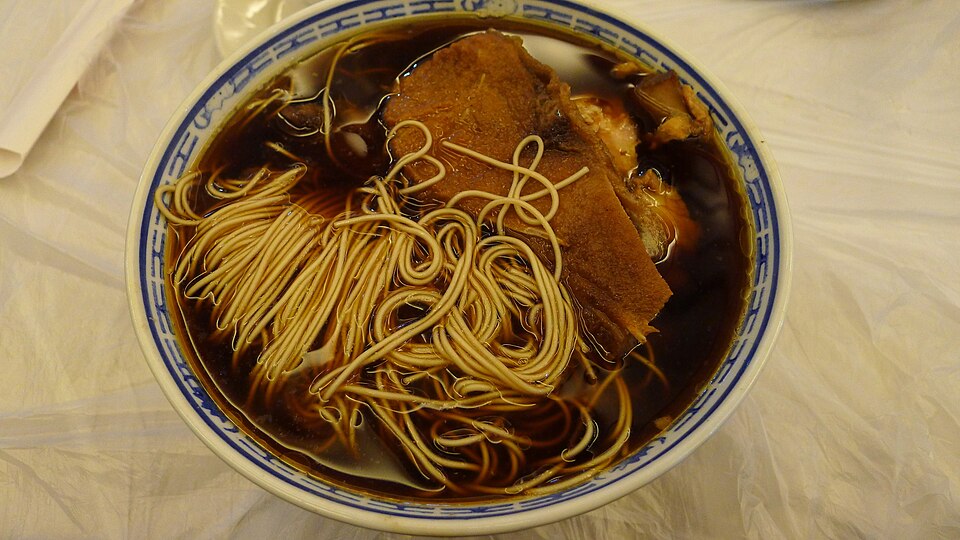
Suzhou breakfast noodles in a clear, faintly sweet broth; toppings ordered by name.
Before 9am; the good broth sells out by late morning.
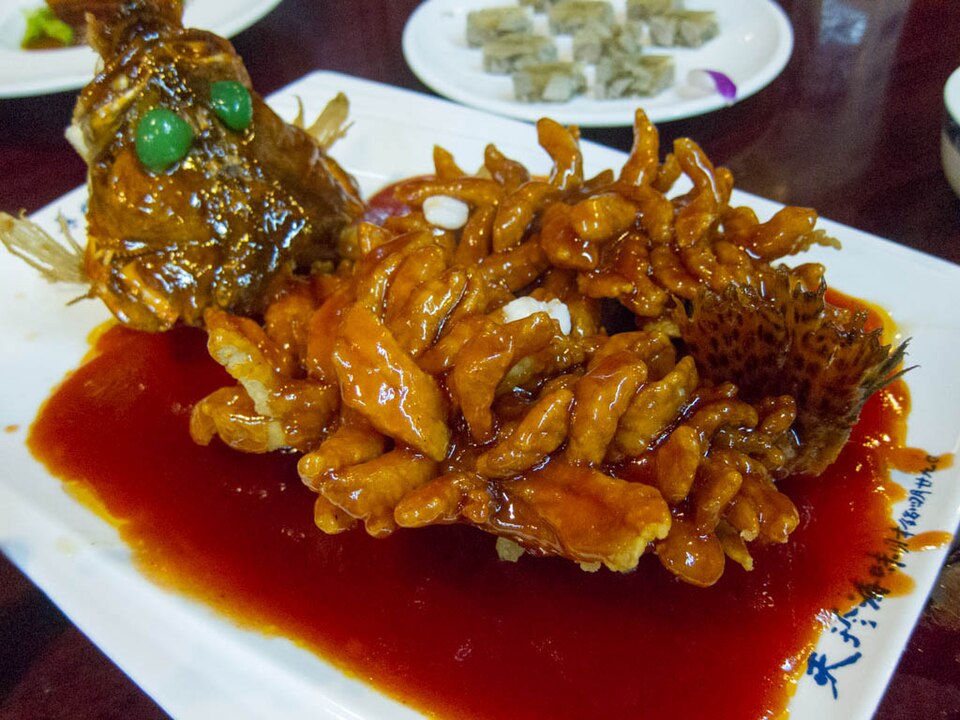
Crosshatched fried mandarin fish under sweet-sour sauce, cut to flare like a squirrel tail.
A table centerpiece for two or more; yes, it's supposed to be sweet.

Fine noodles in a clear, slightly sweet broth with toppings served on the side.
Order toppings (the "jiao tou") separately; locals eat this for breakfast.
Suzhou's morning religion is a bowl of aozao or shrimp-roe noodles: clear, faintly sweet broth, toppings ordered separately by name. The famous shops sell the good broth out by late morning; this is a before-9am errand, like Guilin's mifen.
Suzhou cooking runs sweeter than the rest of China; the gravy on squirrel-shaped mandarin fish is supposed to taste like that. If you want salt and fire, order the seasonal greens and river shrimp; don't fight the cuisine's thesis.
Tai'an →
✓ checked 2026-06-13The local dish is the 'three beauties of Tai'an' — a clear stew of the mountain's spring-water tofu, white cabbage and water from the slopes — plus freshwater fish. Simple, clean Shandong cooking; try it in a local Tai'an restaurant rather than at the mountain gate, where it's marked up for the captive crowd.
Stock up on cheap, portable Shandong food before you head up: jianbing pancakes, big steamed buns, eggs and cucumbers. Food sold on the mountain itself, especially near the summit, is expensive and basic for obvious carry-up reasons — buy your snacks and water in town at the bottom.
Everything sold up the mountain carries a steep carry-up premium, fairly enough. The real eating is in Tai'an city — local Shandong restaurants, night-market snacks, normal prices. Plan a proper meal in town before the climb or after you come down rather than relying on summit stalls.
Taiyuan →
✓ checked 2026-06-13An early-morning medicinal soup of fatty mutton, lotus root and yam in a wine-and-herb broth, invented by a Ming-Qing scholar.
Sold only at breakfast and best at old houses like Qinghe Yuan; eat it with the steamed bread.

Shanxi's signature dish: sliced pork passed through hot oil then stir-fried with wood-ear and vinegar.
Eat it over rice or with knife-cut noodles; it is the dish locals judge a kitchen by.
Thin rolls of oat-flour dough stood up like a honeycomb and steamed, eaten dipped in a lamb or mushroom sauce.
Dip each roll in the hot sauce; the oat flour is heavier than wheat, so one order goes far.
Shanxi is the homeland of daoxiao mian — dough shaved in flying ribbons straight off the block into the pot — and Taiyuan is a fine place to eat them, often topped with braised meat or a tomato-and-egg sauce. Pick a busy local noodle shop over anything aimed at tourists; a proper bowl is cheap and it's the most reliable good meal in town.
Try guoyourou (过油肉), the classic Shanxi dish of velveted, twice-cooked pork with wood-ear and garlic shoots — it's arguably the province's signature stir-fry and Taiyuan does it well. And lean into Shanxi's dark aged vinegar (laochencu): it's on every table for a reason, and locals splash it on noodles, dumplings and the pork without apology. Do the same.
Taiyuan's oddest local specialty is tounao (头脑) — a warm, milky-thick morning broth of mutton, yam, lotus root and rice wine, eaten with a savory pastry and traditionally as a winter tonic. It's a centuries-old Taiyuan thing, usually a morning-only dish at old-line shops, and an acquired taste. If you want to eat something genuinely local rather than generic, go early and order it.
Tianjin →
✓ checked 2026-06-07
Tianjin's famous pleated pork buns, each pinched with eighteen folds; the old-brand restaurants are pricey for what they are.
A name-brand sit-down meal, not street food; smaller local bun shops are cheaper and just as good.

The original Tianjin breakfast crepe: a mung-bean batter wrapped around egg and a crisp fried cracker, painted with sauce.
Morning carts only; the crisp inside is the fried dough (guozi), not a wonton cracker, in the traditional version.
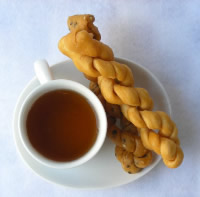
A thick, sweet deep-fried dough twist studded with sesame and candied fruit, one of Tianjin's three famous snacks.
Sold boxed as a gift; the Guifaxiang brand is the original, eat it fresh and crunchy.
A deep-fried glutinous-rice cake with a sweet red-bean centre, crisp outside and soft within; another of the three famous snacks.
Eat it hot off the fryer; it is named for the narrow alley the first shop stood in.
Goubuli is Tianjin's nationally famous stuffed-bun brand, and the flagship restaurants charge tourist prices for buns that locals shrug at. Try them once if the name draws you, but you'll eat better, cheaper baozi at any busy neighbourhood shop. The fame outran the food years ago.
Tianjin claims the jianbing — the savoury mung-bean crêpe wrapped around a crisp fried cracker (guozi), egg, scallion and sauce. This is its hometown, and the street versions here are the real thing, ¥6–10 from a morning cart. Eat it early from a stall with a queue, not from a sit-down restaurant.
Tianjin's other signature is mahua — twisted, deep-fried dough sticks, the boxed 十八街 brand being the famous one. Buy a small fresh bag rather than a gift box. More broadly, the snack streets near the old town and along the Hai River are where Tianjin actually eats; graze there cheaply instead of paying tourist prices in the concession bars.
Tianshui →
✓ checked 2026-06-13Tianshui's local snack is guokui — a thick, dense baked wheat flatbread, sold by weight and good for carrying on a long grotto day. Pair it with a bowl of hand-pulled Gansu noodles (this is the noodle heartland just east of Lanzhou). Eat at a busy local shop in Qincheng rather than the stalls right at the scenic-area gate, where it's pricier for the same thing.
Tianshui guagua is the dish locals will tell you to try: a cold, jelly-like buckwheat or starch liangfen, hand-torn into shreds and drenched in chilli oil, vinegar and garlic. It's a breakfast and morning-snack thing — many shops sell out by midday — and it's properly spicy and sour. Cheap, very local, and not a tourist-menu item; point at what the next table is having.
Tianshui is solidly local Gansu eating with very few foreigners, so English menus and Western food are mostly limited to bigger hotels. That's a feature: a translation app and a busy noodle or guagua shop will feed you well and cheaply. Carry a little cash for the smallest stalls, which don't always take a foreign app payment.
Tiantai →
✓ checked 2026-06-13Tiantai's signature street food is jiaobingtong (饺饼筒) — a thin wheat pancake rolled tight around fillings of meat, egg, tofu and vegetables, then griddled crisp, a bit like a fat local burrito. Pair it with hulafei (糊拉沸), a savoury pan-fried batter pancake, and maibing (麦饼), a stuffed wheat flatbread. These are cheap, filling, genuinely local, and easy to point at in a busy shop in Tiantai town.
On a mountain that gave its name to a Buddhist school, the most fitting meal is su-cai — Buddhist vegetarian. Tofu, mountain vegetables, mushrooms and noodles, simple and clean, eaten near the monasteries. It suits the setting and is usually good value; seek it out rather than defaulting to a tour-bus canteen near the tourist centre.
The proper restaurants are in Tiantai county town; out at the spread-apart scenic areas and the cavernous tourist centre, options thin and prices climb. Eat well in town, and carry water and a couple of snacks for the day if you're moving between the Stone Bridge, Qiongtai and Huading — you can spend hours between meals out there, especially if you're shuttling or hiking.
Tongren →
✓ checked 2026-08-09The thing to eat around Fanjingshan is Jiangkou rice tofu (江口米豆腐), named for the county the mountain sits in: a bright-yellow, glassy set 'tofu' made from rice, cut into slabs or strips and served sour, spicy, cool and slippery with the local chilli oil, vinegared chilli and seasonings. It's cheap, refreshing after a hot climb, and a genuine regional speciality rather than a tourist invention. You'll find it at street stalls and small shops in Jiangkou and on Tongren's Grand Cross pedestrian street; pick a busy local spot over anything dressed up inside a scenic area.
You're in Guizhou, and the defining flavour here is sour-and-spicy, not just hot. The province's signature is sour-soup fish (酸汤鱼) — fresh fish simmered in a tangy, deep-red fermented tomato-and-chilli broth — and you'll find versions of it across Tongren, often as a shared hotpot. Look too for cold folded ear root (折耳根, fish-mint) tossed sour and spicy, a love-it-or-hate-it local crunch, and Tongren 'she rice' (社饭), glutinous rice steamed with wild herbs, bacon and nuts. The sourness comes from fermentation rather than added vinegar, and it's the through-line of the regional cooking.
Tongren is small-city Guizhou and the dining is solidly local: rice tofu, crispy rice flour noodles (锅巴粉), sour radish, yogurt twists and street barbecue around the Grand Cross. Don't expect much Western food or English menus outside the bigger hotels — that's a feature, not a flaw. Use a translation app, point at what looks good, and you'll eat well and cheap. The local Fanjingshan tribute tea (梵净山贡茶), grown on the mountain's slopes, is a worthwhile and very portable souvenir.
Turpan →
✓ checked 2026-06-08Chunks of lamb hung and roasted in a clay naan pit until the skin crisps and the inside stays juicy.
Sold by the piece at bazaar stalls; eat it hot with naan.

A whole young lamb spiced with cumin and salt and slow-roasted in a tandoor, carved at the table; a Xinjiang feast dish.
A banquet order for a group, priced by weight; smaller cuts are sold if you are not a crowd.
Grapes wind-dried in latticed brick drying houses outside town; sweet, green and a Turpan signature buy.
Bought loose by weight at the bazaar; the green seedless ones are the local pride.
Turpan is China's grape and raisin capital - the oasis is laced with vine trellises and drying houses, and in late summer the markets overflow with fresh table grapes and dozens of kinds of raisins. Buy raisins by weight at a market (taste first, agree the price per jin), and if you're here in season, eat the fresh grapes - the seedless green ones are the local pride. Grape Valley is the touristy version of this; the roadside stalls are cheaper and just as good.
Eat the regional staples: laghman (hand-pulled noodles with lamb and veg), polo (lamb pilaf), kebabs and fresh tandoor naan. It's the same Uyghur repertoire as Kashgar and Urumqi, cheap and good at busy local spots. Many places don't serve alcohol; it's tea and yogurt drinks, which actually suit the heat better than beer anyway.
Beyond grapes, Xinjiang's famous Hami-style melons and watermelons are everywhere in summer and gloriously cheap - a wedge of cold melon is the right move between ruins. Fresh fruit-juice and yogurt stands are your friends in this heat; build them into the day. Carry small cash for the roadside fruit sellers who won't fuss with mobile pay.
Urumqi →
✓ checked 2026-06-08
Chicken stewed with potato, onion and chili on a huge plate, with wide belt noodles dropped in at the end.
Built to share; ask them to add the noodles (pi dai mian) to mop up the sauce.
Hand-torn free-range chicken in a cold, oily sauce of green peppercorn and chili that tingles the lips; an Urumqi favorite.
Served cold and lip-numbing; a good shared starter before the grills.
Rice cooked in lamb stock with carrot, onion and chunks of lamb until glossy; the Uyghur pilaf.
Comes with a piece of lamb on top; eaten by hand traditionally, but you will get a spoon.
Urumqi is where you eat the Xinjiang heavy-hitters: laghman (hand-pulled noodles with stir-fried lamb and veg) and dapanji - 'big plate chicken,' a huge dish of chicken, potato and peppers in a spicy sauce, with wide belt-noodles dropped in at the end to soak it up. Dapanji is built for sharing; order one for a table of three or four, not per person.
The everyday wins are naan (chewy tandoor bread, a couple of yuan), cumin-heavy lamb kebabs (kawap) off the grill, and samsa baked pastries. At the Grand Bazaar and markets, the dried fruit and nuts - raisins, apricots, figs, walnuts - are a regional specialty worth buying; taste before you commit and agree the price by weight so you don't get tourist-padded.
This is a heavily Muslim food scene, so many Uyghur restaurants don't serve alcohol - it's tea, yogurt drinks and fresh fruit juice instead. The yogurt is thick and tart, often sold plain to sweeten yourself, and it's a genuinely good pairing with the rich grilled and noodle dishes. If you want beer, Han-run restaurants and hotels have it; don't expect it everywhere.
Weihai →
✓ checked 2026-06-13The Weihai dish to order is 鲅鱼饺子 (bayu jiaozi) — dumplings stuffed with minced Spanish mackerel, springy and faintly sweet from the fresh fish, often with a little chive or leek. It's a genuine local staple, not a tourist invention, and a busy neighbourhood dumpling house does it far better and cheaper than anything by a scenic-area gate. Have a plate as a proper meal, not a snack.
This is northern Shandong sea-cucumber and shellfish country: sea cucumber (海参), clams, sea snails, flatfish and the cold-water catch the Yellow Sea does well. Eat it plain — steamed or quick-fried — and it's excellent. The one trap is the tourist-strip habit of pricing seafood 'by the catty' then weighing it loosely or swapping the fish; confirm the price per unit, watch the scale, or eat a few streets back from the waterfront where locals do. Sea cucumber especially is pricey, so know roughly what you're paying before you nod yes.
Weihai has long, close links to South Korea, so you'll find Korean restaurants and Korean signage around town more readily than Western food or English menus. That's handy if Korean appeals; otherwise dining is solidly local Shandong seafood and dumplings. Use a translation app, point at what's good at a busy place, and you'll eat very well for very little.
Wenzhou →
✓ checked 2026-06-13This is a wealthy coastal trading city and the food is built on seafood: clams, crab, shrimp, razor clams, often cooked simply to taste of the sea rather than drowned in sauce. The local style leans light and a touch sweet compared with inland Zhejiang. A busy seafood place where locals are eating, priced by weight, beats a tourist menu — and as with any by-weight seafood, confirm the per-jin price and rough total before they cook it.
Wenzhou fish balls (鱼丸) aren't round balls but irregular strips of fish in a peppery, vinegary broth — a proper local breakfast or snack, not the bouncy supermarket kind. Pair them with 灯盏糕 (dengzhangao), a deep-fried savoury cake of radish and pork in a lantern-shaped batter, crisp outside and soft inside. Both are cheap, sold from small stalls and old shops, and far better fresh from a local hole-in-the-wall than anything dressed up for tourists.
Wenzhou cooking has a habit of mixing sweet into savoury dishes that can throw first-timers — a little sugar in stir-fries, sweetish sauces on seafood. It's the local palate, not a kitchen error. Lean into it: the regional specialities are tuned that way on purpose, and chasing 'normal' flavours here means missing the point of eating in Wenzhou.
Wudang Mountains →
✓ checked 2026-06-13The mountain's temples and many guesthouses serve Taoist vegetarian meals — tofu, mountain greens, mushrooms, simple and clean. It suits the place and is the authentic thing to eat up here; the in-mountain restaurants are pricier than the town for obvious carry-up reasons, so set expectations on cost.
Down in Wudangshan town and Shiyan you get everyday Hubei cooking — rice noodles, freshwater fish, spicy-savoury stir-fries — at normal prices. Eat your bigger meals in town before heading up, where food is both cheaper and more varied than on the mountain.
As on any Chinese mountain, food and water sold near the summit carry a steep carry-up premium. Buy snacks, water and fruit in the town at the base and carry them, especially if you're doing the climb or a long day around the temples.
Wugongshan →
✓ checked 2026-06-13The serious eating is down at the mountain-foot villages and in the entrance towns, where farm-stays and small restaurants do hearty local Jiangxi mountain fare — free-range chicken, smoked and cured pork, mountain vegetables and bamboo shoots, cooked simply and generously. Up on the ridge it's a different story: food is limited to simple stalls and tent-camp kitchens, prices climb with the altitude, and choice is thin. Eat well before you go up and carry your own snacks and water for the meadow, rather than relying on what's for sale at the top.
You're in western Jiangxi, bordering Hunan, and the cooking leans genuinely hot — fresh and pickled chilli worked through the braises and stir-fries, not just sprinkled on. It's a defining character of the food here, not a single dish. If you don't take chilli well, say 'not spicy' (bù là) when you order; it's understood, though toning it down can flatten dishes that are worth eating as the locals make them. The cured and smoked meats of the region pair especially well with the heat.
The Anfu county side of the mountain is known for Anfu ham, a traditional Jiangxi cured ham, and more broadly this is cured- and smoked-meat country — pork preserved through the damp mountain winters and then stir-fried with chilli and local greens. Look for these regional specialities in the farm-stay restaurants around the mountain rather than ordering anything generic; they're the local thing to eat, hearty fuel for a day on the ridge.
Wuhan →
✓ checked 2026-06-11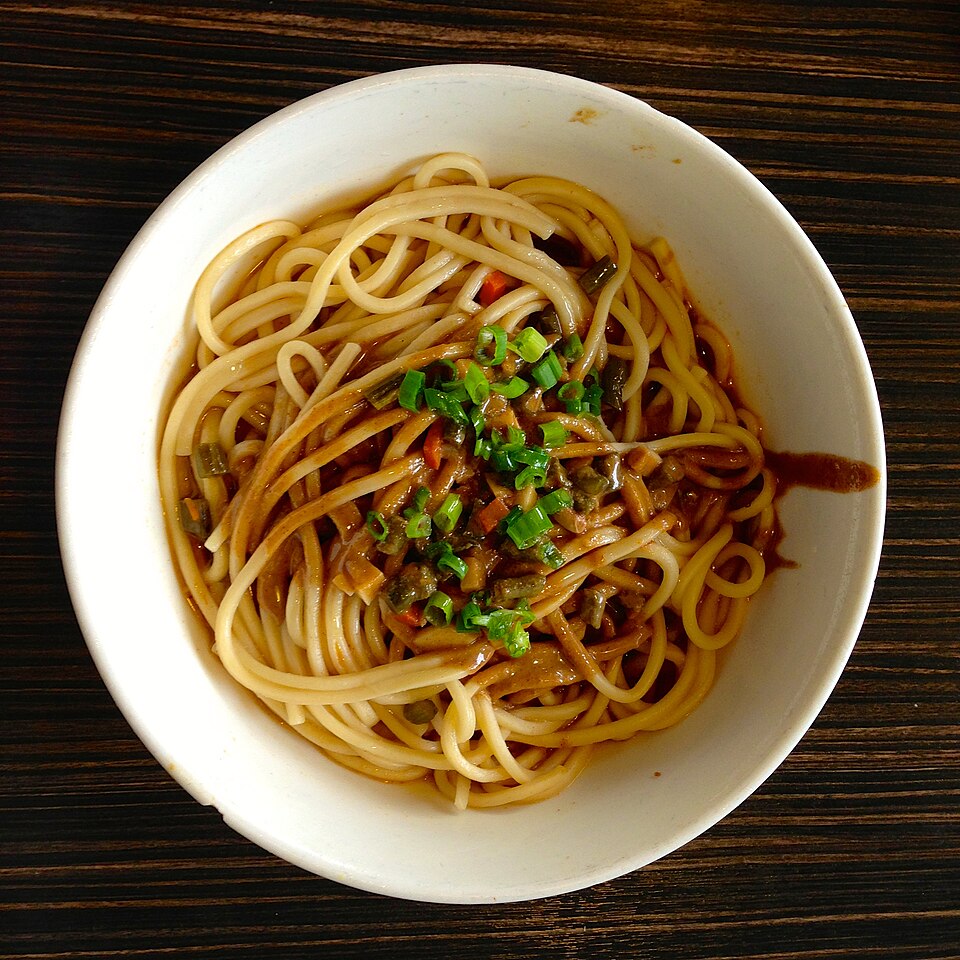
Wuhan's breakfast: alkaline noodles slicked with sesame paste, pickles and scallion, mixed fast and eaten faster.
Mix immediately and thoroughly or the paste sets; eaten standing.
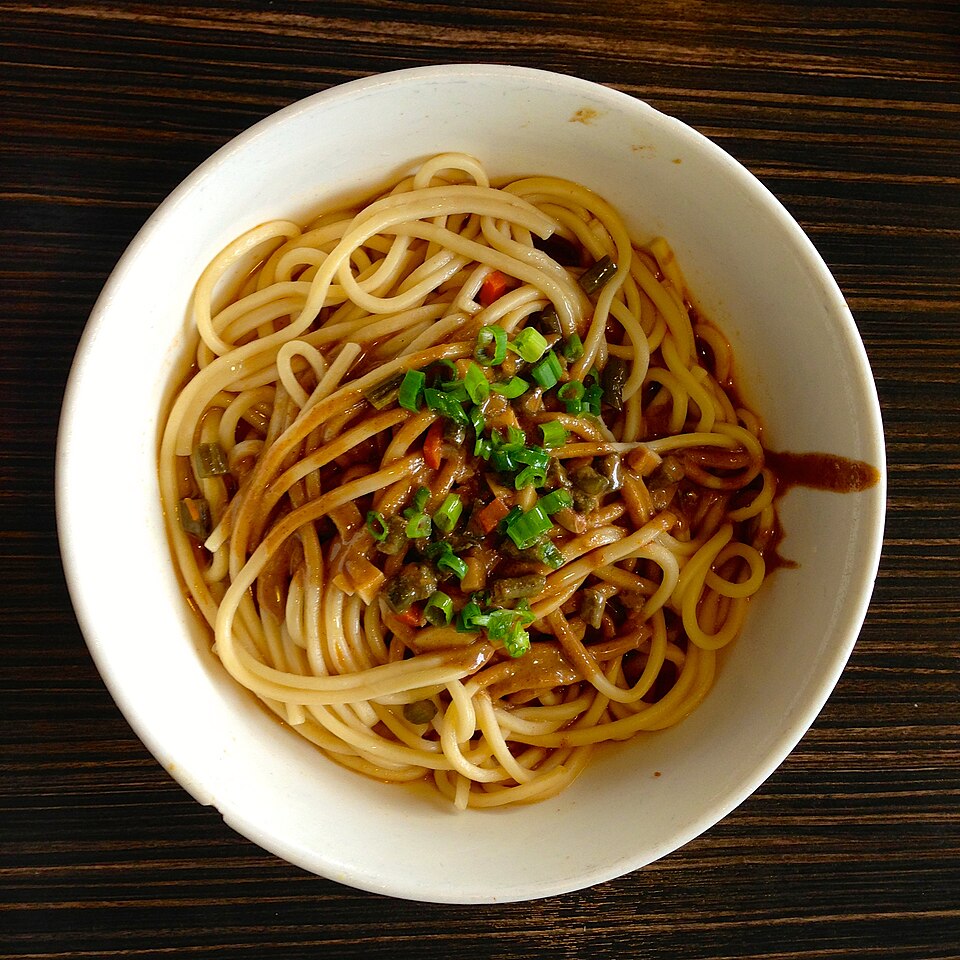
Dry noodles tossed with sesame paste, pickles and chili oil; Wuhan's breakfast.
Eat it within minutes and toss hard, or the sesame paste clumps.
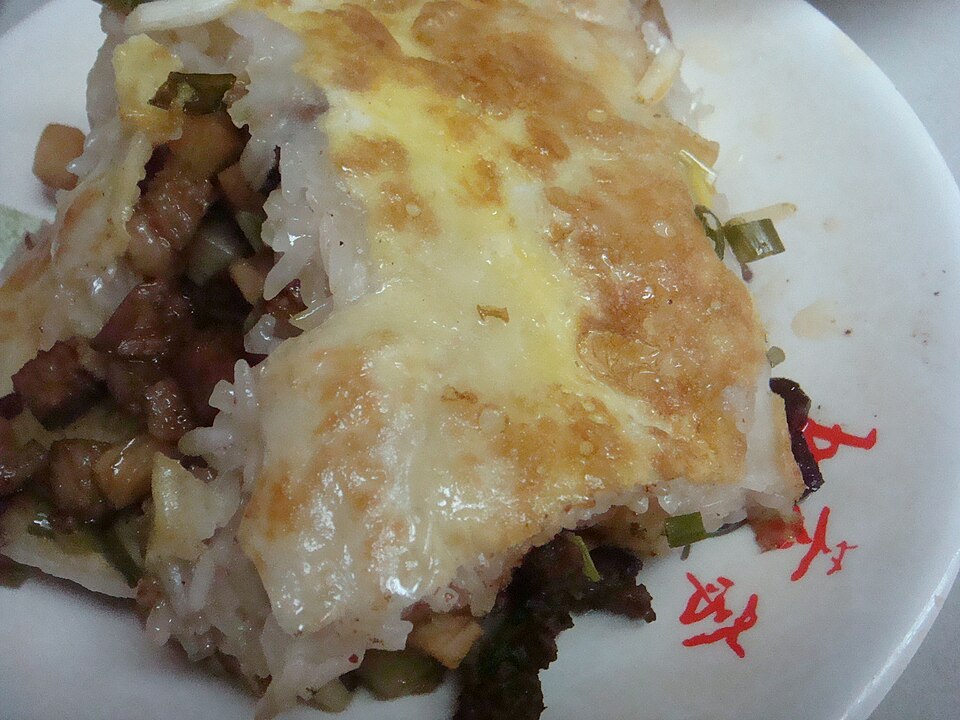
A pan-fried square of egg-skin over glutinous rice, pork and mushroom.
A morning dish; ask for a fresh-cut piece off the big griddle, not a reheated one.
Wuhan treats breakfast as an event with its own verb, guozao. The anchor is hot dry noodles: sesame-paste coated, ready in a minute, eaten standing or walking. Any shop with a fast-moving line before 9am qualifies; the famous chains are fine but no better than a busy corner stall.
The other breakfast star is doupi, a pan-fried square of sticky rice, egg skin and braised bits. The good shops sell out by mid-morning, and the corner pieces with the crisp edges go first. If the tray is fresh, ask for a corner.
Wuhu →
✓ checked 2026-06-13The local signature: hand-pulled noodles in a broth seasoned with tiny dried river shrimp roe, savory and distinctly Wuhu rather than generic. It's a breakfast-and-snack dish, cheap and everywhere in old-town noodle shops. Order it where the locals queue rather than inside a polished mall food court, and you've eaten the one thing that's genuinely this city's.
Wuhu sits in Anhui, home of Hui cuisine — rich, braised, fermented, bolder and oilier than the coastal cities. The famous test dish is chou guiyu, mandarin fish lightly fermented so it smells pungent but tastes clean and delicious. Don't let the name scare you off; it's a regional point of pride and a good preview of what you'll eat deeper in Huangshan country. Expect freshwater fish, braised meats and bamboo.
Beyond the headline dishes, Wuhu does the everyday Anhui breakfast well: xiaolong tangbao (little soup-filled steamed buns) and zha rou zheng fan — rice steamed with a layer of seasoned, rice-flour-coated pork until it's soft and savory. Both turn up at morning stalls and small shops for a few yuan. When you don't know what to order, point at what the breakfast crowd is eating; you'll do better than any tourist menu, and English is rare here, so a translation app helps.
Wulong →
✓ checked 2026-06-13The thing Wulong is known for at the table is its black goat (武隆黑山羊) — a hardy local mountain breed, served as fresh goat/lamb hotpot, in clear stewed-goat soups, or braised. Down in Wulong town there are dedicated fresh-goat restaurants doing it as the house speciality, and vacuum-packed goat jerky and preserved slices are the standard take-home gift from the town markets. It's a genuine regional specality rather than a tourist-menu invention, and on a cool mountain evening a goat hotpot is exactly the right call.
Wulong is a district of Chongqing, so the everyday food is Chongqing/Sichuan cooking at full strength: numbing-spicy málà hotpot, firewood chicken (柴火鸡), 'fatty-intestine fish' (肥肠鱼) combining offal and river fish in the local style, and home-style stir-fries that come properly hot and oily, not toned down. There are solid Chongqing-style hotpot places in Wulong town. If you don't take chilli well, say 'bù là' (not spicy) when you order — it's understood — but know the local default is seriously spicy, and the dishes worth coming for are built around that heat.
The resort strip around Fairy Mountain (Ginkgo Avenue / Qise Tianjie) is lined with farmhouse-style restaurants leaning into what the highland does well: wild-mushroom 'mountain treasure' soups (山珍菌汤), barbecue, big-bone pots and farm vegetables, alongside more of the fatty-intestine-fish and firewood-chicken places. Prices up here run a notch higher than in town, as mountain-resort food usually does, but the mushroom soups in particular are a local highlight worth ordering. Dried bamboo shoots and high-mountain tea from the karst slopes make easy, packable souvenirs from the same shops.
Wutaishan →
✓ checked 2026-06-13On a Buddhist holy mountain the standout meals are vegetarian — many temples and Taihuai restaurants serve clean, simple su-cai (Buddhist vegetarian) dishes, noodles and mountain mushrooms. It suits the setting and is usually good value. Seek it out rather than defaulting to the tourist canteens.
You're in Shanxi, China's noodle-and-vinegar heartland, so eat like it: hand-pulled and knife-cut noodles, plenty of black vinegar on the table, and hearty mountain-cold-weather food. The local style is filling and cheap — exactly what you want after a day of stairs and temples.
Restaurants cluster in Taihuai town; once you're out among the higher temples or on the cable car, options thin out and prices climb. Eat properly in town and carry water and a few snacks for the day, especially if you're walking between the further temple groups.
Wuwei →
✓ checked 2026-06-13The local signature is the 'three-piece set' (三套车): a bowl of stewed-beef hand-pulled noodles, a plate of braised meat, and a cup of sweet spiced fu tea, eaten together. It's hearty Hexi Corridor cold-climate food, cheap, and genuinely a Wuwei thing rather than a generic tourist menu item. Look for a busy local noodle house in the Liangzhou District centre and order the set; it's the most characteristic single meal in town.
Gansu does a whole family of cold wheat-and-starch noodles — mian pi (面皮) and niang pi (酿皮), broad slippery sheets dressed with chilli oil, vinegar, garlic and chickpea bits. They're a street-stall and night-market staple in Wuwei, refreshing in the dry northwestern heat and a few yuan a bowl. The town's night market is the easy place to graze them alongside grilled skewers and sweet pastries.
This is mutton-and-lamb country: roasted lamb, skewers and hand-grabbed lamb are everywhere, and they're done well here, often in the halal northwestern style you'll find near the Confucian Temple and the night market. Pair it with the ubiquitous Lanzhou-style beef noodles for breakfast and you've covered the regional basics. As across Gansu, the food leans toward wheat, mutton and warming spice rather than rice — eat to the local grain and you'll eat well and cheaply.
Wuxi →
✓ checked 2026-06-13The local signature is Wuxi-style braised spare ribs — slow-cooked until tender in a dark, glossy, frankly sweet sauce. It catches a lot of first-timers off guard: Wuxi food is the sweetest of the Jiangnan cities, sugar-forward in a way even Shanghai isn't. Love it or not, the ribs are the dish to try once, and the older Chinese-time-honoured restaurants downtown do the proper version.
Expect the gentle, sweet-leaning Jiangnan palate across the board: xiaolongbao soup dumplings (the Wuxi ones run sweeter than Shanghai's), oil-gluten (mianjin) stuffed with meat, and freshwater fish and 'three whites' from Lake Tai — whitefish, white shrimp and silverfish — when in season. It's comfort food, not spice; if you don't like sweet savoury dishes, say 'shao tang, bu yao tian' (less sugar) and pick the lake fish.
Food right at the big lakeside scenic areas is overpriced tourist fare. The good, cheap eating is back in the city — around Sanyang Plaza and the Nanchang Jie / canal area — where time-honoured local restaurants and noodle shops do the real Wuxi versions. Carry a snack to the sights and save the proper meal for downtown.
Wuyishan →
✓ checked 2026-06-08Goose smoked over tea leaves and glutinous rice until fragrant, then chopped; Wuyishan's signature, from Langgu township.
Sold by the half or whole, often spicy; a regional intangible-heritage dish worth seeking out.
A green glutinous-rice cake colored with cudweed herb and stuffed with a savory or sweet filling; a Wuyishan street breakfast.
Found on the breakfast streets; eat it fresh and warm.
The local product is yancha (岩茶), cliff-grown rock oolong with a roasted, mineral 'rock-bone floral' character — Da Hong Pao is the famous name. It's genuinely worth buying from a reputable tea shop or farm in town. Just hold the line on one thing: nobody is selling tea from the protected mother trees, so treat any such claim as a sales pitch, not a fact.
Xun'e (熏鹅) from Langgu township is the real local meat dish — smoked goose, spicy and aromatic, recognised as a regional geographical-indication speciality rather than a tourist invention. Look for it in restaurants in town and out toward Langgu; it's a proper Fujian-mountain plate, not something dressed up for visitors.
These are bamboo mountains, and the shoots show up everywhere — fresh and stir-fried in season, dried (sun (笋干)) the rest of the year, and sold as a regional dry-good to take home. It's more a defining ingredient across the local cooking than a single signature dish, but a plate of fresh local bamboo shoots is worth ordering when they're in.
Wuyuan →
✓ checked 2026-06-13Wuyuan cooking leans on steaming — clay-pot and bamboo-steamer dishes of pork, vegetables and freshwater fish, often with a 'glutinous,' savoury Huizhou edge rather than the heavy chilli you might expect from Jiangxi elsewhere. Look for the steamed-dish set meals (蒸菜) in village restaurants. As with anywhere ticketed, the food inside the busiest scenic villages is priced for tourists; the better-value bowl is in a plain restaurant in Wuyuan town.
Wuyuan's local specialty fish is the 荷包红鲤鱼 (hébāo hóng lǐyú), a plump, deep-red local carp raised in village ponds and paddies — usually braised or steamed, and a genuinely regional dish rather than a tourist invention. It's worth ordering once where it's a house specialty. Confirm the price before they net it, since fish is sold by weight.
Don't expect the tongue-numbing heat of some Jiangxi cooking; Huizhou-influenced Wuyuan food is more about steaming, preserved meats and freshwater fish than firepower, though you can ask for it spicier. Out in the smaller villages, mobile pay works most places but signal and acceptance get patchy at little stalls — keep some cash for a snack or a homestay that only takes a local QR code.
Wuyuan Huangling →
✓ checked 2026-06-13Once you're up on the ridge you're eating at scenic-area restaurants and homestay kitchens, so expect tourist pricing and check it before you order. The local Wuyuan dishes to look for are steamed/clay-pot fare — Wuyuan 'glutinous' braises and freshwater fish — but the better-value, more authentic version of all of it is down in Wuyuan town.
Foreign Visa/Mastercard linked to Alipay or WeChat Pay cover most things, but signal and acceptance get patchy at small rural stalls on the mountain. Keep some cash for a snack or a homestay that only takes a local QR code.
Wuzhen →
✓ checked 2026-06-13The local signatures are rich and Jiangnan-sweet: red-braised pork, braised mutton in the cooler months, and 'gusao bing' sesame pancakes. The restaurants inside the zones are convenient but marked up; the cooking is decent rather than a destination, so eat when hungry and don't expect bargains inside the gate.
This is sweet-savoury Jiangnan country — soy-braised dishes, river fish, freshwater shrimp, lots of rice wine in the cooking (Wuzhen makes its own). Try the local rice wine (sanbai jiu) if you drink; it's a genuine Dongzha workshop product rather than a tourist gimmick.
Food inside the scenic zones is captive-priced. If you're staying in Wuzhen or Tongxiang town outside, the ordinary local restaurants there do the same Jiangnan dishes for much less. Inside the zone, treat meals as part of the experience's cost rather than a value choice.
Xi'an →
✓ checked 2026-08-08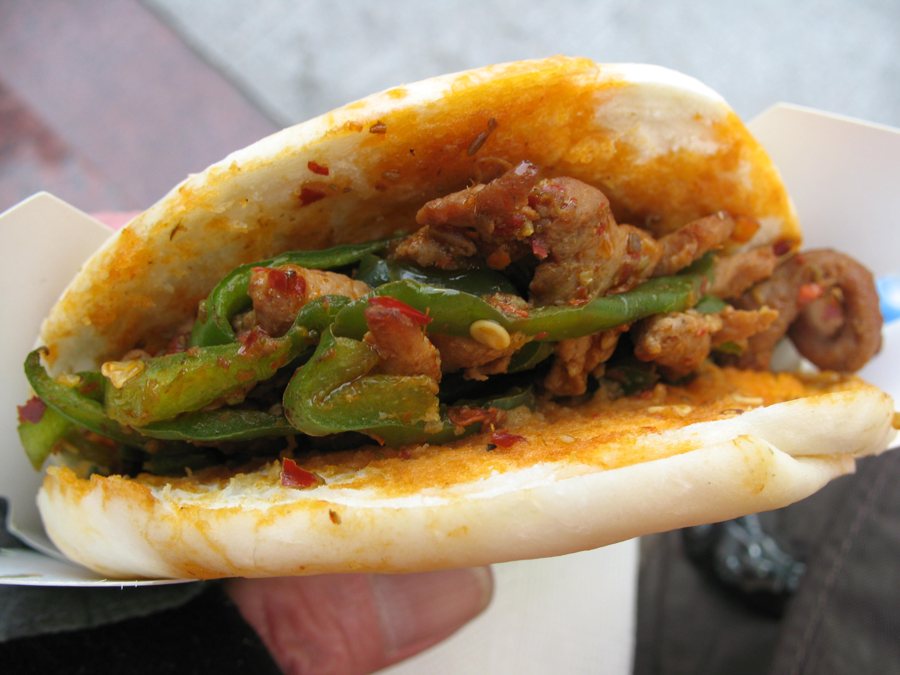
Slow-braised pork stuffed in a crisp griddled flatbread; the original burger.
The lean/fatty mix ('féi shòu') is the one locals order.
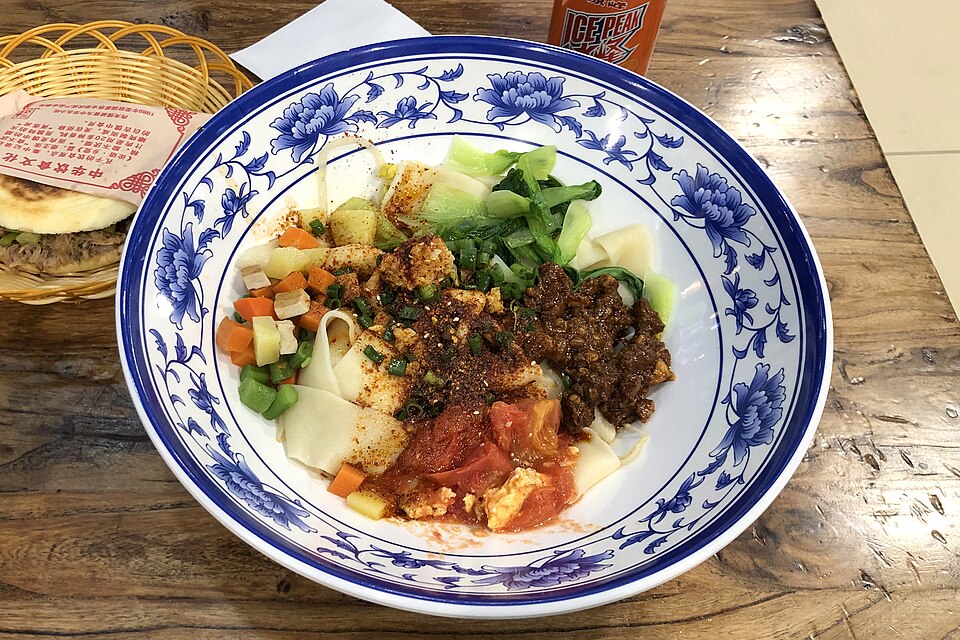
One belt-wide hand-torn noodle under chili, scallion and a hiss of hot oil.
One bowl is a full meal; don't double-order.
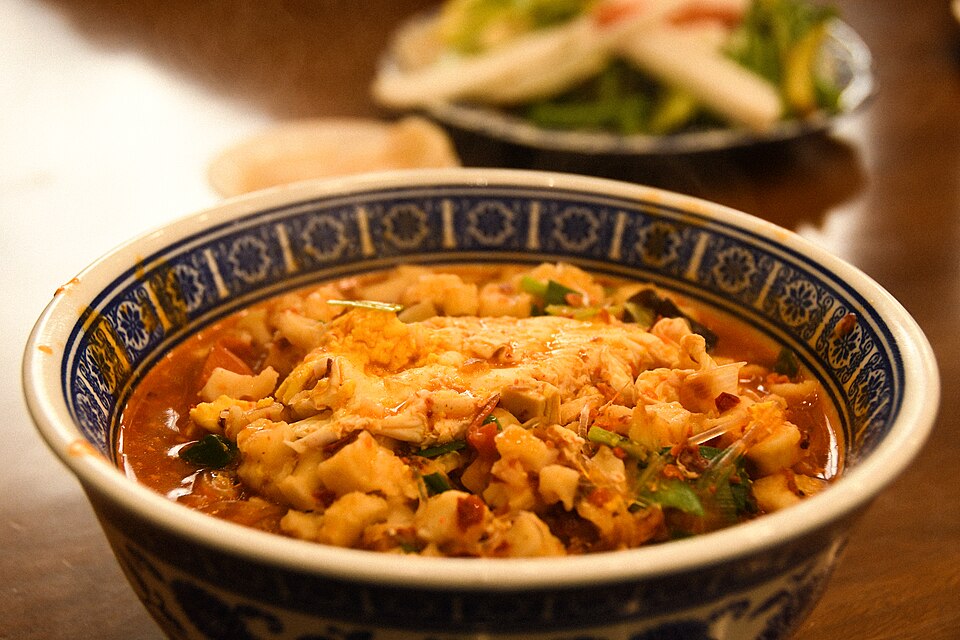
Lamb soup poured over flatbread you tear into the bowl yourself.
Tear the bread small and slowly; the ritual is the point.
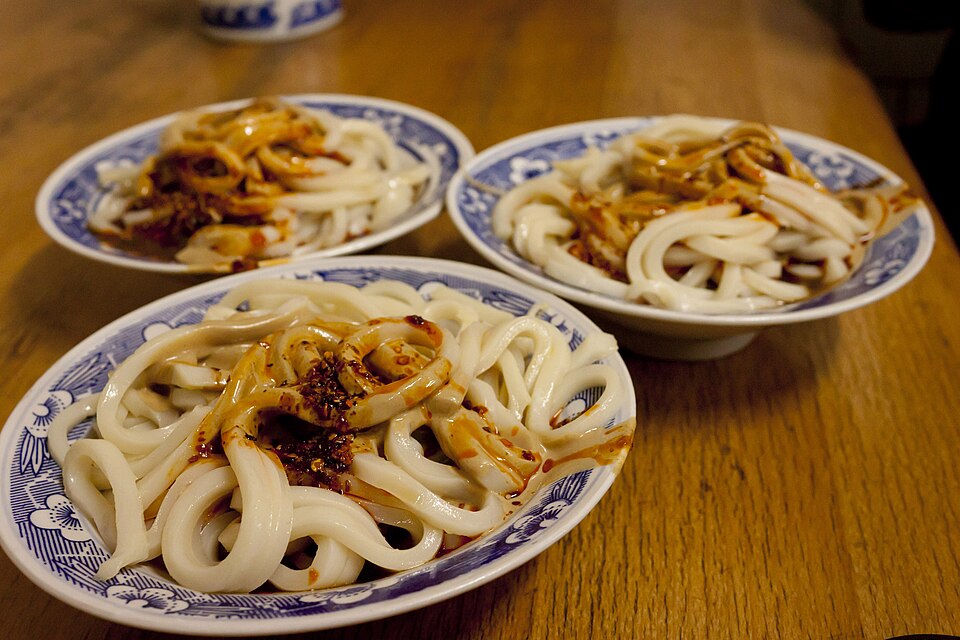
Cold wheat-starch noodles in chili oil, vinegar and garlic, with chewy gluten cubes.
A summer staple; ask for it with extra mianjin (the gluten) and some heat.
Roujiamo (the original meat-in-flatbread), yangrou paomo (lamb soup; you tear the bread into the bowl yourself, that's the ritual, don't rush it), and biangbiang noodles (one belt-wide noodle, named after the sound of dough hitting the counter). All three under ¥40 total in the right alleys.
Off Beiyuanmen's photo lane, the side alleys around Sajinqiao are where locals actually queue: same dishes, half the price, no posing scorpions. If the menu is handwritten and laminated, you're in the right place.
Suanmeitang — sour plum drink, sold everywhere for ¥5-10, iced. It's what cuts through a lamb-heavy Xi'an day. The cloudier it looks, the more likely it's house-made.
Xiahe →
✓ checked 2026-06-13The dish to seek out is tsampa — roasted barley flour worked together with yak butter (and often tea) into a dense, nourishing ball, the daily staple of the Tibetan plateau rather than a tourist novelty. Pair it with yak-butter tea, the salty, buttery brew that warms you against the altitude chill; a few backpacker cafés even do a 'cappuccino-style' frothed version that's an easier first sip if the straight stuff is too much. It's filling, it travels, and it's the genuine local food. The older traveller cafés near where the main street meets the monastery have long served it alongside their Chinese and Western dishes.
Beyond tsampa, the Tibetan plate here leans on yak — yak meat in stews and fillings — and on momos, the steamed dumplings stuffed with meat or vegetables that you'll see everywhere. Look out too for a local speciality of rice cooked with a deliciously sweet wild root (you'll see it written as jueniao/juema fan), a genuinely regional dish worth ordering over the generic Chinese stir-fries that fill most menus. The food clusters tightly within about 100 m of where the main street enters the monastery, and the menus next door to each other are often near-identical — so the move is to look for the one or two dishes that are actually Tibetan rather than the interchangeable Chinese list.
Xiahe has been on the backpacker trail long enough that a handful of cafés do passable Western comfort food — fresh coffee, hot chocolate, approximations of familiar dishes — which is a fair fallback on a cold high-altitude evening or after a long bus. But the reason to eat here is the Tibetan food, not the toast and pasta, and the local stuff is cheaper and more interesting. Use the Western places for a coffee and a warm-up, then order the tsampa, the yak, the momos and the butter tea. And as everywhere in China, point-and-translate gets you a long way past the thin English on most menus.
Xiamen →
✓ checked 2026-06-11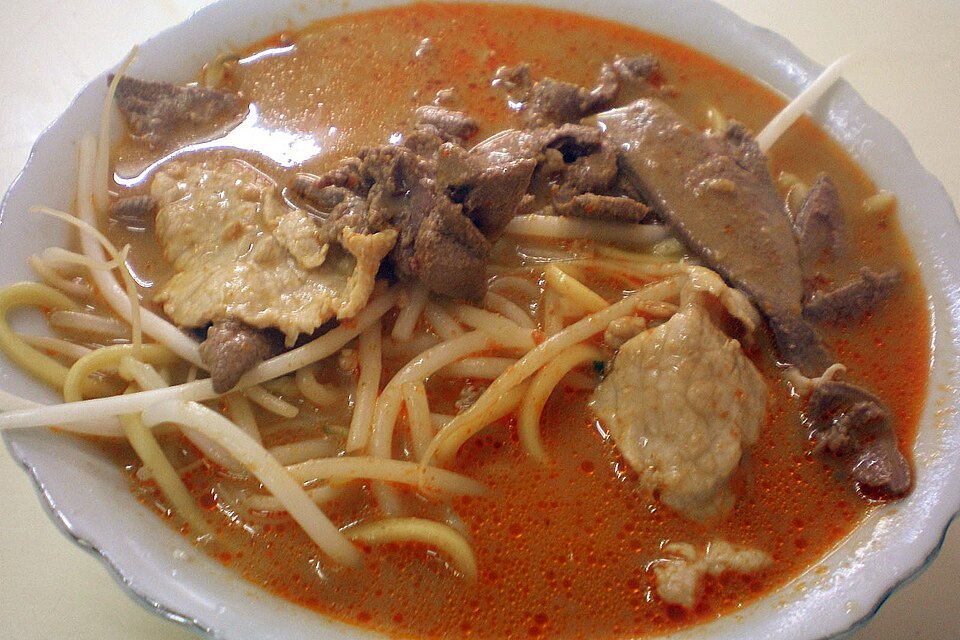
Xiamen noodles in a peanut-satay broth; pick your add-ins at the counter.
Point at the toppings you want; pay by the bowl.
Small oysters fried into a soft, starchy egg pancake, crisp at the edges.
A Fujian-Taiwan classic; eat it hot with the chili-garlic sauce on the side.
Noodles in a nutty, mildly spicy satay-style broth; pick your own toppings.
Point at the toppings tray; they price by what you add to the bowl.
Tanks outside, scales inside. Agree the per-jin price and watch the weighing, or order from places that print prices. A normal seafood dinner for two is low hundreds of yuan; surprise thousand-yuan bills are a choosing-badly problem, not a Xiamen problem.
Xiamen's bowl is sha cha mian: peanut-satay broth, your choice of add-ins, done in minutes for under ¥20. The shops with laminated picture menus near Zhongshan Road are fine; the ones with no menu and a queue are better.
Xiangxi (Jishou) →
✓ checked 2026-06-13Rice tofu (米豆腐) — a soft, savoury 'tofu' set from rice slurry, served cold and sliced with chilli, vinegar, garlic and pickles — is the snack of the region, and it is especially tied to Furong Town, where stalls trade hard on the dish's screen fame. It is genuinely local rather than a tourist invention, smooth and tart and cheap. Eat it at a busy stall, and don't overpay just because of the film connection.
This is Tujia country, and the larder runs to smoked and soured pork: Xiangxi bacon (湘西腊肉), cured and hung over a smoky fire-pit until it is dark and firm, then sliced and stir-fried; and Jishou-style sour meat, fermented to a tangy, slightly sour edge and fried up hot and oily. Both are hearty mountain food, properly local, and worth ordering in a plain neighbourhood restaurant over anything generic on a tourist menu.
The wider Miao-and-Tujia table leans sour and spicy: sour-soup fish, the dark and rich blood-cake duck (duck stir-fried with chunks of glutinous-rice-and-blood cake, ginger and chilli), and a morning bowl of Jishou rice noodles with long-simmered meat and a pile of seasonings. It is western-Hunan cooking — distinct from the rest of the province and properly hot by default. Say so if you want it milder, but the local version is the one worth coming for.
Xiangyang →
✓ checked 2026-06-13Xiangyang's signature is its beef noodles (襄阳牛肉面): alkaline noodles in a fierce, oily, chilli-red beef broth with pieces of beef, eaten first thing in the morning at a busy local shop. It's hearty, spicy and cheap — often around ¥10–12 a bowl. This is the dish locals are genuinely proud of, so skip anything dressed up for tourists and join the queue at a packed neighbourhood place where they're shaving beef and ladling broth non-stop.
The properly local move is to chase that bowl of beef noodles with a small bowl of warm huangjiu (黄酒) — a mild, cloudy, lightly sweet local rice wine, drunk in the morning, not at night. To outsiders it sounds odd; here it's an everyday breakfast pairing with a long pedigree. The alcohol is low and the point is the ritual and the warmth, not getting tipsy at 8am. Try one small bowl alongside the noodles and you've eaten breakfast the Xiangyang way.
Beyond noodles, look for chanti (缠蹄) — a local cured-and-bound pig-trotter charcuterie, sliced cold — and the freshwater-leaning Jingchu home cooking the region does well: lotus-root-and-rib soup, river fish, pickled-fish dishes. It's fresh, rich and unfussy rather than refined, and it's solidly local. Use a translation app, point at what looks good in a busy restaurant, and you'll eat well and cheaply; English menus are thin outside the bigger hotels.
Xichang →
✓ checked 2026-06-13Xichang barbecue (火盆烧烤) is the city's signature: a low table with a fire pit sunk into the middle and a wire net over it, where everything from skewered meat to potatoes and offal gets grilled in front of you. It's smoky, communal, cheap-ish and goes late into the night - the real Xichang eating experience. Pair it with the local Liangshan snow yogurt to cut the heat. Pick a busy local pit over anything aimed at tour groups.
This is Liangshan Yi country, so look for tuotuo rou (坨坨肉) - big hand-cut chunks of boiled pork or mutton, eaten plain, a genuine Yi staple rather than a tourist novelty - alongside buckwheat dishes, sour cabbage-and-potato soup and wild-vegetable copper-pot hotpot. It's hearty highland food. Treat the Yi-flavour restaurants and the buckwheat items as the local specialty they are, not as a sideshow to the BBQ.
With a big lake on the doorstep, freshwater fish is local and fresh here - spicy lake fish fillet from the small fishing villages, and 'drunken shrimp' (醉虾), live lake shrimp served in liquor, are Qionghai specialties you'll see on local menus. Eat it lakeside where the supply is closest. As always, point at what's good in busy local places and use a translation app - English menus are rare and the food is solidly regional, which is exactly the point.
Xining →
✓ checked 2026-06-08Lamb on the bone boiled plain and eaten by hand with salt and garlic; the Qinghai plateau staple.
Sold by weight; dip the meat in salt or vinegar-garlic, no heavy sauce needed.

Cold wheat-gluten noodles in vinegar, chili oil, garlic and mustard, sour and spicy; a Xining summer snack.
A street snack, not a meal; ask for the chewy gluten cubes (mian jin) added in.
Lamb intestines stuffed with flour and spice, sliced and served over hand-pulled noodles in a clear broth.
A Xining breakfast; the intestine is the topping, the broth is the point.
Qinghai yogurt is thick, tart and excellent - sold plain in little tubs to sweeten yourself with sugar or honey, often from yak or local cow milk. It's a real regional specialty, not a novelty, and a perfect cheap snack between sights. Look for it at markets and the Muslim quarter; the homemade-style sets are far better than the supermarket cups.
This is plateau food: yak meat (in stews, dried into jerky, or in momo dumplings), hand-pulled noodles, and Tibetan-style butter tea if you want to try it. Yak is leaner and gamier than beef and it's the everyday regional meat here, not a tourist gimmick. The Tibetan and Hui kitchens overlap with what you'd eat in Lhasa, minus the permit to get there.
Xining's Hui Muslim quarter, around the Dongguan Mosque, is the best cheap eating in the city: hand-pulled lamb noodles (a Lanzhou-style beef/lamb noodle culture runs strong here), lamb skewers, stuffed breads and sweet milk tea. It's halal, busy and good value. Point at what's coming out hot, pay cash or mobile, and skip the bland hotel restaurants.
Xinyang →
✓ checked 2026-06-13Forget the heavy noodle-and-wheat image of northern Henan. Xinyang sits in the warm, wet south of the province and eats like it: rice rather than wheat as the staple, freshwater fish and river produce, and a real taste for chilli and fresh heat that comes straight from neighbouring Hubei and the Sichuan-Hunan belt beyond. 'Xinyang cai' (信阳菜) is its own thing within Henan, and the local point of pride is the slow-cooked clay-pot stew.
The dish to seek out is Xinyang dun cai (炖菜) — long-simmered casseroles and clay-pot stews, classically done over a small charcoal or gas burner kept bubbling at the table. Stewed local chicken, stewed fish, stewed pork with dried vegetables, all deeply savoury and built for sharing. It's the genuine regional speciality rather than a tourist menu item, and a busy local stew house is a better bet than anything dressed up for visitors. By Nanwan Lake, the version to order is a clay-pot or braised 'Nanwan fish' (南湾鱼) pulled from the reservoir.
End or start a meal with the local Xinyang Maojian green tea — a tightly rolled, downy, grassy-fresh green that locals drink constantly; a glass of it is the regional default and worth ordering properly rather than from a sachet. One caveat to manage your expectations: you'll see 'hot dry noodles' (热干面) everywhere, but that's a borrowed Wuhan dish reflecting how close Xinyang is to Hubei, not a Xinyang original — eat it if you like it, but the truly local plates are the stews and the river fish, not the noodles.
Xishuangbanna →
✓ checked 2026-06-13Banna's Dai kitchen is the reason to eat out here. The signature is pineapple rice — sticky rice steamed inside a hollowed pineapple — alongside whole fish grilled in lemongrass and herbs, grilled chicken, and skewers off the charcoal. The Gaozhuang night market is the easy place to graze on all of it in one evening; point at what's cooking, and lean into the grilled fish and the pineapple rice as the things to try first.
Dai food tastes closer to Laos and Thailand than to the rest of China: sour-and-spicy salads, lots of fresh raw herbs, lime, chilli, fermented and pickled notes, and dipping sauces that carry the dish. Expect green papaya-style salads, sour bamboo-shoot soups and plenty of mint and coriander. If you like Southeast Asian flavours you'll be very happy; if you don't, ask for things less spicy, because the local baseline runs hot.
Night-market grazing is half the fun, but in this heat use a little judgement: favour busy stalls with high turnover, eat grilled food hot off the fire, and stick to bottled or boiled water. Tropical fruit is abundant and cheap — go for it, peeling what you can yourself. A translation app helps with the Dai and Chinese menus, and most stalls take Alipay or WeChat Pay, though small cash is handy for the smallest vendors.
Xitang →
✓ checked 2026-06-13The stalls lining the busiest waterfront stretch charge for the view. Step one lane back and the same snacks — zongzi, smoked beans, rice wine, the eight-treasure dishes Xitang is known for — cost noticeably less and the cooks are locals feeding locals. Worth the short detour.
Xitang is a rice-wine town and shops will happily pour you tastings. It goes down soft and sweet and sneaks up on you. Buy a small bottle to take home rather than drinking your way down the canal.
Xuancheng →
✓ checked 2026-06-13The dish to seek out across southern Anhui is chou guiyu (臭鳜鱼), 'stinky' mandarin fish: river fish lightly fermented until it smells pungent, then pan-fried so the flesh turns firm and faintly cheese-like, usually braised with a little pork and chilli. It's the defining plate of Hui (Huizhou) cuisine, and the smell is far stronger than the taste — most first-timers end up converts. This is local food, not a tourist invention, and a good version is worth ordering even if the name puts you off.
Anhui's other oddity worth trying is mao doufu (毛豆腐), 'hairy tofu' — bean curd deliberately fermented until a downy white mould covers it, then pan-fried until golden and crisp-edged, eaten with chilli sauce. Around it sits the rest of Hui cooking: heavy on braising and stewing, mountain ingredients like bamboo shoots, dried vegetables, freshwater fish and cured ham, and a preference for deep, savoury, slow-cooked flavours over flash and spice. It's hearty country food built for a damp, hilly climate — order the braises and the local fish over anything generic.
Out in Jing and Jixi counties the dining is solidly local and there's essentially no foreign-food scene or English menus — that's part of the appeal, but plan for it. Busy small restaurants in the county towns and around the villages will feed you well and cheaply; point at what looks good, lean on a translation app, and ask for the local fish or the day's braise. Prices inside the ticketed village areas run higher than in the ordinary town streets just outside, as everywhere.
Ya'an →
✓ checked 2026-06-13The dish to seek out is Ya fish (雅鱼), a prized local river fish, most classically served as a casserole or claypot fish soup (砂锅雅鱼汤) — simmered slowly, often in the traditional Rongjing-style earthenware pot, so the broth carries the freshness rather than burying it in spice. Half the restaurants in town put 'Ya fish' on the sign, and it's a genuine regional speciality, not a tourist invention. It's the right thing to order on a grey, wet Ya'an evening; pick a busy local place and let the soup do the work.
Ya'an's mountainous Hanyuan County grows what many cooks consider China's finest huajiao (Sichuan pepper / Zanthoxylum) — cultivated here for over two thousand years and sent to the Tang court as tribute, which is why it's still called 'tribute pepper' (贡椒). That bright, numbing, citrus-fragrant tingle is the local pride, and you'll taste it at its best in dishes like Qingxi 'tribute-pepper fish' (贡椒鱼), where thin fish slices are lifted by Hanyuan's peppercorns. If you take any single ingredient home from Ya'an, make it a bag of Hanyuan huajiao — it's a real cut above the supermarket stuff.
Beyond the fish, Ya'an eats like good rough Sichuan. Look for jiaoma ji (椒麻鸡) — cold chicken drenched in that numbing pepper-and-oil dressing — local 'market' hotpot (some places cook it with eagle tea), and tata noodles (撻撻面), hand-tossed thick noodles slapped out fresh and served with chicken or beef for well under ¥20. There's plenty of grilled skewers and yak meat from the nearby high country too. It's hearty, cheap, properly spicy local food; use a translation app, point at what looks good in a busy shop, and skip anything aimed squarely at tour groups.
Yan'an →
✓ checked 2026-06-13Don't expect the Xi'an wheat-and-lamb playbook up here. Northern Shaanxi (Shaanbei) is dry loess-plateau country, and the staples lean on coarse grains — millet above all. Xiaomi (yellow millet) turns up as porridge and as qianqian fan, a homely millet-and-bean dish, and the local cooking is hearty, rustic and cheap. It's peasant food in the best sense; eat it where the locals do rather than in a tour-group hall.
The Shaanbei snack worth hunting down is youmomo: little fried rings made from a millet-flour dough, slightly sweet, crisp outside and chewy inside. They're a regional specialty you won't find done the same way in Xi'an, sold by street vendors and at markets. Cheap, portable, and a genuinely local taste rather than a tourist-menu item.
This is herding country on the edge of the loess plateau, and the lamb and mutton are good — stewed, in soups, on skewers. A bowl of mutton soup is the right call on a cold day, and it's a local staple rather than something dressed up for visitors. Pair it with the millet sides and you've eaten Shaanbei properly for very little money.
Yanbian (Yanji) →
✓ checked 2026-06-13The one thing to eat here is Korean-Chinese cold noodles — chewy buckwheat-ish noodles in an icy, sweet-sour, faintly spicy broth, often topped with chilled beef, pickle, half an egg and a slice of pear. Locals will tell you the Yanbian version isn't quite like anything in Seoul, and they're right; it's its own thing. Look for the signs 冷面 (lěngmiàn) or 랭면 (raengmyeon); a bowl runs about ¥10–15, and the busy local shops around the central streets do it best. In winter, the cold-broth ritual is half the experience — order it anyway, it's what people do.
Beyond the noodles, this is barbecue and stew country: Korean-style charcoal BBQ and Yanbian skewers (延边串) are everywhere, and samgyetang (参鸡汤 / 삼계탕) — whole young chicken stuffed with rice, ginseng and herbs in a milky soup — is a local staple worth seeking out, especially in cold weather. For the cheap, authentic end, graze the dawn Water Market and the West Market for rice cakes (tteok), freshly made kimchi, blood sausage (sundae) and home-brewed rice wine. Yanji also has a real café culture by northeastern-China standards, a South Korean import, so good coffee is genuinely easy to find here.
Be aware that dog meat (狗肉 / gǒuròu) is a traditional dish in the Korean-Chinese food culture and you will see restaurants advertising it, particularly older specialist places. It's easy to avoid — it's not slipped into ordinary cold-noodle or BBQ menus — but if you'd rather not risk wandering into one unaware, watch for the characters 狗肉 on signs and boards. Sticking to the well-marked cold-noodle houses (冷面), BBQ joints and samgyetang restaurants keeps you clear of it entirely.
Yancheng →
✓ checked 2026-06-13Yancheng's name literally means 'Salt City', founded on the salt fields of this coast, and the kitchen reflects it. The local saltwater duck — duck cured in a salt brine then cooked so the meat stays tender and savoury — is the dish most tied to the place, a coastal-Jiangsu cousin of the better-known Nanjing version. It's a genuine local speciality rather than a tourist invention, and a good first thing to order to taste what the city is about.
This is the Yellow Sea coast, so the seafood is the reason to eat here: a seafood hotpot of local shellfish and fish in cool weather, steamed fish done simply with ginger and scallion so the freshness carries, and river and field eel cooked in the Jiangsu manner — braised or stir-fried with a touch of sweetness. Crab from the Dafeng area down the coast is particularly prized for sweet, delicate meat, best in autumn when it's in season. Order what's fresh and local over anything generic on a tourist menu.
If your day runs down to the Dongtai end for Tiaozini, look for Dongtai fish-soup noodles (东台鱼汤面) — fine wheat noodles in a milky-white broth simmered from fish and bone until it's rich and almost creamy, a recognised local speciality of that town rather than a city-wide dish. It's a regional bowl worth seeking out near Dongtai, the kind of thing you'd otherwise drive straight past. As everywhere, a busy local shop beats whatever's quoted at a tourist-facing restaurant.
Yangshuo →
✓ checked 2026-08-08Yangshuo's signature dish: a whole local river fish braised with beer, tomato, chilli and garlic, served as a shared hotpot-style plate. Almost every restaurant does a version; the riverside and back-lane local places do it better and cheaper than the West Street tourist fronts. Order it with rice and a vegetable and split it between two or three.
The regional staple you'll eat for breakfast and cheap lunches: round rice noodles with pickled beans, peanuts, fried bits and a dark savoury sauce you mix yourself, broth optional. A bowl is a few yuan at a hole-in-the-wall. It's the most reliable cheap meal in the area — find a busy local shop, not a tourist menu.
Two local things worth trying: tianluo, big river snails stuffed with minced pork and spices (more a beer snack than a meal), and the Zhuang/Yao 'oil tea' (youcha) of the surrounding hills — a savoury, slightly bitter tea-broth poured over puffed rice and bits, an acquired but genuinely local taste rather than a tourist invention.
Yangzhou →
✓ checked 2026-06-13Yangzhou's real fame is its morning-tea ritual (zaocha): a slow breakfast of steamed buns, dumplings and delicate pastries with green tea, eaten unhurried, often into late morning. Go early to a known teahouse (the city's old tea-house names are an institution), order a steamer or two and a pot of tea, and don't rush it. This, more than any single dish, is the Yangzhou meal to plan your morning around — and it's where the city's cooking is at its most characteristic.
The dish to seek at morning tea is the crab-roe or plain soup bun and the steamed three-diced bun (sanding bao); at lunch or dinner, the braised 'lion's-head' meatball (shizitou) — a giant, soft pork meatball — is the classic Huaiyang plate. And yes, Yangzhou fried rice is from here, though the local version is more refined than the takeaway one you know; have it once, but don't make it your whole impression of the food.
Yangzhou is a cradle of Huaiyang cuisine — subtle, knife-skill-heavy, not spicy — so this is a city to eat carefully cooked Chinese food rather than hunt for Western menus, which are thin on the ground. Pick busy local teahouses and restaurants over the priciest tables right on Dongguan Street, use a translation app, and you'll eat very well. The morning-tea places get crowded — earlier is better.
Yantai →
✓ checked 2026-06-13Yantai sits on the Bohai and Yellow seas and eats accordingly: sea cucumber (the local soup is a genuine specialty), prawns, scallops, clams and the fish that go into Shandong (Lu) cuisine staples like braised sea cucumber with scallions and oil-stewed prawns. Eat it simple — steamed or quick-fried — and a few streets back from the most touristy waterfront stretches, where seafood priced 'by the catty' can get weighed loosely. Confirm the price per unit and watch the scale, and you'll eat very well for not much.
The local thing to seek out is menzi (焖子) — a fried mungbean-starch jelly, soft and gelatinous inside with a crisped surface, served with sesame paste, garlic and vinegar. You'll see it on menus as 'Yantai fried starch jelly', a cheap, very local street and restaurant dish that most visitors walk straight past. It's the snack that says you ate here rather than at a chain; order it alongside the seafood.
Yantai is fruit country — the 'Yantai apple' (the red Fuji) is a national name, and the sweet cherries in early summer are excellent — so buy fruit from a market, it's part of the place. And since this is China's oldest wine town, having a glass of local Changyu wine with dinner here is more fitting than it would be anywhere else in China. Pair the seafood with a local white; it's a rare spot where the regional wine isn't just a novelty.
Yibin →
✓ checked 2026-06-13The dish to eat here is Yibin ranmian (宜宾燃面), literally 'burning noodles' — dry noodles, no soup, tossed hot the moment they're scooped from the pot with oil, chilli, crushed peanuts, sesame and scallion until they're so dry and oily they're said to almost catch light. It's the signature Yibin breakfast and lunch, cheap (often under ¥10 a bowl) and everywhere; locals and students queue at unglamorous shops like the ones on Liuchen Street. Skip the polished tourist versions and find a busy local noodle joint — a good bowl of ranmian is one of the genuine reasons to stop in Yibin.
Tied to the Li Zhuang day trip is Lizhuang bairou (李庄白肉) — pork belly sliced paper-thin and draped over a garlicky, chilli-and-oil dipping sauce. It's a real regional speciality rather than a tourist invention, and it's done best in and around Li Zhuang town itself, though you'll also find dedicated Lizhuang white pork restaurants back in central Yibin. Order it where the slicing is done in front of you; the knife work is part of the dish's local pride.
You're in southern Sichuan, so the cooking leans into chilli and Sichuan-pepper heat as a default, not a garnish — the cold-pot skewers (lengguo chuanchuan), bullfrog-and-fish-head hot pots and home-style braises around town all carry it. That's the character of the food here, and toning it all the way down can flatten the dishes worth coming for. If you genuinely don't take chilli well, say 'bu la' (not spicy) when you order, but know the local baseline is hot. Yibin is also tea and citrus country (the Pingshan mandarins are a local buy), so a tea-house break or a bag of fruit is the gentle counterweight to a spicy lunch.
Yichang →
✓ checked 2026-06-13The local boast is the Yangtze 'fatty fish' — a river fish with pale, tender flesh, usually done as a milky white soup or steamed. It's the dish Yichang puts forward, and it's worth ordering at a proper riverside restaurant rather than a tourist canteen at the dam. Ask for it fresh and let them cook it simply; the broth is the point.
This is western Hubei, so the food leans on river fish, freshwater shrimp, lotus root soups and a real chilli kick that creeps toward neighbouring Sichuan and the Tujia hill country. Hot-dry noodles (reganmian) for breakfast are a Hubei staple you'll find here too. Eat in town rather than at the sights, where it's pricier for less.
Cruise food is included but uneven and aimed at a mass palate. When the boat docks for a shore excursion or an evening in Yichang, that's your chance for the real local fish and noodles. Carry a bit of cash and a translation app for the smaller riverside places, which won't have English menus but will cook the better bowl.
Yinchuan →
✓ checked 2026-06-13Ningxia is sheep country, and the signature dish is shouzhua yangrou — mutton simmered on the bone, traditionally eaten with your hands, prized for being clean-tasting and not gamey. The local lamb genuinely lives up to its reputation. Look for it at busy local restaurants rather than hotel dining rooms, and don't be shy about the simplest preparation — boiled with little more than salt is how locals rate the meat.
Yinchuan is a Hui Muslim city, so the food is halal and the breakfast bowls are excellent. Yangza (羊杂) — a hearty soup of mutton offal, often with vermicelli and chilli oil — is a classic warming start to the day. You'll also find lamb noodles, fragrant pulled-noodle dishes and plenty of cumin. The whole street-food scene leans toward the northwestern, central-Asian-tinged end of Chinese cooking.
Ningxia is China's goji-berry (枸gou qi / wolfberry) heartland, and the red berries turn up everywhere — dried by the bag as a souvenir, and floated in the local 'eight-treasure' tea (babao cha) along with dried fruit, nuts and rock sugar, sipped from a lidded cup. It's a genuinely regional thing rather than a tourist gimmick, and a bag of good Zhongning goji is the standard edible souvenir to take home.
Yining →
✓ checked 2026-06-13Ili eats like the Kazakh-Uyghur borderland it is: naan (nang) — the big chewy bread baked stuck to the side of a tandoor — turns up with every meal, sold fresh and warm for a couple of yuan and built to travel for a grassland day. Lamb is the protein, whether as cumin-heavy skewers off a street grill, hand-pulled laghman noodles, or big-plate boiled mutton. Eat where the locals queue, point at what's coming out of the oven, and pay cash for the small stuff.
Up on the Kazakh pastures the food turns to dairy. Look for nai geda (奶疙瘩) — hard, intensely sour dried-milk curds the herders carry; they're an acquired taste but the real thing. You'll also meet fresh yoghurt, milk skin, and butter-rich naan. It's herder food, not a tourist menu, and a grassland family's table is where you'll meet it at its best.
Two regional drinks are worth a try: fermented horse-milk (kumis / 马奶酒), tangy, fizzy and mildly alcoholic, the classic Kazakh pastoral drink; and kvass (格瓦斯), the bread-fermented soft drink you'll see bottled and on tap all over Ili, a Russian legacy in this border valley. Neither is a tourist gimmick — both are everyday here. Horse-milk is an acquired taste; kvass is an easy, refreshing yes on a hot grassland afternoon.
Yiyang →
✓ checked 2026-06-13You're in Hunan, one of China's spiciest cuisines, and Anhua's mountain cooking leans hot: fresh and pickled chilli, dried-and-smoked meats, and pungent fermented flavours woven through the stir-fries and stews rather than sprinkled on top. Smoke-cured pork and bacon (腊肉) over a winter fire is a regional staple up in the hills. If you don't take chilli well, say 'bu la' (not spicy) when you order — but know the local default is genuinely hot, and toning it all the way down flattens the dishes worth ordering.
The one unmissable 'eat' here is to drink Anhua dark tea (安化黑茶) on its home ground — a smooth, earthy, low-bitterness brew you can sip cup after cup. Ask for Fu-brick tea (茯砖茶) with its golden 'golden flower' to taste the style Anhua is famous for, and look out for the thousand-tael (千两茶) logs in any serious tea house. Locals drink it strong and often, sometimes with milk or in mountain households all day long. Buying a brick or two direct from an estate is a far better souvenir than anything in a city shop.
Down on the Zi River around Yiyang city, freshwater fish is the thing — cooked simply, often steamed or in a chilli-and-bean-paste braise so the freshness carries, sometimes as a fish-head hotpot in the broad Hunan style. Up in Anhua the food turns to hearty mountain fare: free-range chicken, river snails and crayfish in season, smoked meats, mushrooms and bamboo shoots cut straight from the hills. Pick a busy local place over anything aimed at tour buses inside a scenic area, where you'll pay more for a thinner version of the same plate.
Yuanyang →
✓ checked 2026-06-13Local eating is Hani and Yi hill cuisine — terrace-grown red rice, free-range chicken, cured meats, wild greens and mushrooms, often quite rustic. Guesthouses up in the terraces usually cook simple, hearty meals for guests, which is the easiest and most authentic way to eat given how spread out things are.
The terraces grow a distinctive red rice that's the local staple; you'll see it for sale at the rotating ethnic markets along with hill vegetables, tofu and snacks. The markets are as much a food experience as a cultural one — graze a little, and buy red rice if you want an edible souvenir.
Restaurants are thin on the ground between viewpoints, so most travellers eat at their guesthouse — convenient given the dawn-and-dusk schedule. Tell them in advance if you'll want an early breakfast or a packed bite before a sunrise run; there's nothing open at 5am on the ridge.
Yueyang →
✓ checked 2026-06-13This is lake country, so freshwater fish is the local table — Dongting fish done Hunan-style, plus the small translucent 'silver fish' (yinyu) you'll see in egg dishes and soups. A whole steamed or braised lake fish at a riverside restaurant is the honest local order. Pick a busy place near the water with turnover rather than the souvenir-shop eateries right at the tower gate.
Yueyang is Hunan, and Hunan means real heat — fresh and pickled chili used as a base, not a garnish, and 'a little spicy' will still bite. The local 'fish cake' (yu gao, a steamed minced-fish loaf, one of Yueyang's 'three treasures') is a milder, genuinely local thing worth trying. If you can't take chili, say bu la clearly and still expect some.
Junshan silver-needle (jun shan yin zhen) is a yellow tea grown only on Junshan Island and counted among China's famous teas — the upright leaf buds 'stand up' in the glass, which is half the show. It's a genuine local specialty here, not a generic souvenir, so buying it in Yueyang makes sense. Buy from a proper tea shop rather than a tour-stop counter, and be aware the real thing is expensive by the gram for a reason.
Yulin (Shaanxi) →
✓ checked 2026-06-13Forget any preconception of Shaanxi as just Xi'an's biangbiang noodles and roujiamo; up here in Shaanbei the cooking is northern-frontier and hearty. Mutton and lamb are the heart of it — stewed mutton, mutton soup, lamb done plainly so the meat carries — reflecting the steppe edge the region sits on. In the cold months especially, a bowl of mutton soup or a lamb dish is the local default and the right call, and it's everyday food here rather than a tourist menu item.
The Shaanbei loess country runs on coarse, sustaining grains, and the local plates reflect it: potato in many forms (including grated-potato dishes), yellow millet, buckwheat, and youmian — oat or naked-oat flour worked into chewy 'noodles', rolls or little fish-shaped pieces, often eaten with a savoury sauce. It's rustic, filling highland food built for a hard climate, and trying the oat-noodle and millet dishes is the most authentic eating you'll do in Yulin. Look for them at busy local canteens rather than anything aimed at out-of-towners.
Yulin has a locally prized tofu (Yulin doufu) — bean curd locals credit to the local water, served braised, fried or in clay-pot — that's a genuine regional speciality rather than a tourist invention. Around it you'll find Shaanbei snacks like the thin, crackling fried oil-pastry (youpi), savoury oil-tea (youcha), and the cured meats and red dates the dry highland is known for. Pair the tofu and an oat-noodle dish at a local place and you've eaten Yulin properly; as everywhere, prices in the rebuilt old-street tourist stretch run higher than at the neighbourhood shops a block away.
Yuncheng →
✓ checked 2026-06-13You're in Shanxi, the heartland of daoxiao mian (knife-shaved noodles) — thick, chewy ribbons shaved off a dough block straight into the pot, usually served here in a beef or mutton broth. It's cheap, filling and everywhere; pick a busy local noodle shop over anything dressed up for tourists and you'll eat a proper bowl for a few yuan. This is the default lunch between sights, and it travels well as a quick, reliable meal when you're out in the counties.
Two local plates worth seeking out. Yangrou paomo (羊肉泡馍) here is a mutton soup served with torn flatbread soaking in the rich broth — hearty winter food, more associated with neighbouring Shaanxi but done well in this border corner of Shanxi. And youpo mian (oil-splash noodles) — wide noodles topped with chilli, garlic and scallion, then finished with a ladle of smoking-hot oil poured over to sizzle it all — is a fragrant, mildly spicy street favourite. Both are local and cheap, and both beat anything generic on a tourist menu.
Shanxi is the home of Chinese aged vinegar, and the local stuff is sharp, dark and used liberally — splash it on your noodles the way locals do rather than treating it as an afterthought. Yuncheng is also fruit country, the 'granary of southern Shanxi', famous for grapes (and a small wine scene), apples and dried apricots; in late summer and autumn the fresh grapes are genuinely good and make an easy snack. Round it out with simple street snacks — fried cakes, oil cakes, flatbreads — and you'll eat cheaply and well without needing an English menu.
Yushu →
✓ checked 2026-06-13This is Tibetan Plateau food and that's the point. The staples are yak — yak meat, yak-milk yogurt, yak butter — plus tsampa (roasted barley flour) and butter tea, the salty yak-butter-and-tea brew that fuels people at altitude. The yak-milk yogurt sold by nomad women around Yak Square is the local highlight: very thick, very creamy, properly strong. One honest tip travellers pass on: yak butter, eaten plain or in tea, often tastes rancid to outside palates even when it's fresh, so don't judge the place by it — try it once and decide. Highland barley wine (qingke) shows up at festivals and gatherings.
Beyond the Tibetan staples, you'll eat well from the Hui (Muslim) noodle and lamb tradition that runs through Qinghai: hand-pulled beef noodles in clear broth, cumin-and-chilli lamb skewers, and stir-fried noodle dishes. There's decent food across the town's main streets and at the night market on the square; the more adventurous can try sheep's head. At altitude your appetite may drop and digestion slows, so lean on warm, simple, cooked food and hot drinks rather than anything heavy or raw, and keep drinking water and tea — both help with the elevation as much as the cold.
Yushu is remote, high and Tibetan, and it sees few independent foreign travellers, so the dining is entirely local — Tibetan and Hui, with menus in Chinese and sometimes Tibetan, and little to no Western food or English. That's a feature here, not a problem. Use a translation app, point at what looks good in busy local places, and you'll eat cheaply and well. Carry some cash and a few snacks for day trips out to the monasteries and the grasslands, where there may be nothing open between stops.
Zhangjiajie →
✓ checked 2026-06-11A dry hotpot of smoked pork, tofu and radish; the post-hike reward.
Eat in town, not inside the park, where prices double.
Smoke-cured pork belly stir-fried with dried chilies and garlic shoots.
A mountain-village staple; it is salty by design, so order rice alongside.
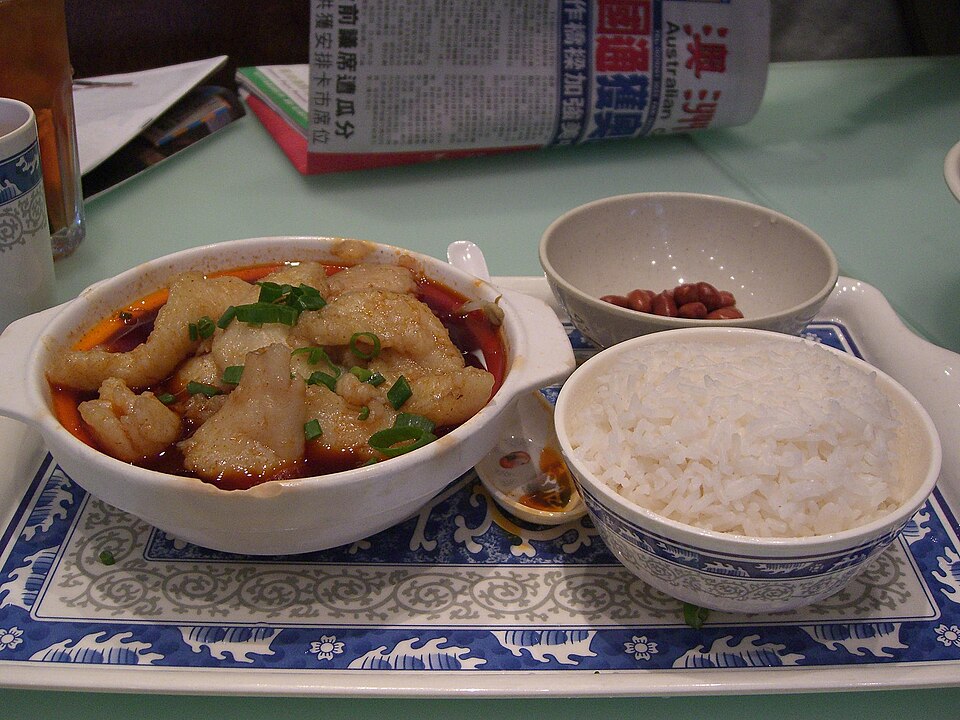
River fish simmered in a tangy fermented-tomato and chili broth, hotpot style.
A shared pot for the table; add tofu and greens to the broth as you go.
The local dish is sanxiaguo, a dry hotpot of smoked pork, tofu and radish that tastes like a reward for 20,000 steps. Order it in town where it's a ¥60 dinner, not inside the park where everything doubles.
Restaurants inside the scenic area charge mountain prices for average food. Carry fruit, nuts and water from town, eat the big meal after descending, and treat in-park corn and cucumbers as fair-priced snack staples; they usually are.
Zhangjiakou →
✓ checked 2026-06-13This is northern frontier country on the edge of the Mongolian grassland, and lamb is the local meat done best. Look for roast whole lamb (烤全羊), the signature northern-Hebei banquet dish, cooked with cumin and chilli, and for yangza tang (羊杂汤), a hearty lamb-offal soup with ginger and spices that's the right thing to eat after a cold day on the slopes. Bashang grassland lamb in particular has a genuine reputation. These are local staples rather than tourist menu inventions, and they're at their best in winter.
The mountain-and-plateau staple here is youmian (莜面), naked-oat flour, most famously served as youmian wowo (莜面窝窝) — dough hand-rolled into little cone or tube shapes, stood upright and steamed, then eaten with a dipping sauce, minced meat or pickled vegetables. It has a nutty flavour and a chewy, substantial texture built for cold-climate calories, and it's a defining regional dish across this corner of Hebei and neighbouring Inner Mongolia. Order it where locals eat rather than in a resort hotel and it's cheap and filling.
On the Chongli slopes you'll find international buffets, hotpot, Western bistros and café fare in the resort base areas — convenient, English-friendly and built for the Olympic-era international crowd, but priced accordingly. For the real regional food at fair prices, eat down in Chongli town or back in Zhangjiakou city, where the lamb dishes and youmian come from busy local shops rather than a ski-village menu. Out on the grassland, meals lean to farm-stay nongjiale spreads — grilled lamb, local mutton, hand-pulled noodles — and that's part of the experience, but carry cash, since card and mobile-pay coverage thins out in the rural areas.
Zhangye →
✓ checked 2026-06-08Tiny diced noodle bits cooked in beef broth with red beans, vermicelli and beef; Zhangye's breakfast bowl.
A morning dish; the 'rice' is actually little squares of noodle, not grain.
Short noodles hand-rubbed into little fish shapes, then boiled or stir-fried; a Zhangye wheat-country staple.
Ask for it stir-fried (chao cuo yu) if you want it dry rather than in soup.
Chopstick-thick noodles pinched into firecracker-length pieces and stir-fried with meat and vegetable sauce.
Named for the firecracker shape; a heartier, drier alternative to the soup bowls.
Zhangye's signature morning bowl is niurou xiaofan (牛肉小饭): tiny rice-grain-sized nuggets of wheat dough in a beef-bone broth with tofu, vermicelli and beef. Despite 'rice' in the name it's a dough dish — chewy, warming and cheap, and you'll find it at breakfast stalls all over town.
Cuoyu mian (搓鱼面), literally 'rubbed-fish noodles', are short noodles hand-tapered at both ends so they look like little fish, served in soup, sauced or stir-fried. It's a genuinely local home-style staple rather than a tourist dish — look for it in small noodle shops, not hotel restaurants.
Chaopao (炒炮) is short, thumb-length segments of hand-pulled noodle — the name means 'firecrackers' — stir-fried with lamb and vegetables. It's filling and on the oily side, proper cold-climate corridor food. Common in Zhangye and the nearby Sunan eateries.
Zhangzhou →
✓ checked 2026-06-13Zhangzhou's signature dish is lor mee (卤面 lǔmiàn) — thick wheat noodles in a glossy, starch-thickened savoury gravy, typically topped with pork, egg, prawn, mushroom and squid and finished with garlic, vinegar and chilli at the table. This is the original of the braised-noodle dish that travelled with Minnan emigrants and became a staple in Singapore, Malaysia and Indonesia. Eat it at a busy local morning shop rather than a tourist restaurant; it's cheap, filling and the thing the city is genuinely known for.
This is Minnan (Hokkien) country, and the snack culture runs deep. Zhangzhou's oyster omelette (蚵仔煎 ô-á-chiⁿ) is its own version — crispier than the Xiamen or Taiwanese ones and served with pickled radish on the side. Look too for muah chee (麻糍), soft glutinous-rice dough rolled in ground peanut and sugar, and the local hai li jian-style oyster-and-egg griddle snacks at street stalls. Wash it down with the regional teas — Zhangping's pressed white tea and local black teas are a point of pride. Minnan here is close enough to Xiamen's dialect to be mutually intelligible, but you'll order fine in Mandarin or by pointing.
On the coast the food changes entirely. Dongshan is a fishing island, and the right meal there is seafood — abalone, squid, razor clams, mantis shrimp, fish and the local oysters, often cooked plainly so the freshness carries, plus the island's asparagus, a noted local crop. Eat at a harbourside place in Tongling or near the beaches, point at what's swimming in the tanks, and agree the price by weight before they cook it so there are no surprises. It's a genuine reason to make the coastal trip and a complete change of register from the inland Hakka tulou food.
Zhaoqing →
✓ checked 2026-06-13Zhaoqing's signature is guozheng zong (裹蒸粽) — a fist-sized, leaf-wrapped parcel of glutinous rice, mung bean and fatty pork, steamed for hours until it's soft and savoury. It's a year-round local thing here, not just a Dragon Boat Festival treat, sold warm from shops and stalls around the old town. One is a meal; buy a vacuum-packed one as a take-home snack if you like it.
Sitting on the Xijiang river and ringed by lakes, Zhaoqing does river fish properly — steamed whole with ginger and scallion, or in a clear soup. As with anywhere that sells fish by weight, agree the price per jin and the rough total before it hits the wok at tourist-facing spots, and you'll eat cheaply. A busy local restaurant off the lakefront beats the view tables for both price and freshness.
This is Guangdong, so morning dim sum is the move: a tea house full of locals by 9am, carts of har gow and siu mai, chrysanthemum tea. Prices are gentler than in Guangzhou for much the same food. Tap two fingers when someone tops up your tea, order before you over-think it, and you've had the most local meal in town for not much money.
Zhaoxing Dong Village →
✓ checked 2026-06-13Dong and Miao cooking in this corner of Guizhou runs on sour (酸) — sour-soup fish, pickled vegetables, preserved meats. Order the sour-soup fish hotpot (酸汤鱼) at least once; it's the regional signature, not a tourist invention, and a small guesthouse kitchen often does it better than the show restaurants on the main lane.
Sticky (glutinous) rice is the staple here, often steamed in bamboo, and rice wine comes out at almost any meal that turns social. If you're invited to share a cup around a drum tower, that's the experience you came for — pace yourself, it's stronger than it tastes.
Zhengzhou →
✓ checked 2026-08-08The dish the city is known for, and it is a soup rather than a stir-fry. Lamb and lamb bones are boiled hard and long until the stock turns white and opaque; the dough is worked, rested and then pulled by hand into broad strips of deliberately uneven width, which is what gives the noodles their bite. Day-lily buds, wood-ear fungus and vermicelli go in with the meat, and coriander and chilli come separately at the table so you build it yourself. It is a cold-weather dish that the city eats year-round, it is cheap, and it is one of the few things you can order by pointing.
Zhengzhou sits at the geographic centre of the country and gets food from everywhere, which means the safe move is not the imitation Western or Korean places but a busy noodle shop with a queue. The wider problem in Zhengzhou is the same as anywhere in China — the counter wants a domestic payment app, not your card — so set that up before you arrive rather than at the till.
Zhenjiang →
✓ checked 2026-06-13Zhenjiang's signature bowl is guogai mian (锅盖面), 'lid noodles', cooked in a big pot with a small wooden lid floating on the broth — supposedly the trick to the texture. The noodles are thin and springy in a soy-based broth, and a good shop draws a queue of locals at breakfast. Pick a busy neighbourhood noodle place over anything dressed up for tourists; it's cheap, it's everywhere, and it's the most characteristically Zhenjiang thing you'll eat.
The local cold plate is yaorou (肴肉), a pink, savoury pressed-pork aspic, traditionally eaten at breakfast with a saucer of Zhenjiang black vinegar and slivered ginger. The vinegar (香醋) is the city's real fame — a dark, mellow, aromatic rice vinegar that's a national pantry staple — and here you dip almost everything in it. Have the classic local combination once: lid noodles, a slice of aspic pork, ginger and vinegar. It's the Zhenjiang breakfast in three items.
Zhenjiang cooks subtle, not-spicy Jiangnan food, and Western menus are thin on the ground, so this is a city to eat carefully made Chinese food rather than hunt for familiar dishes. The river also means good freshwater fish in season. Pick busy local restaurants over the priciest tables right by the scenic gates, use a translation app, and you'll eat very well and cheaply — and don't leave without buying a bottle of the black vinegar to take home.
Zhenyuan →
✓ checked 2026-06-13This is Guizhou, and the cooking runs on sour — sour-soup fish (酸汤鱼) is the regional signature, a tomato-and-fermented-rice red broth with river fish and vegetables, and it's not a tourist invention. Order it at least once in a plain local restaurant a lane back from the river rather than a tourist front. The default is sour-and-spicy; say if you want it milder.
Zhenyuan's own specialty is daocai (道菜), a dark, preserved/fermented mustard-green dish that's been a local thing for generations, often braised with pork. It's distinct from the standard Guizhou menu and worth asking for by name. A small guesthouse kitchen or an old-quarter family restaurant usually does it better than the show places on the main strip.
A gorge town on a green river means freshwater fish done well — grilled, in the sour soup, or simply braised. Pick a busy local place and ask what came out of the river that day. It pairs naturally with the sour broth and a bowl of rice, and it's cheap if you eat where the locals do rather than on the photogenic waterfront.
Zhongshan →
✓ checked 2026-06-13If you eat one thing in Zhongshan, make it Shiqi roast pigeon (石岐乳鸽), the local squab that put this city on the Cantonese food map. The birds are a specific Shiqi breed, roasted until the skin is lacquered and shatteringly crisp while the meat stays juicy — eaten with a pinch of spiced salt. It's a genuine regional speciality, not a tourist invention, and it's the thing locals will send you to eat. Order it at an established Cantonese restaurant in Shiqi rather than a stall and you'll understand why people make the trip for it.
Zhongshan sits in the heart of Guangdong, so the cooking is classic Cantonese: light-handed, fresh-ingredient-led, and far gentler on chilli than inland China. Expect steamed and clear-flavoured dishes, good seafood from the Pearl River estuary, and river fish done simply — the local crisp-fleshed grass carp (脆肉鲩), prized for a firm, crunchy texture, is a regional point of pride. Don't miss yum cha (morning dim sum with tea) if you have a slow morning; it's a defining ritual here, not a special occasion. Eat where the locals are full and you'll do well.
Zhongshan's signature edible souvenir is the almond cake (杏仁饼) — a crumbly, melt-in-the-mouth round biscuit that's been a local specialty for over a century and is sold boxed in every gift shop downtown. It travels well and makes the obvious thing to carry back. In season, also look out for Shenwan pineapple (神湾菠萝), a small, intensely sweet local pineapple from the Shenwan area that locals rate highly. Both are honest regional products rather than airport-gift filler, and the almond cakes in particular are worth a box.
Zhongwei →
✓ checked 2026-06-13Zhongwei's signature is 蒿子面 haozi mian — long, thin hand-cut noodles flecked with ground haozi, a local wild herb (中卫蒿) that gives the bowl its faint, grassy fragrance. It's a genuine local dish, not a tourist invention, traditionally served with a light topping and meant to be eaten long for good luck. Find it at a busy local noodle shop in town rather than at a scenic-area food court, where you'll pay more for a thinner version.
This is sheep country like the rest of Ningxia, and the lamb is the thing — clean-tasting and not gamey, done simply: hand-grabbed mutton on the bone, mutton soups, cumin-heavy skewers. Look for it at local halal restaurants in the city rather than hotel dining rooms, and trust the plain preparations; locals rate the meat by how little it needs.
Food inside and right around Shapotou is priced for a captive audience and rarely worth it. The better move is to eat a proper bowl of haozi noodles or a mutton meal back in Zhongwei before or after the desert day, and carry your own water and snacks into the scenic area — vendors inside charge a desert markup, and not all of them take a foreign card, so keep some cash on you.
Zhoushan →
✓ checked 2026-06-13This is the single most important food fact about Zhoushan: it sits on China's richest fishing grounds, and seafood is the entire point of eating here. The signatures are hairtail (带鱼, the silver ribbon-fish Zhoushan is most famous for, sweet and tender), small yellow croaker (黄鱼), crab — including the local swimming crab (梭子蟹) — pomfret (鲳鱼) and conger eel (海鳗). The honest move everywhere is to order what was landed that day rather than off a generic menu, and to keep the cooking simple — steamed, lightly braised — so the freshness carries. It costs more than inland China; that's the price of premium-fresh seaside seafood, not a tourist mark-up.
The set-piece meal is the seafood night-stall strip (海鲜夜排档) along the Shenjiamen waterfront: you walk the rows, pick your live fish, crab and shellfish from tanks and ice, agree a price, and have it cooked to order while you sit harbour-side. It's lively, a little chaotic, and the most Zhoushan thing you can do. Two practical notes: confirm the price by weight before they cook (point, weigh, agree — it's normal here), and know that China's summer fishing moratorium (roughly May–August in the East China Sea) means the very freshest wild catch is strongest outside high summer, when more of the offering is farmed or frozen-at-sea.
Beyond the headline fish, the everyday Zhoushan table is worth seeking out: seafood noodles (海鲜面) loaded with shellfish and fish, the pungent fermented Shengsi 'snail sauce' (泥螺/螺酱) that locals spoon onto rice and congee, dried-fish and dried-shrimp specialities, and cold jellyfish. For sweets and gifts, look for the Buddhist-style Guanyin cake. If you're coming off Putuoshan — which serves temple vegetarian food near its monasteries — the Zhoushan side (Shenjiamen, Zhujiajian) is exactly where you save the big seafood blowout, since the island itself leans vegetarian around the temples.
Zhouzhuang →
✓ checked 2026-06-13The town's signature is Wansan hoof — a whole braised pork knuckle, slow-cooked dark and sweet, named after the famously rich local merchant Shen Wansan. It's sold everywhere vacuum-packed as a souvenir, but a freshly braised one at a sit-down spot is a different thing entirely. Order it shared; one hoof feeds a table.
The restaurants crowding the photogenic Twin Bridges charge for the view and the foot traffic. Walk a canal or two back into the quieter lanes and the same Jiangnan home cooking — river shrimp, steamed fish, stewed greens — costs noticeably less and tends to be cooked by people feeding locals, not turning over coach groups.
The main drag pushes a lot of identical squid-on-a-stick and bubble-tea stalls that have nothing to do with Zhouzhuang. If you want the local sweet, look for ato (阿婆茶) tea houses and the sticky rice and bean treats the water towns actually do well, rather than the generic snack-street stuff sold at a premium by the entrance.
Zhuhai →
✓ checked 2026-06-13This is the Pearl River Delta, so the default is Cantonese, and Zhuhai's edge is the sea. At the Wanzai Seafood Street and the island fishing villages you pick your fish, crab or shellfish live from the tank and have it cooked simply — steamed with ginger and scallion is the local move that lets the freshness do the work. Agree the price by weight before they net it, and you'll eat better here than in pricier Macau across the water.
Hengqin Island is oyster country — fat, briny oysters that locals rate highly. You'll see them grilled over charcoal with garlic and chilli at night-market stalls and done in claypot or congee in seafood houses. Cheap, regional, and a better souvenir of Zhuhai than anything in a gift shop; order a half-dozen grilled and see if you want more.
Delta cooking here leans on river-and-sea eel — the prized 'golden' wind-dried eel (huangjin fengshan) turns up braised or claypot-style in Cantonese kitchens. And Zhuhai eats late and outdoors: the city's BBQ culture, strongest up in the working-class Jinding district, is a lively local scene of grilled skewers and seafood well away from the tourist strips. Go where the plastic stools are full of locals, not where the menu has photos.
Zhuzhou →
✓ checked 2026-06-13Zhuzhou eats Hunan, and Hunan food is among China's hottest: fresh and pickled chilli, fermented black bean and plenty of garlic, woven through the dishes rather than sprinkled on top. The dish to order is chopped-pepper fish head (剁椒鱼头) — a whole fish head steamed under a blanket of red chopped chilli, a Hunan classic that's spicy, savoury and built for sharing over rice. If you don't take heat well, say 'bu la' (not spicy) when you order, but know the local default is genuinely hot, and toning it all the way down flattens the dishes worth coming for.
Hunan stinky tofu (臭豆腐) — fermented bean curd, deep-fried dark and crisp, ladled with chilli and garlic sauce — is a defining Changsha-Zhuzhou street snack, and far better than the smell suggests; eat it fresh and hot from a busy stall. For something gentler, look for fu-rong (hibiscus) egg, where the white and yolk are cooked separately into a soft, layered stir-fry, and for the local rice-noodle bowls (Zhuzhou's 'laoyou' noodles come with savoury sauce, minced garlic, crushed peanut and braised beef). These are cheap, local and everywhere — skip the generic tourist menus for a busy neighbourhood noodle shop.
If you have time, Liling — an easy bus or taxi hop east of Zhuzhou (a bus runs from the city centre, roughly two-plus hours; a taxi from the south railway station is quicker) — is one of China's great ceramics centres, home to the 'underglaze five-colour' porcelain tradition and a whole Ceramic Valley / world ceramic-art complex with museums and kilns. It isn't food, but it's the regional craft to know about: Liling porcelain is the local thing to see and to buy, and a Liling day pairs the ceramics with the same hearty Hunan cooking — river fish, chilli, stinky tofu — you'll eat in Zhuzhou proper.
Zigong →
✓ checked 2026-06-13This is the sleeper reason to come. Zigong's salt merchants and the boatmen and laborers of the salt trade bred a distinct branch of Sichuan cooking — yanbang cai, 'salt-gang cuisine' — that's known for being fiercer, fresher-chillied and more aggressively spiced than the Chengdu-Chongqing mainstream. Locals will tell you Zigong food is hot even by Sichuan standards, and they're not exaggerating. It leans on fresh and pickled chilli rather than just numbing peppercorn, and on bold, punchy stir-fries. Seek out a proper salt-merchant-style (盐帮菜) restaurant rather than a generic hotpot chain.
Zigong is rabbit country. The dish to chase is lengchi tu (冷吃兔), 'cold-eaten rabbit' — diced rabbit stir-fried then deep-fried with chilli and spices and served cool, intensely savoury and hot, made to pick at with chopsticks. You'll also see diced rabbit in chilli oil, double-pepper rabbit, corn-braised rabbit, even rabbit head as a beer snack. It's not a tourist gimmick; rabbit is genuinely the local protein of pride. If you eat one thing in Zigong, make it a rabbit dish.
The other pillar is xiaojian xiaochao — the 'small-fry, small stir-fry' tradition of fast, high-heat wok cooking in single-portion batches, which keeps everything fresh and fiery. The household example is xiaojian ji (小煎鸡), little bone-in chicken pieces flash-fried with chilli. And look for Zigong dengying niurou (灯影牛肉), 'lamplight beef' — beef sliced paper-thin (the name says it's thin enough to see light through), spiced bright red, dried and chewy-crisp. Both are local specialties, not menu padding.
Beyond the marquee dishes, Zigong does great cheap everyday food: Fushun douhua (富顺豆花), silky tofu with a fierce chilli dip; sweet rice-wine snacks; chaoshou wontons; and a proper night-food scene — the stalls along Tongxing Road are a known spot, and early-morning breakfast vendors set up around dawn. Use a translation app, point at busy stalls, and order spicy as the locals do. If you don't take heat well, 'bu la / not spicy' is understood — but know that toning it down flattens exactly what makes Zigong food worth the trip.
Zunyi →
✓ checked 2026-06-13The local breakfast to know is yangrou fen (羊肉粉): rice noodles in a rich mutton broth with slices of mutton, a chilli-and-pickle hit on top. Zunyi is one of the towns Guizhou argues about for the best bowl, and it's cheap, hearty and everywhere in the morning. Pick a busy local shop, add the chilli oil and pickled vegetables yourself, and you've eaten like the city does.
Guizhou food runs sour and chilli-hot rather than just numbing like Sichuan, leaning on pickled and fermented sourness — sour-soup fish, pickled chillies, fermented bean pastes. It's a distinct regional palate worth leaning into here. If you don't want it blistering, say 'weila' (mild) and they'll dial the chilli back, though the sourness is part of the point.
Look for douhua mian (豆花面): noodles served with soft tofu pudding and a separate dipping sauce you spoon over, a Guizhou comfort dish that's filling and a few yuan. Between that, the mutton noodles and the sour-soup standards, you eat very well and very cheaply at ordinary local shops. Skip anything dressed up for tour groups near the memorial sites and follow the busy neighbourhood places instead.
Straight answers
How do I order from a Chinese menu with no English on it?
Photograph it. The menu scanner reads the page back in seconds with every dish in English plus pinyin, the printed price and a spice level, and hands you a show-the-waiter card in large Chinese characters to point at.
How do I ask for a dish if I cannot pronounce the Chinese name?
You do not have to say it. Every dish card on this page shows the Chinese name in large characters with its pinyin, marked "show the waiter" — hold up your phone and point at it.
Do restaurants pay to be listed on these food pages?
No restaurant pays to appear here, and none can. There are no sponsored restaurants and no paid placements, so a place is listed because the note held up when we re-checked it, not because someone bought the slot.
How current are these food notes?
Each city section carries the date it was last checked, shown next to the city name. The notes get re-checked rather than written once, and if you find a place that has slipped or a price that has moved you can tell the desk through the chat.
What do the city food notes actually cover?
What to order and where locals actually queue, plus the friction around it: hotpot rules, noodle hours, dim sum etiquette and the beer-fish price game. The dish cards add the English and Chinese name with pinyin, a price band and an ordering tip.
Still stuck? Ask the desk.
AI answers grounded in the facts on this site. Booking walls, hotels, payments.
No restaurant pays to appear here, and none can. Spotted a place that slipped or a price that moved? Tell the desk via chat.